What to Include in a PCB Manufacturing RFQ
A practical RFQ checklist for getting accurate PCB manufacturing quotations, reducing clarification cycles and comparing suppliers effectively

Engineer preparing a PCB manufacturing RFQ with Gerber files, stack-up and manufacturing specifications
Getting a PCB manufacturing quotation should be straightforward.
You send the PCB files, tell the manufacturer how many boards you need, and receive a price.
In practice, it is rarely that simple.
Two suppliers can receive what appears to be the same PCB design and return substantially different quotations because the RFQ did not clearly define:
Even small ambiguities can create clarification cycles, quotation revisions or—more importantly—different assumptions between the buyer and manufacturer.
A well-prepared PCB manufacturing RFQ does more than request a price.
It establishes a common technical and commercial definition of what is being purchased.
This guide explains exactly what to include.
1. What Is a PCB Manufacturing RFQ?
RFQ stands for:
Request for Quotation
A PCB manufacturing RFQ is a structured request sent to one or more PCB manufacturers asking them to quote for fabrication according to a defined set of technical, quantity, quality and commercial requirements.
A good PCB RFQ should allow the manufacturer to answer:
What exactly needs to be manufactured, in what quantity, to what specification, by when, and under what commercial conditions?
The more clearly these questions are answered, the more comparable supplier quotations become.
2. Why Does the Quality of the RFQ Matter?
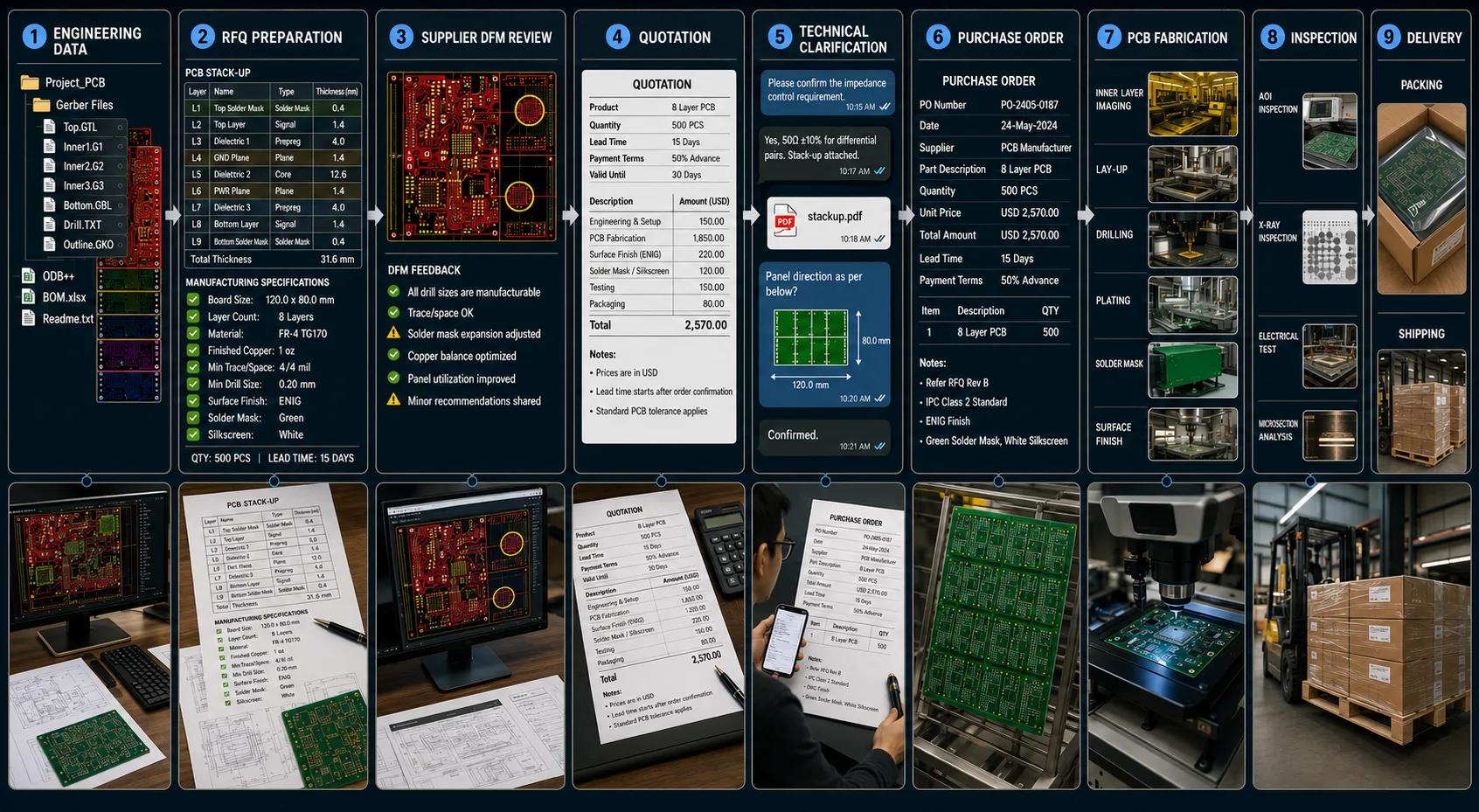
A well-defined RFQ creates a clear technical baseline from quotation through PCB production.
A poorly defined RFQ can create several problems.
Problem 1 — Inaccurate pricing
The supplier may make assumptions about material, copper weight or finish.
Problem 2 — Multiple clarification rounds
Engineering and procurement teams spend time exchanging emails to establish basic requirements.
Problem 3 — Non-comparable quotations
Supplier A may quote one material while Supplier B assumes another.
Problem 4 — Unexpected cost
Special requirements may emerge after the quotation.
Problem 5 — Production delays
Missing manufacturing information can delay engineering review or fabrication.
Problem 6 — Specification mismatch
The finished PCB may technically meet the supplier's interpretation but not the buyer's actual requirement.
A good RFQ reduces these risks before the purchase order is issued.
3. Start With the PCB Design Data
The first requirement is the actual manufacturing data.
For most conventional PCB fabrication RFQs, this will include the relevant fabrication files generated from the PCB design system.
The supplier needs enough information to understand the physical construction and manufacturing requirements of the board.
4. Include the Gerber Files
Gerber files remain one of the most common data formats used to communicate PCB fabrication information.
Depending on the design, the fabrication package may include:
The exact file structure depends on the PCB design and manufacturing workflow.
The important principle is:
Do not send only the files you think the manufacturer needs. Send a complete, internally consistent fabrication package.
5. Include the Drill Files
Drilling information is essential for PCB fabrication.
The fabrication package should communicate:
Where separate drill files are used, ensure they correspond correctly to the PCB revision being quoted.
6. Include the Board Outline
The board outline defines the physical shape and dimensions of the PCB.
It should clearly identify:
An unclear board outline can cause both quotation and manufacturing problems.
For unusual board geometries, a fabrication drawing can be particularly helpful.
7. Specify the Layer Count
Do not assume the supplier will infer layer count correctly from the files alone.
State it explicitly.
Examples:
For multilayer boards, the layer count directly relates to construction, manufacturing complexity and cost.
8. Include the PCB Stack-Up
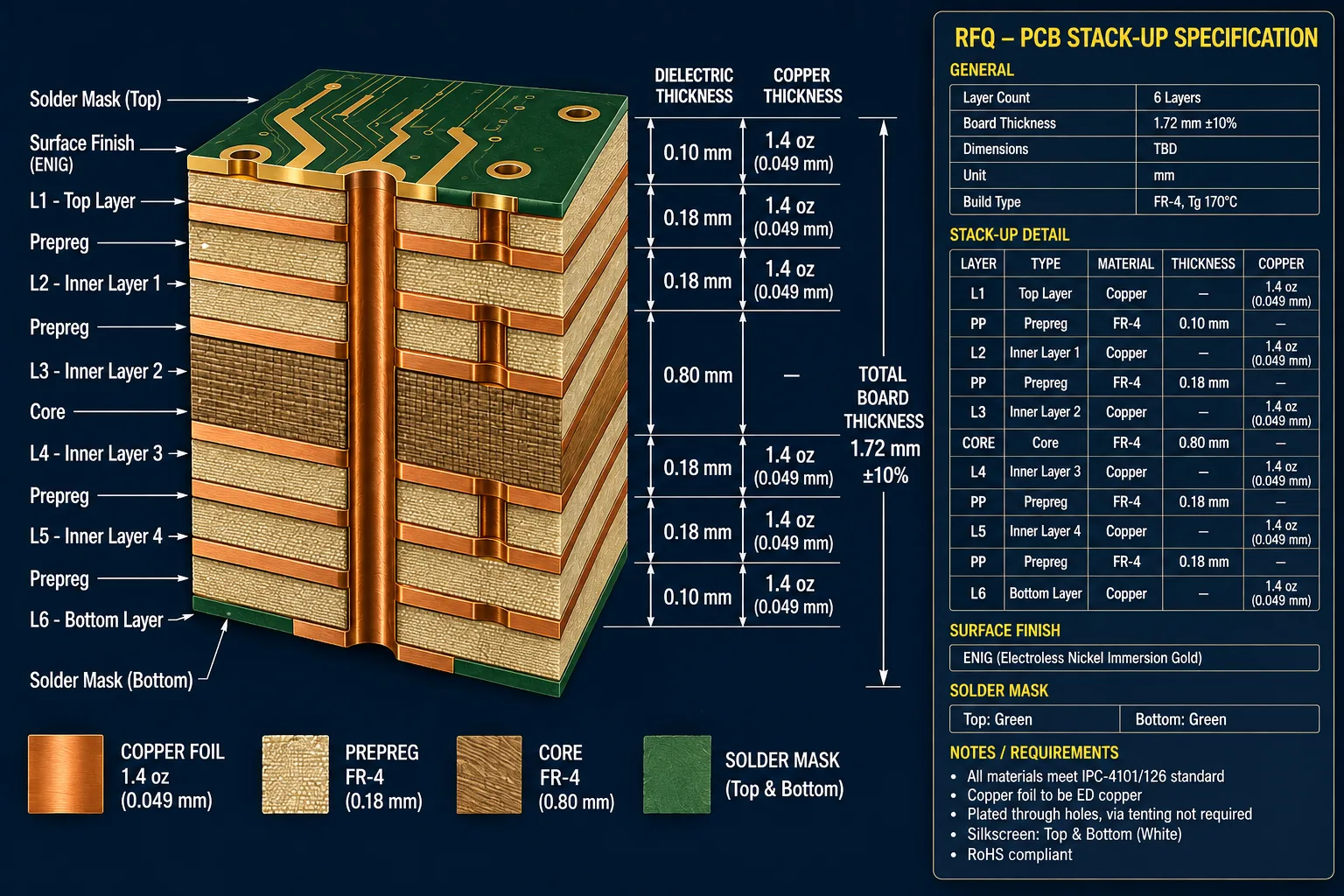
For multilayer PCBs, the stack-up should be explicitly defined rather than left to supplier assumptions.
For multilayer boards, the stack-up is one of the most important parts of the RFQ.
Specify, where applicable:
A stack-up should not be treated as a decorative engineering document.
It defines the physical construction of the PCB.
9. Specify the Base Material
A PCB RFQ should identify the required material or the performance category.
For example:
If a particular material manufacturer or material family is required, state that clearly.
If the requirement is performance-based rather than brand-specific, define the relevant parameters.
10. Specify Board Thickness
Board thickness should be clearly stated.
For example:
1.6 mm
or another required finished thickness.
If the requirement includes a tolerance, specify it.
Thickness can affect:
Do not leave critical mechanical dimensions to supplier interpretation.
11. Specify Copper Weight
Copper requirements can apply to:
If different layers require different copper weights, provide that information in the stack-up or fabrication drawing.
Copper requirements can significantly affect manufacturing capability and pricing.
12. Specify Surface Finish
The RFQ should clearly identify the required surface finish.
Common examples include:
The choice can depend on:
Do not simply state:
"Standard finish."
Specify the actual requirement.
13. Specify Solder Mask and Silkscreen Requirements
Where relevant, specify:
Standard requirements may be acceptable for some products, while branded, consumer-facing or specialized products may require more precise definition.
14. Specify Controlled Impedance Requirements
If the PCB contains high-speed or RF signals, state the impedance requirements.
The RFQ may need to identify:
For example:
50 Ω single-ended
or
90 Ω differential
depending on the design.
Do not assume that a supplier will automatically know which traces require impedance control.
15. Include the Impedance Requirements in the Fabrication Documentation
For controlled-impedance boards, provide sufficient information for the fabricator to understand:
This allows the manufacturer to review the design and propose a suitable construction.
16. Define Minimum Feature Requirements When Relevant
Depending on the PCB, the RFQ may need to communicate:
These may also be determined from the fabrication files.
However, explicitly identifying unusually demanding requirements helps the supplier evaluate manufacturability early.
17. Include PCB Quantity
Quantity is one of the most important commercial variables.
Clearly state:
Prototype quantity
For example:
10 pcs
NPI quantity
For example:
100 pcs
Production quantity
For example:
5,000 pcs
If you expect recurring production, provide an annual forecast where possible.
18. Include Multiple Quantity Breaks
If you are comparing suppliers, ask for several quantity breaks.
For example:
| Quantity | Required |
|---|---|
| 10 | ✓ |
| 50 | ✓ |
| 100 | ✓ |
| 500 | ✓ |
| 1,000 | ✓ |
| 5,000 | ✓ |
This helps you understand the relationship between:
Volume → Unit Cost → Tooling/NRE → Production Economics
It can also reveal whether a supplier is optimized for prototypes, low-volume production or larger production runs.
19. Specify Prototype vs Production
A supplier needs to know whether the requirement is:
The manufacturing process and commercial assumptions may differ.
A prototype order should not automatically be treated as a mass-production requirement.
20. Include Delivery Requirements
State the required delivery date or target lead time.
For example:
Required delivery: 30 September
or
Target: 15 working days after order confirmation
Also clarify whether the requested timeline means:
This distinction matters greatly for international sourcing.
21. Specify the Destination
For international RFQs, include:
The destination can affect:
22. Specify Incoterms
For international transactions, clarify the intended Incoterm or ask the supplier to quote appropriate options.
Examples include:
The correct choice depends on the buyer's logistics model and responsibilities.
The key is to ensure that quotations are being compared on a consistent basis.
23. Define Applicable Standards
Your RFQ should state the applicable manufacturing or quality standards.
Depending on the application, these may include requirements related to:
Do not include standards simply to make the RFQ look sophisticated.
Only specify requirements that are actually relevant to the product.
24. Specify Quality Class Where Applicable
If your product requires a particular IPC classification or quality level, state it clearly.
For example:
IPC Class 2
or another applicable class.
If additional customer-specific acceptance criteria apply, include them in the RFQ documentation.
25. Include Testing Requirements
Specify whether you require:
Not every PCB requires the same testing regime.
The requirement should be appropriate to the product risk and specification.
26. Specify Inspection and Documentation Requirements
If documentation is required, state it upfront.
Possible requirements include:
If these are requested only after production, they may affect both cost and lead time.
27. Include Special Manufacturing Requirements
Some boards require special handling.
Examples include:
These should be clearly identified.
28. Identify the PCB Application When It Matters
You do not always need to disclose sensitive product information.
However, identifying the application category can help the supplier understand the risk profile.
For example:
Application context can influence:
29. Include Mechanical Requirements
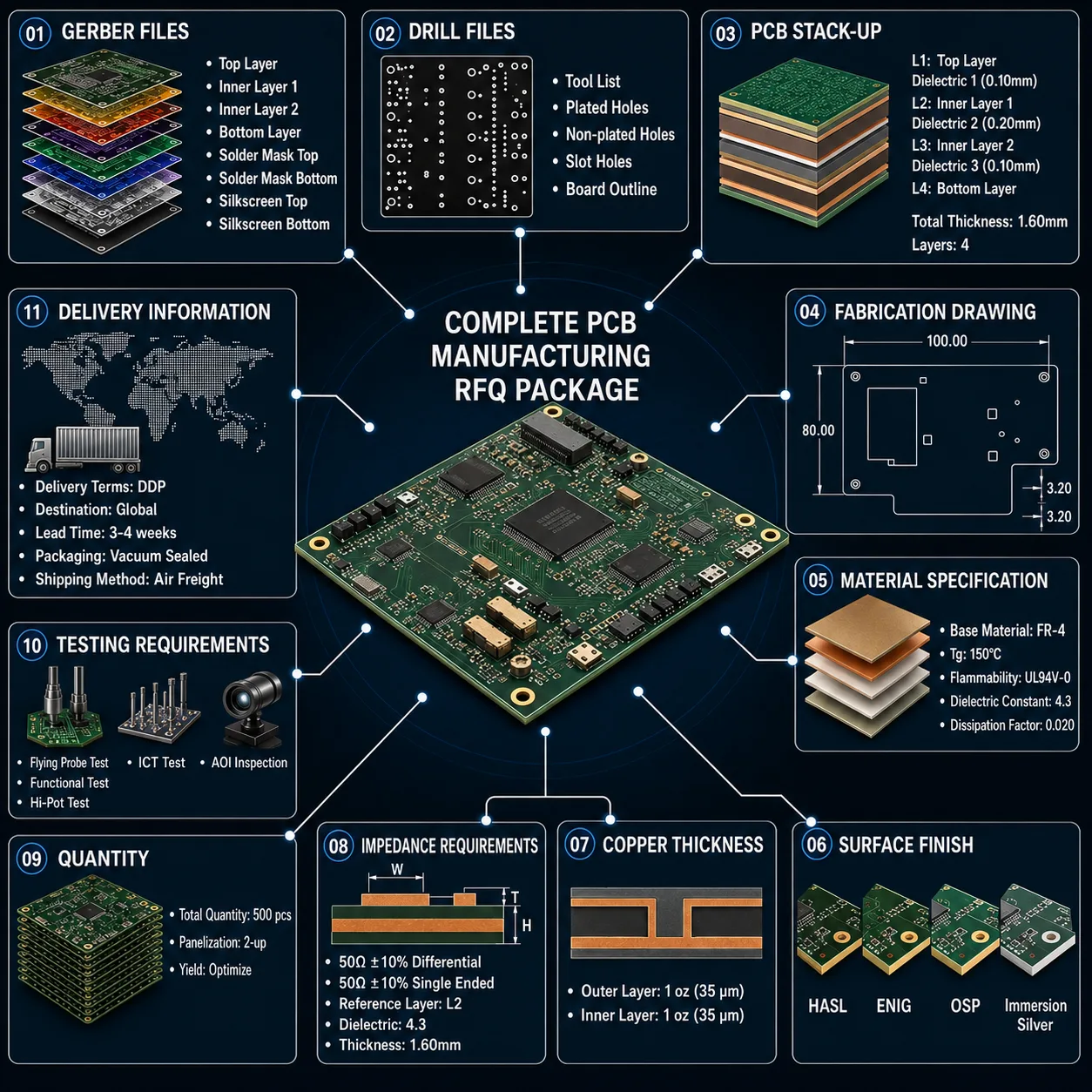
A complete PCB RFQ combines manufacturing data, technical specifications, quality requirements and commercial information.
If the PCB must fit into a specific enclosure or mechanical system, communicate relevant requirements.
These may include:
A PCB that is electrically correct but mechanically incompatible is still a failed product.
30. Specify the PCB Revision
Always identify the design revision.
For example:
PCB Rev B
This is particularly important when multiple versions of the board exist.
The supplier should know exactly which design version is being quoted.
31. Include a Fabrication Drawing
A fabrication drawing can consolidate critical manufacturing requirements that may not be obvious from the Gerber package alone.
It can include:
A well-prepared fabrication drawing can significantly reduce ambiguity.
32. Include a Readme or Manufacturing Notes
A short manufacturing notes document can be useful when the design has unusual requirements.
For example:
Critical impedance-controlled interfaces require controlled impedance within the specified tolerance.
or:
All boards require lead-free assembly-compatible surface finish.
Keep such notes concise and specific.
33. Tell the Supplier What Is Non-Negotiable
Not every specification has equal importance.
Separate requirements into:
Mandatory
Must be met.
Preferred
Desired where practical.
Supplier recommendation
Open to engineering feedback.
For example:
| Requirement | Priority |
|---|---|
| PCB thickness | Mandatory |
| ENIG finish | Mandatory |
| 50 Ω impedance | Mandatory |
| Specific material manufacturer | Preferred |
| Panelization approach | Supplier recommendation |
This gives the manufacturer room to optimize without compromising critical requirements.
34. Ask Suppliers to Identify Exceptions
One of the most useful RFQ instructions is:
"Please identify any deviations, assumptions or exceptions to the supplied specification in your quotation."
This encourages suppliers to surface differences before the purchase order.
It also makes supplier comparison much easier.
35. Ask for Lead Time in a Defined Format
Instead of simply asking:
"What is your lead time?"
ask for:
This makes the response much more useful for planning.
36. Ask for Tooling and NRE Separately
Your quotation should clearly distinguish:
Recurring cost
and
Non-recurring cost
Possible NRE items include:
Separating these costs allows a more accurate comparison between suppliers.
37. Ask About Quotation Validity
PCB quotations may have different validity periods because:
Ask suppliers to clearly state:
Quotation validity: XX days
38. Ask About Material Availability
A supplier may quote a PCB successfully but have difficulty procuring the specified material within your required timeline.
Ask:
"Is the specified material currently available, and does it affect the quoted lead time?"
This can be particularly important for specialty materials.
39. Ask Whether the Supplier Has DFM Concerns
Do not make the quotation purely commercial.
Ask:
"Please identify any DFM issues or manufacturing risks identified during quotation review."
This turns the RFQ into an early engineering checkpoint.
A good supplier may identify:
before production starts.
40. Build a Standardized RFQ Package
For companies that frequently source PCBs, create a standard RFQ template.
A useful structure is:
Section A — Product Identification
Section B — Technical Requirements
Section C — Manufacturing Data
Section D — Quantity
Section E — Quality
Section F — Commercial
Section G — Logistics
41. PCB RFQ Checklist
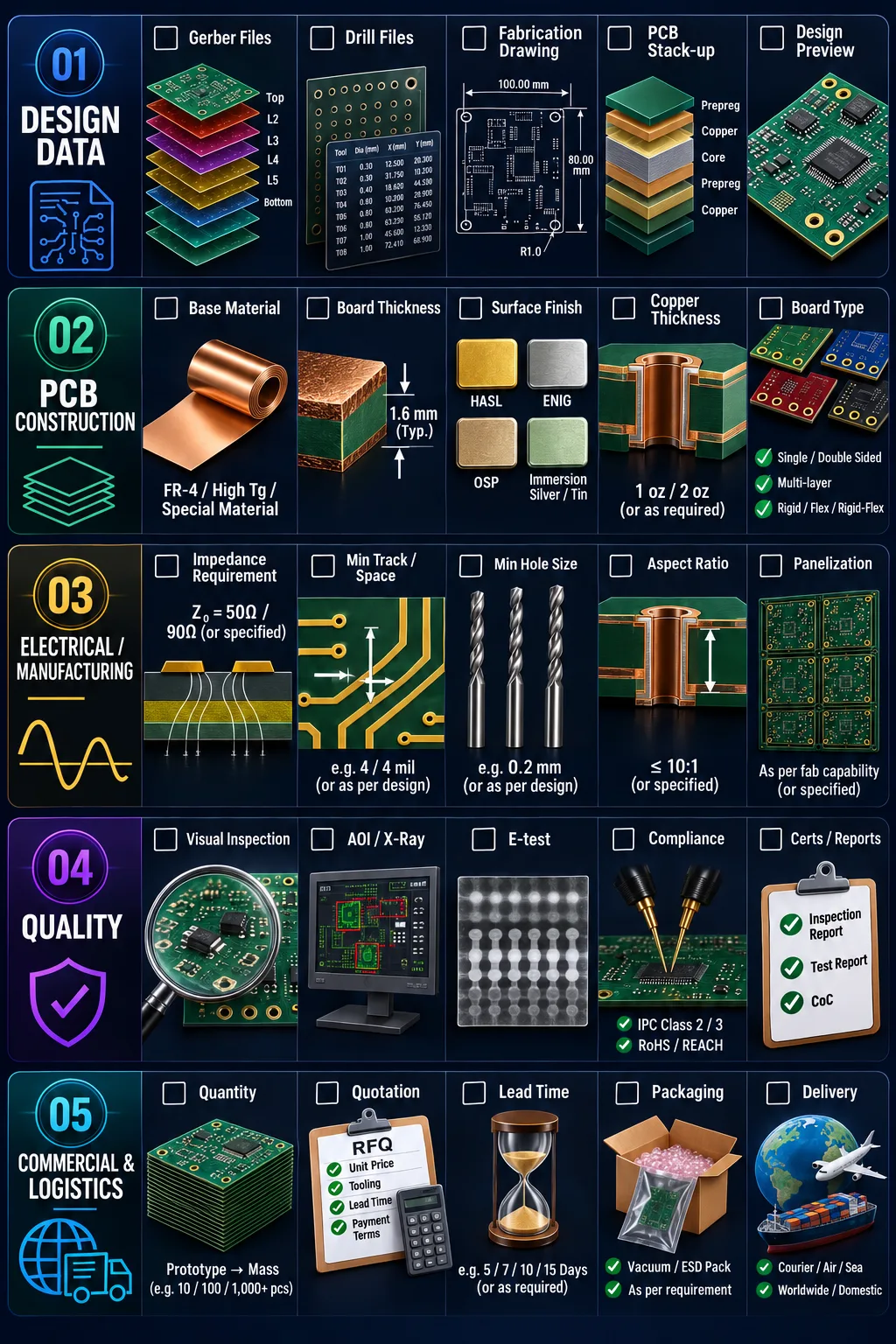
A standardized RFQ checklist helps procurement and engineering teams provide suppliers with the information needed for an accurate quotation.
Before sending the RFQ, use this checklist.
Engineering Data
PCB Construction
Electrical
Manufacturing
Quality
Commercial
Logistics
42. How to Compare PCB Quotations Properly
Once quotations arrive, do not immediately sort them from lowest to highest price.
First compare:
Technical assumptions
Are all suppliers quoting the same:
Commercial assumptions
Are they quoting the same:
Lead time
Are lead times being measured from the same starting point?
Exceptions
Did any supplier identify deviations?
Only after normalizing these factors should price become the primary comparison variable.
43. Why the Cheapest PCB Quote May Not Be the Best Quote
Consider three quotations:
| Supplier | Quoted Price | Lead Time | Key Assumption |
|---|---|---|---|
| Supplier A | $X | 15 days | Required specification |
| Supplier B | $X − 8% | 14 days | Different material |
| Supplier C | $X − 12% | 12 days | Testing excluded |
Supplier C appears cheapest.
But the three quotations are not actually equivalent.
This is why:
RFQ quality determines quotation comparability.
44. RFQ Quality Also Affects Supplier Response Quality
A strong RFQ does something else that is often overlooked.
It signals to the supplier that the buyer understands the manufacturing process.
A technically organized RFQ can help establish a more productive relationship between:
Engineering ↔ Procurement ↔ Supplier Engineering ↔ Manufacturing
That collaboration can become increasingly valuable during NPI and production.
45. For International Buyers: Add These Items
International PCB buyers should additionally provide:
This prevents a technically accurate quotation from becoming commercially unusable.
46. For PCB + PCBA Projects, Separate the PCB RFQ From the Assembly RFQ Requirements
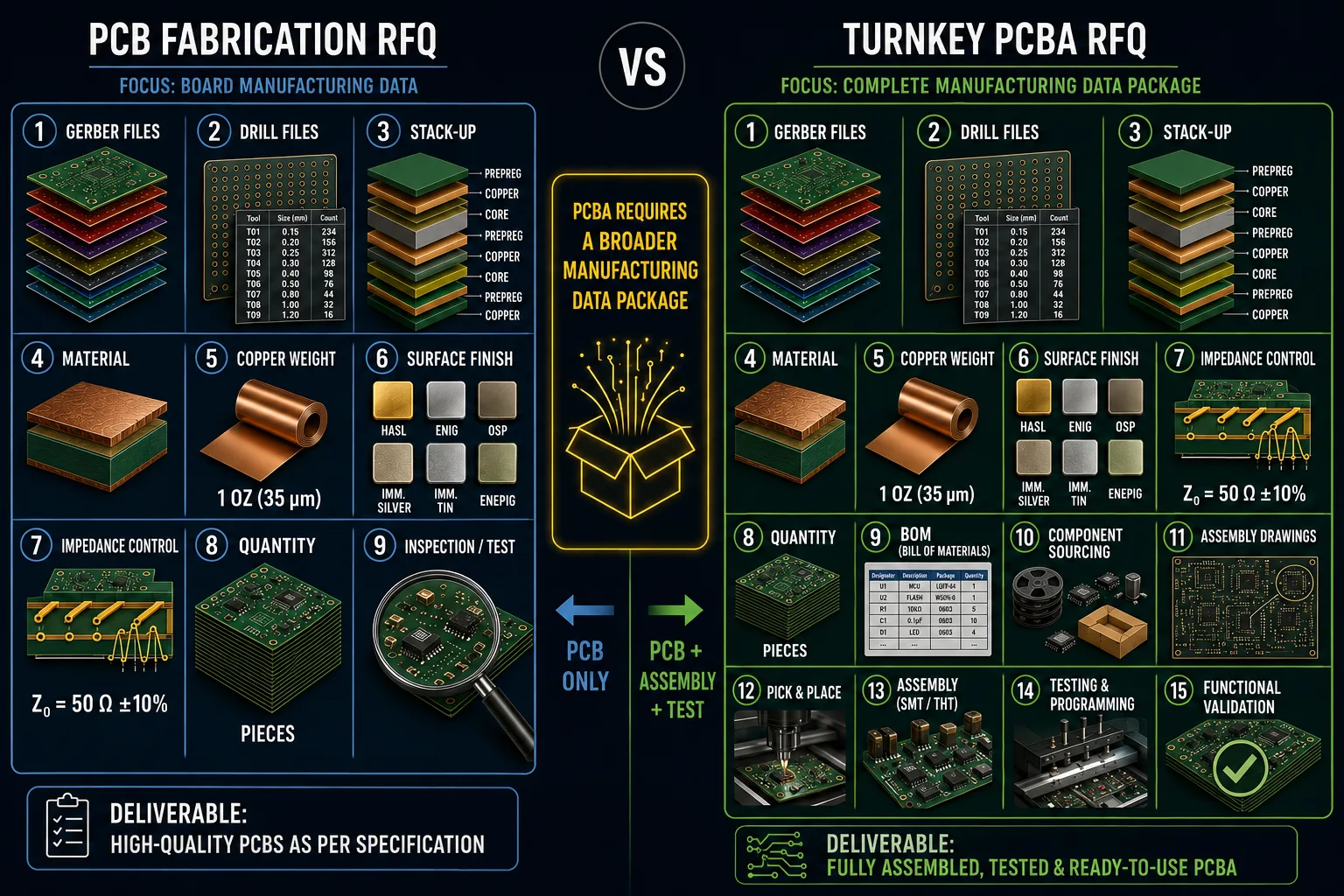
A turnkey PCBA RFQ requires substantially more information than a PCB fabrication-only RFQ.
If you are buying both PCB fabrication and assembly, the RFQ becomes broader.
In addition to PCB fabrication data, you may need:
Do not assume a PCB-only RFQ contains enough information for turnkey PCBA quotation.
47. A Better Way to Think About the RFQ
A PCB RFQ is not merely a request for:
"Price for 100 PCBs."
It is a structured definition of:
Product
Construction
Manufacturing process
Quality
Quantity
Schedule
Commercial terms
Logistics
The better these elements are defined, the less uncertainty exists between buyer and supplier.
48. Final Takeaway
A strong PCB manufacturing RFQ should answer five fundamental questions:
What?
What PCB is being manufactured?
How?
What construction, materials, processes and quality requirements apply?
How many?
What quantities and production stages are required?
When?
When does the buyer need the boards?
Where?
Where must they be delivered and under what commercial/logistics terms?
If those five questions are clearly answered, the supplier can focus on what matters most:
manufacturing feasibility, accurate costing and reliable delivery.
The objective of an RFQ is therefore not simply to obtain a low price.
It is to obtain a technically comparable, commercially transparent and manufacturable quotation.
49. QUADRIONIX PERSPECTIVE
At QUADRIONIX, we believe a good PCB quotation starts with a good technical definition.
When engineering files, construction requirements, quality expectations, quantities and delivery requirements are clearly communicated, suppliers can spend less time resolving ambiguity and more time evaluating manufacturability and cost.
For international buyers, this becomes even more important because the RFQ must bridge:
→ Engineering
→ Procurement
→ Manufacturing
→ Quality
→ Logistics
A structured RFQ creates that common baseline.
From PCB fabrication to PCBA production, QUADRIONIX helps connect engineering requirements with manufacturing execution.
Frequently Asked Questions
Ready to manufacture your electronics project?
Upload your Gerber files & BOM for automated DFM review, engineering feedback, and guaranteed delivery timelines.