Sourcing PCB/PCBA Manufacturing from India: A Complete Guide for International Buyers
Cost, Component Sourcing, Manufacturing Capability, Quality, Logistics, NPI and Supplier Qualification Considerations
India is increasingly being considered by international electronics companies looking to diversify manufacturing, develop additional PCBA capacity and establish alternative supply-chain routes.
But the question should not simply be:
“Is India cheaper?”
A more useful question is:
“Can an India-based manufacturing partner provide the right combination of engineering capability, manufacturing quality, component availability, lead time, scalability, logistics, resilience and total landed cost for our product?”
That distinction is critical.
India can potentially serve as an additional manufacturing and supply-chain node within a diversified global strategy rather than necessarily replacing an existing manufacturing geography.
At the same time, India's electronics ecosystem is developing rapidly, while significant components and manufacturing inputs can still come through international supply chains. The first article therefore correctly presents India as an increasingly relevant global manufacturing location—but not as a completely localized electronics ecosystem.
For an international buyer, the real decision is therefore not simply India vs another country.
It is:
Which manufacturing configuration and supplier are the best fit for the product, volume, quality requirements and long-term supply-chain strategy?
1. First Understand What You Are Actually Sourcing
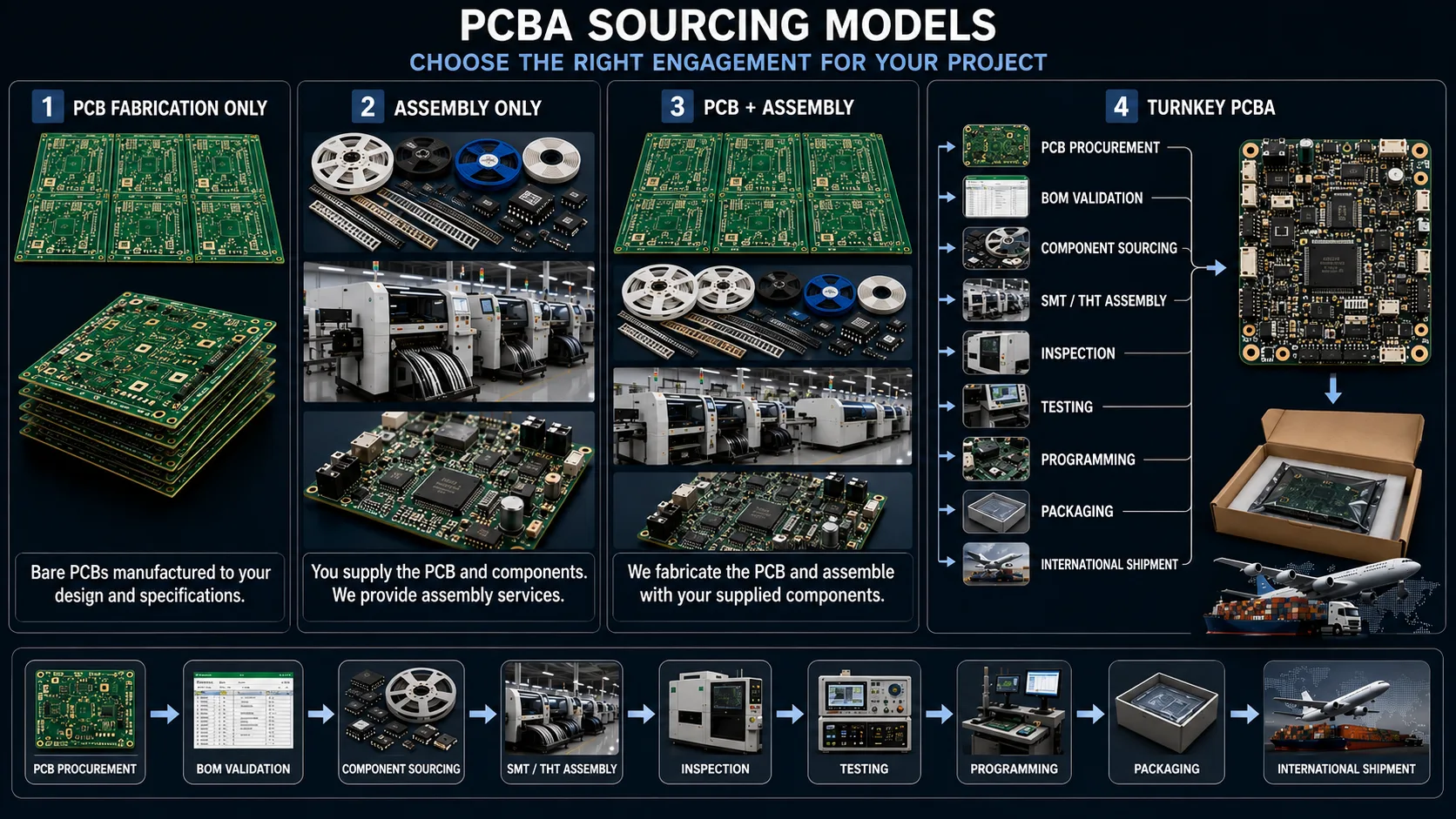
International buyers should define the exact manufacturing scope before comparing PCBA suppliers.
“PCBA manufacturing” can mean very different things.
A supplier may provide:
PCB Fabrication Only
The supplier manufactures bare PCBs.
Assembly Only
The buyer provides the bare PCB and components.
PCB + Assembly
The supplier manufactures the PCB and performs assembly.
Turnkey PCBA
The supplier manages a broader manufacturing chain such as:
→ PCB procurement
→ BOM validation
→ Component sourcing
→ SMT/THT assembly
→ Inspection
→ Testing
→ Programming
→ Packaging
→ International shipment
The scope should be defined before comparing quotations.
Otherwise, one supplier may appear cheaper simply because important activities are excluded from its quotation.
2. Why Are International Buyers Looking at India?
There is no single reason.
Companies may consider India for:
For many companies, the question is not:
“Should India replace our existing manufacturing source?”
It may instead be:
“Can India become a technically and commercially viable second manufacturing source?”
That is a fundamentally different sourcing strategy.
3. Do Not Evaluate “India” as One Supplier
This is one of the most important principles in the entire article.
Indian PCBA suppliers can differ significantly in:
Therefore:
Country selection should be followed by rigorous supplier qualification.
The question should not be:
“Is India suitable for PCBA?”
It should be:
“Which India-based supplier is suitable for our product, technology, volume, quality requirements and supply-chain model?”
4. Prepare Your Product Before Asking for Quotes
Before approaching suppliers, prepare a complete manufacturing package.
PCB Data
Include, where applicable:
Assembly Data
Include:
Testing Requirements
Specify:
Product Information
Include:
The better the technical package, the more meaningful supplier responses become.
5. BOM Quality Becomes Especially Important
International component sourcing makes BOM quality even more important.
A professional BOM should ideally include:
A vague entry such as:
Microcontroller — 100 units
is not procurement-ready.
A better specification includes:
Manufacturer: XYZMPN: ABC1234-QFNPackage: QFN-48Quantity: 100
MPN-level information makes it easier to:
6. India Does Not Mean “Everything Is Made in India”
This distinction is essential.
A PCBA manufactured in India may still contain components sourced from:
The same may apply to PCB materials, specialty chemicals and other manufacturing inputs.
Therefore:
“Manufactured in India” does not necessarily mean “100% sourced in India.”
That is not inherently a weakness.
Modern electronics manufacturing is global.
The important question is:
How effectively can the manufacturer manage that global supply chain?
7. Global Component Sourcing + Indian Manufacturing
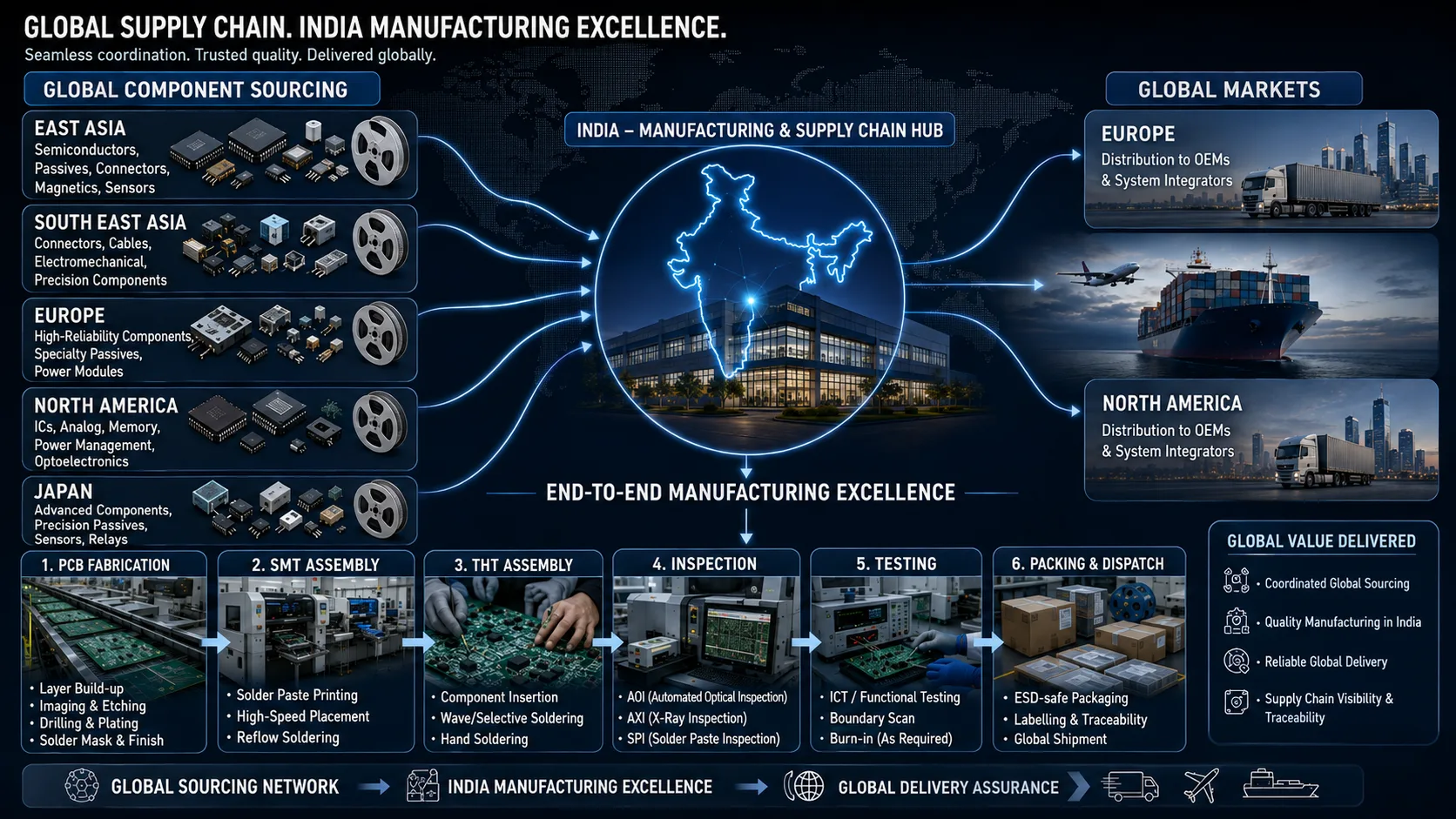
India-based manufacturing can combine global component sourcing with local PCB/PCBA production and international delivery.
A potentially useful model is:
Global Component Ecosystem
↓
Qualified Sourcing
↓
India-Based PCB/PCBA Manufacturing
↓
Inspection & Testing
↓
International Shipment
This allows a buyer to evaluate India as a manufacturing base while retaining access to global component manufacturers.
The supplier's international procurement capability therefore becomes extremely important.
8. How Should Components Be Sourced?
A professional component-sourcing process may look like:
Customer BOM
↓
MPN Validation
↓
Global Availability Check
↓
Supplier Qualification
↓
Price Comparison
↓
Lead-Time Verification
↓
Purchase
↓
Incoming Inspection
↓
Production
This makes component procurement an engineering-controlled activity, rather than simply a purchasing transaction.
The supplier should be able to explain how it handles:
9. Control Alternate Components
Component shortages can occur in any manufacturing geography.
What matters is how the supplier responds.
A controlled substitution process should look like:
Shortage Identified
↓
Potential Alternate Identified
↓
Technical Comparison
↓
Engineering Review
↓
Customer Approval
↓
Controlled BOM Revision
↓
Production
This protects the buyer from unauthorized substitutions.
10. PCB Cost Is Driven by Board Complexity
“PCB cost in India” is not a single number.
Two boards with identical dimensions can have very different manufacturing economics.
Important variables include:
Therefore the correct question is:
“What is the manufacturing cost for this specific PCB construction?”
11. Panelization Can Change Unit Economics
A PCB manufactured individually can have different economics from one manufactured as part of an optimized panel.
Panelization can improve:
But panel design must still consider:
Panelization is therefore both an engineering decision and a cost decision.
12. Assembly Cost Is More Than Placement Count
PCBA cost can depend on:
A board with 1,000 simple placements may not be economically equivalent to a board with fewer but highly complex components.
13. Yield Is a Hidden Cost Driver
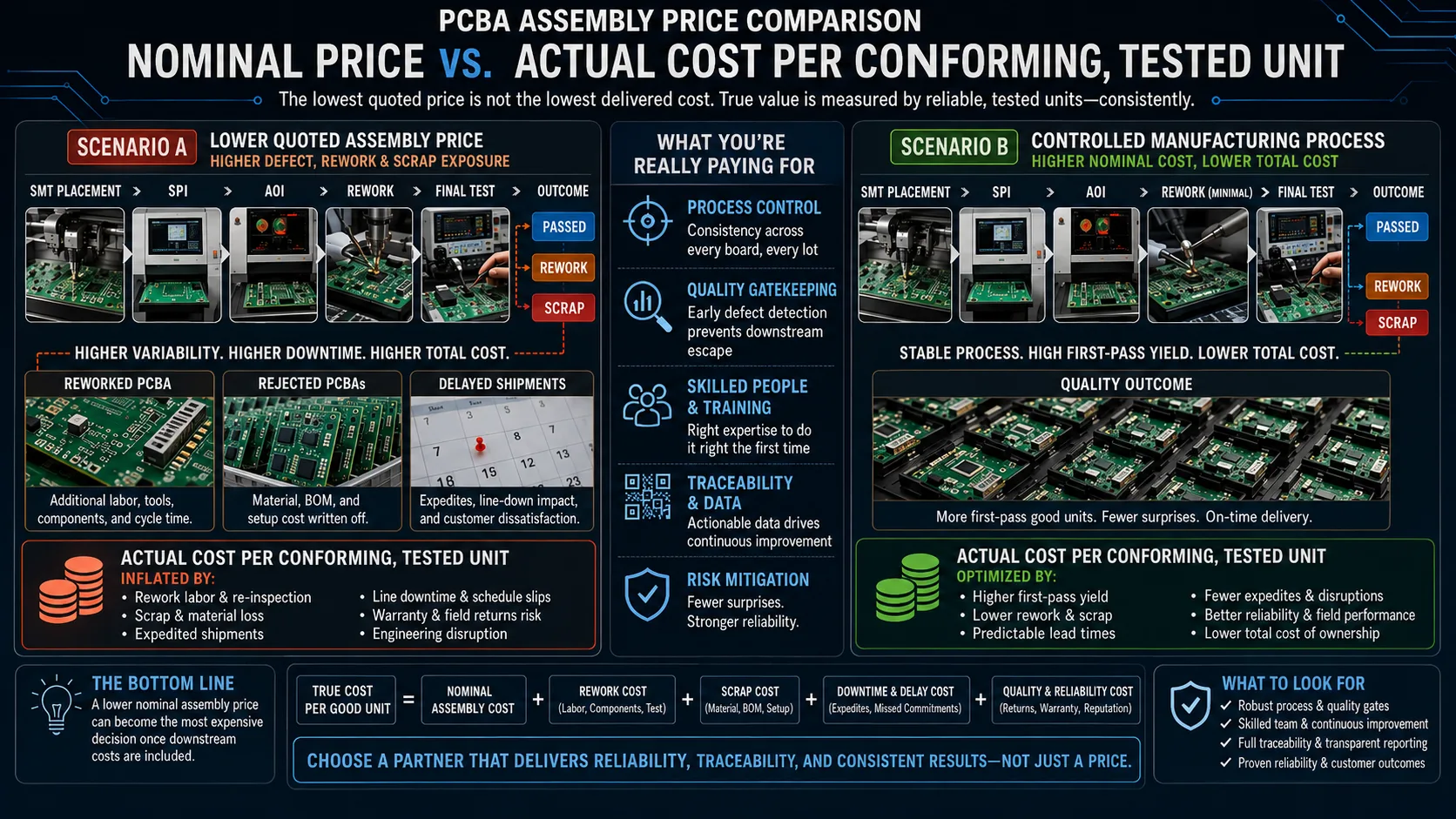
The lowest assembly quotation does not necessarily produce the lowest cost per conforming, tested unit.
Suppose:
Supplier A
Lower assembly quotation
but higher:
Supplier B
Higher assembly quotation
but better:
The apparent price advantage of Supplier A can disappear.
Therefore:
Cost per conforming, tested assembly is more meaningful than cost per assembled board.
14. Components Can Dominate PCBA Cost
In many electronic products, bare PCB cost represents only a fraction of total PCBA material cost.
The BOM may be dominated by:
Therefore, moving PCB fabrication to a lower-cost geography may have a relatively small effect on total product cost if the component BOM remains unchanged.
This is why:
BOM optimization can sometimes be more economically significant than PCB fabrication price optimization.
15. The Cheapest Component Is Not Necessarily the Cheapest Program
Consider:
Source A
Lower unit price
but:
Source B
Slightly higher price
but:
Source B may create the lower total program cost if it prevents production delays.
Procurement should therefore consider:
Price + Availability + Quality + Lead Time + Risk
rather than price alone.
16. Start With Total Landed Cost
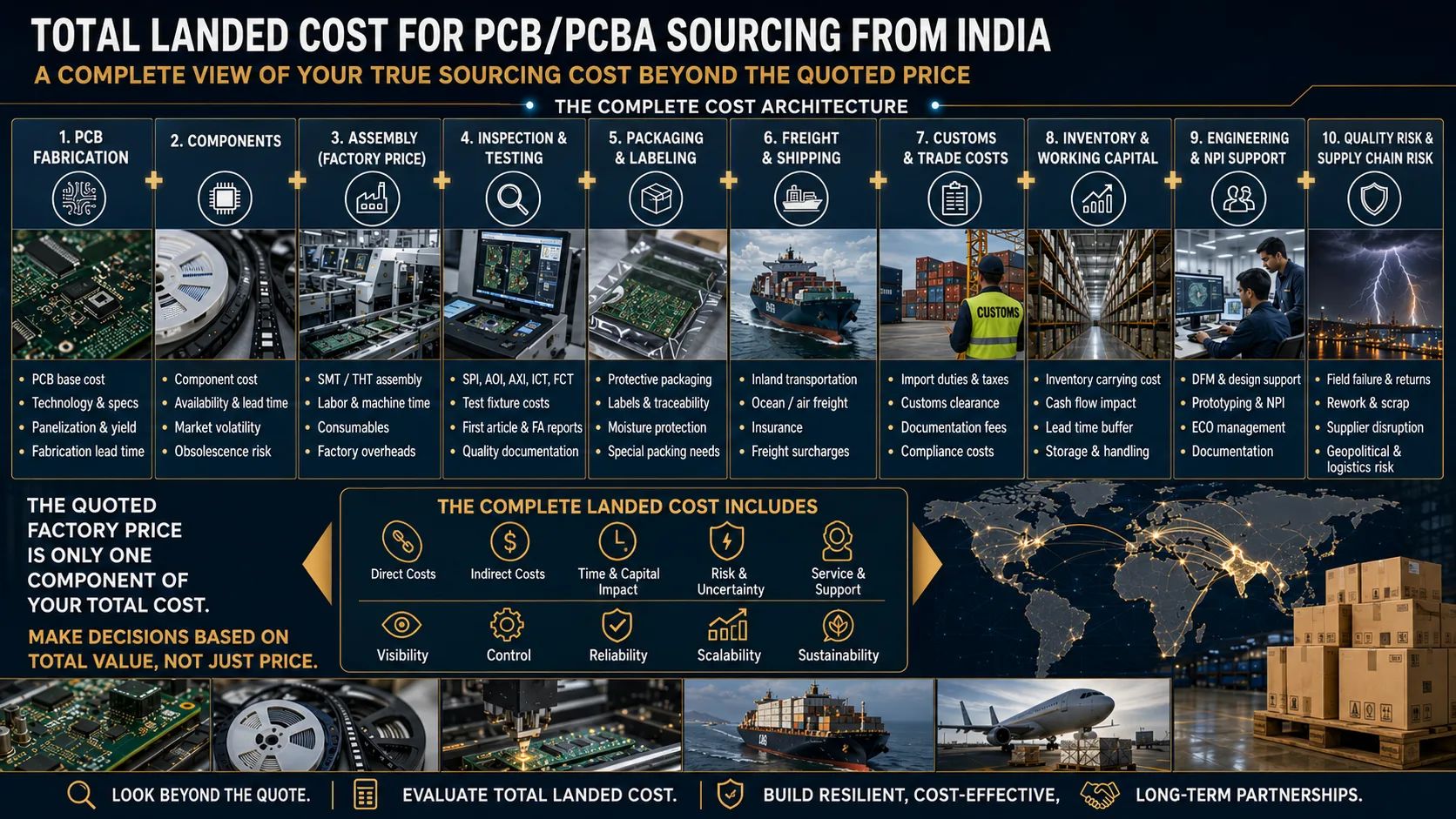
A PCB quotation is only one component of the procurement equation.
Total landed cost may include:
Manufacturing
Materials
Logistics
Trade
Supply Chain
17. Labor Cost Should Not Be the Only India Argument
India is sometimes discussed primarily in terms of labor-cost advantage.
That is incomplete.
Modern PCB/PCBA manufacturing involves:
Therefore, the meaningful comparison is:
Total manufacturing cost per conforming, tested and delivered assembly.
Automation, utilization, yield, material cost, procurement efficiency and manufacturing complexity can have significant impact beyond direct labor.
18. India's Electronics Ecosystem Is Expanding
The first source describes India's ecosystem as developing across:
It also notes the Electronics Component Manufacturing Scheme (ECMS) and its stated focus on areas including multilayer PCBs and HDI/MSAP/flexible PCB technologies.
However, the article makes an important qualification:
India's component ecosystem is still evolving.
Some components may be sourced efficiently domestically while others may continue to require international procurement.
Therefore, a capable India-based PCBA partner needs both:
Local manufacturing capability
and
International procurement capability.
19. India Should Be Evaluated as a Supply-Chain Diversification Strategy
For companies dependent on a single manufacturing geography, the objective does not necessarily need to be:
“Move everything to India.”
A more practical strategy can be:
“Establish India as an additional qualified manufacturing source.”
Potential benefits include:
Resilience does not mean eliminating every external dependency.
It can mean having:
20. China + India Is Not Necessarily an Either/Or Decision
A global supply chain may contain multiple manufacturing locations.
For example:
China
→ Existing high-volume production
India
→ Alternative production / NPI / regional supply
Europe / North America
→ Customer-side engineering or final integration
The optimal architecture depends on:
The objective is not simply to replace one country with another.
It is to create the best-fit supply chain.
21. Evaluate the Supplier's Manufacturing Technology
Do not assume every PCBA supplier can manufacture every board.
Evaluate:
SMT
THT
Reflow
Complex Packages
The key question is:
Can the supplier reliably manufacture this specific board?
22. Evaluate DFM and DFT Engineering Support
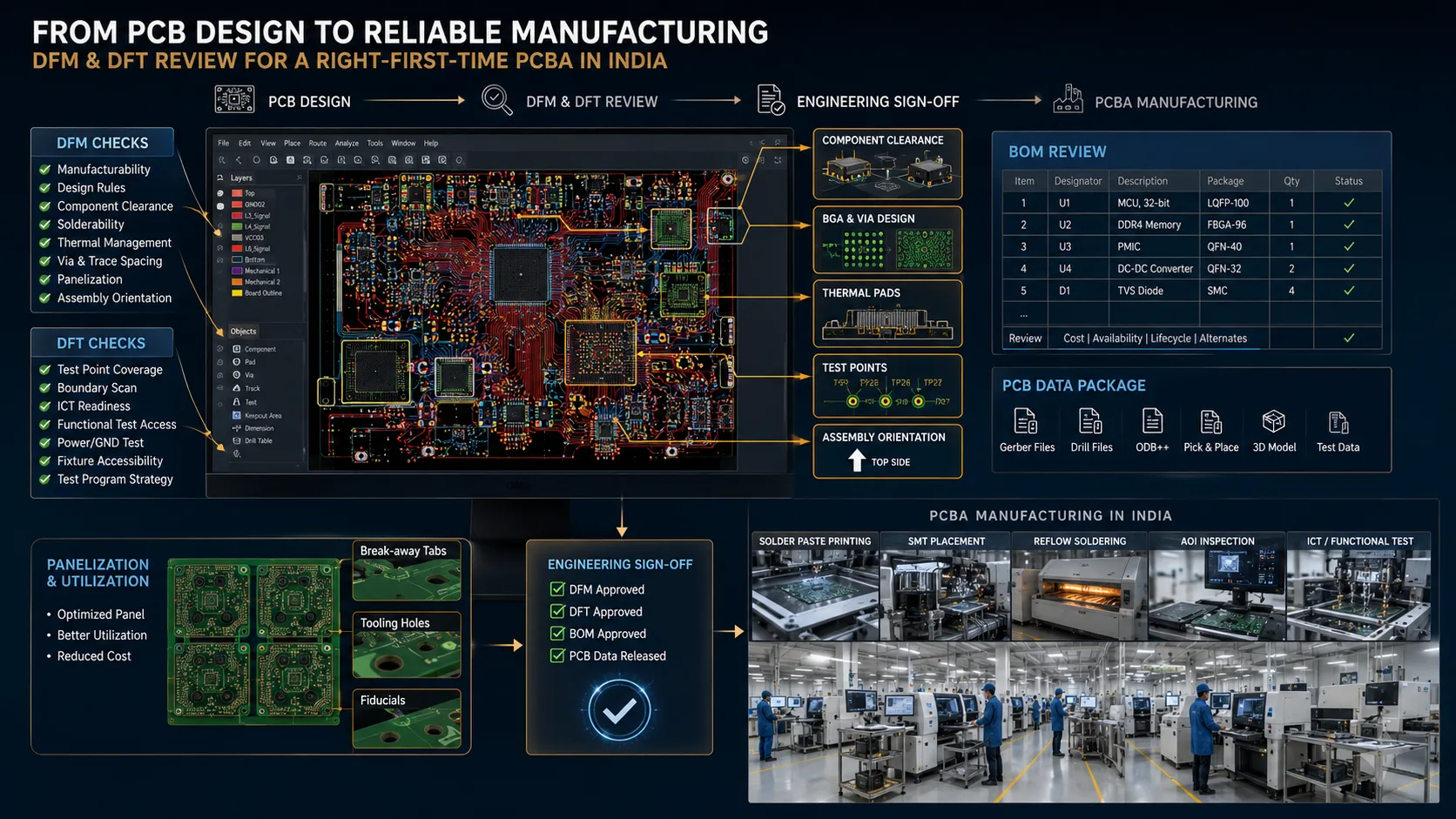
A strong PCBA partner should identify manufacturing and test risks before the first production build.
A capable manufacturing partner should not simply wait for production files.
Ask whether the supplier performs:
DFM
Design for Manufacturability
DFT
Design for Test
Review:
The first article also highlights DFM/DFA as a direct cost-optimization mechanism because design decisions such as excessive layer count, difficult via structures, poor panel utilization and unnecessary manual operations can increase manufacturing cost.
23. Ask About NPI Capability
If the product is not already in stable mass production, NPI capability matters.
A capable supplier should be able to support some combination of:
Prototype
↓
Engineering Review
↓
NPI Build
↓
Pilot Production
↓
Process Optimization
↓
Production Release
↓
Recurring Production
↓
Ongoing Supply-Chain Management
This continuity can reduce the need to repeatedly transfer manufacturing knowledge between suppliers.
24. Can the Supplier Support Low-Volume Production?
Do not assume that an Indian PCBA supplier only supports large-volume manufacturing.
Ask specifically about:
Also ask:
“What changes in your process when volume is low?”
This can reveal whether the supplier's manufacturing model actually fits your product.
25. Can the Supplier Scale With You?
The opposite question matters too.
Suppose your production grows from:
500 units/month
to:
5,000 units/month
Can the supplier support that transition?
Ask about:
A supplier should be evaluated not only for today's volume but also for the expected production trajectory.
26. Inspection and Testing Capability
Depending on the product, relevant capabilities may include:
The question should not simply be:
“Do you have AOI?”
Instead ask:
“Which inspection and testing methods would you recommend for our board, and why?”
The answer should be based on the actual product.
27. BGA and Hidden-Joint Assemblies Need Special Attention
For boards containing:
ask specifically about:
Manufacturing capability should be evaluated together with the supplier's ability to inspect and control the process.
28. Quality Has Economic Value
Quality is not separate from cost.
A defect discovered:
Before shipment
is generally less disruptive than one discovered:
At the customer's factory
And a defect discovered:
After deployment
can be substantially more expensive.
Potential downstream costs include:
Therefore:
Quality assurance is part of cost management.
29. Evaluate the Supplier's Quality System
Discuss:
Certification is useful evidence.
But:
Operational quality control is what protects the product.
30. Understand Traceability
Depending on product requirements, traceability may include:
The appropriate level depends on the product and industry.
31. Engineering Change and Revision Control
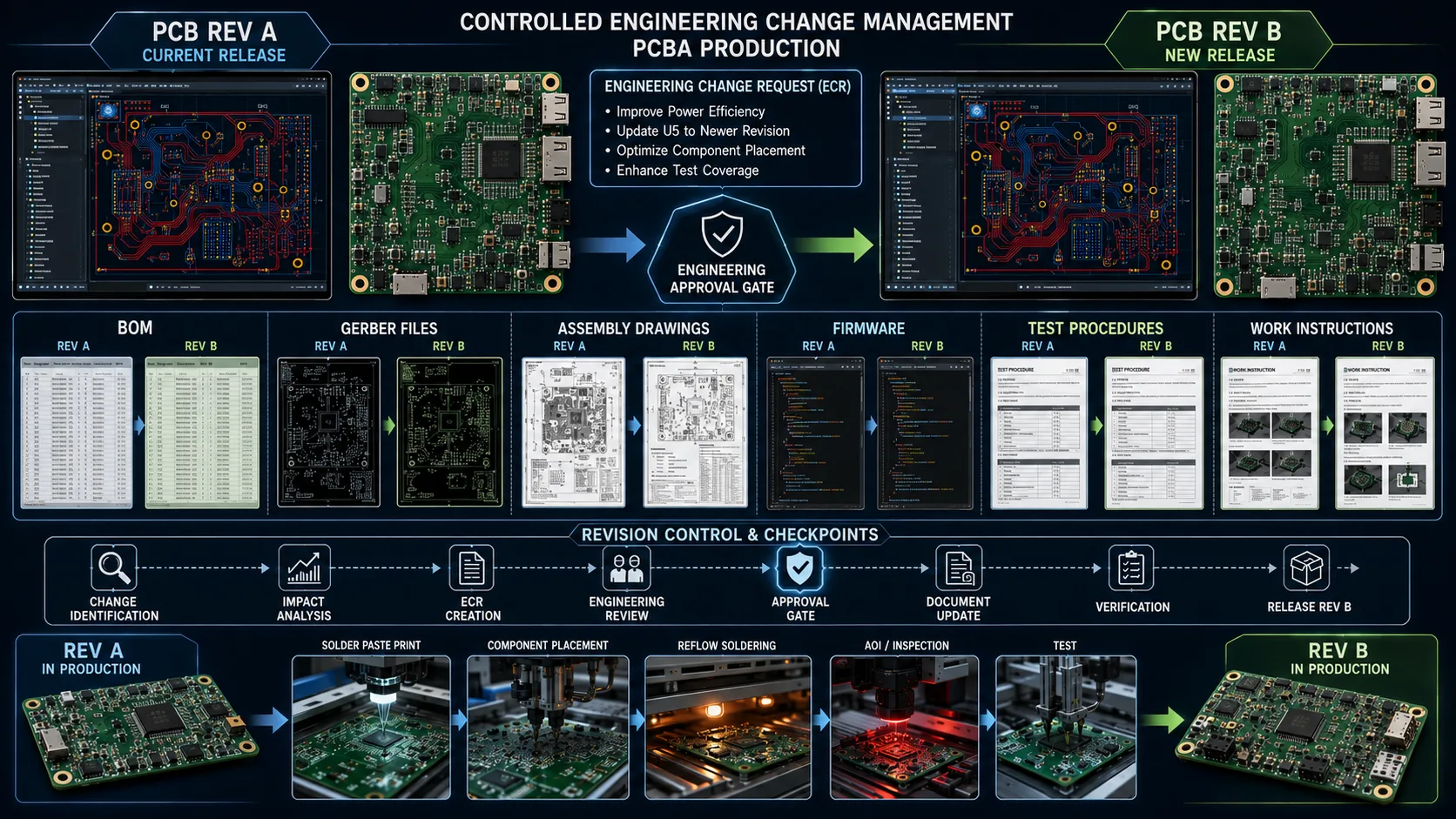
Controlled revision management prevents outdated PCB, BOM and test information from entering production.
Ask:
“How do you prevent obsolete engineering files from being used?”
The supplier should control revisions of:
This becomes particularly important for recurring production over several years.
32. Understand ESD, Moisture and Manufacturing Controls
Ask how the supplier controls:
The exact controls depend on component technologies and product requirements.
33. Rework and Repair Must Be Controlled
Even good production processes can occasionally produce non-conforming assemblies.
Ask:
“How is rework controlled?”
Understand:
Uncontrolled rework can create hidden reliability risks.
34. Ask What Happens When Something Goes Wrong
One of the most revealing supplier questions is:
“Tell us what happens when a production lot does not meet specification.”
A mature supplier should be able to explain:
Containment
↓
Root-Cause Analysis
↓
Corrective Action
↓
Verification
↓
Customer Communication
↓
Prevention
No manufacturing process is completely free of defects.
What matters is whether the supplier has a disciplined system for detecting, containing and eliminating them.
35. Lead Time Must Be Decomposed
Do not rely on:
“Our lead time is 2–3 weeks.”
Ask for separate estimates for:
Then ask:
“Which part of the manufacturing cycle determines the final delivery date?”
For many PCBA programs, component availability can be more important than assembly time.
36. Logistics From India to International Markets
Relevant considerations include:
The factory is only one part of the international supply chain.
The responsibilities of buyer and supplier should be explicitly defined.
37. Freight Can Change the Sourcing Equation
For small, high-value PCBAs:
Air freight
may be commercially reasonable because product value can be high relative to shipment weight.
For large production quantities:
Sea freight
may become more attractive depending on route, volume and delivery requirements.
Therefore, the right question is not:
“Is shipping from India expensive?”
It is:
“What is the optimal logistics model for this product, destination, volume and delivery requirement?”
38. Working Capital Is a Supply-Chain Cost
International sourcing should consider:
A supplier strategy that reduces inventory without compromising continuity can create substantial value even if its quoted unit price is not the lowest.
39. MOQ Matters
Minimum order quantity can materially affect commercial attractiveness.
An NPI project may require:
100–500 boards
while a mature product may require:
10,000+ boards
The ideal supplier model may therefore differ between:
The sourcing strategy should evolve with the product lifecycle.
40. Customer-Owned Inventory vs Supplier-Procured Components
Clarify:
This becomes particularly important for long-running production programs.
41. Tax, Customs and Commercial Structure
International sourcing from India may involve:
These are transaction-specific.
Therefore, a quotation should make clear:
What is included—and what remains the customer's responsibility?
42. Do Not Compare Currency-Converted Quotes Alone
Suppose:
Supplier A: USD quotation
Supplier B: INR quotation
Simply converting the currencies does not produce a meaningful comparison.
Normalize:
Only then is the comparison meaningful.
43. Currency Risk Matters in Long-Term Agreements
Currency movement can affect:
For longer-term supply agreements, procurement teams may consider:
The appropriate structure depends on the commercial relationship.
44. Communication Is Part of Supplier Capability
Ask:
“Who will manage our project?”
Ideally identify responsibility for:
Also establish:
A technically capable supplier can still become difficult to manage if communication is poor.
45. Engineering-to-Engineering Communication
For complex boards, ask:
“Can our engineering team communicate directly with your manufacturing engineering team?”
This can significantly improve collaboration during:
International sourcing should not create a communication barrier between technical teams.
46. International Customer Experience
Ask:
The supplier does not need to disclose confidential customer information.
But you do need confidence that it understands the operational requirements of international business.
47. Ask for Evidence, Not Just Capability Lists
A supplier website may list:
SMT + AOI + X-ray + ICT + Functional Testing + NPI
That is only the starting point.
Ask for evidence such as:
This helps distinguish claimed capability from demonstrated capability.
48. Audit the Supplier When Practical
For strategically important programs, an audit or facility visit can reveal information a quotation cannot.
Evaluate:
Factory
Engineering
Quality
Supply Chain
A physical audit can be particularly valuable before committing significant production volume.
49. Compare India and China Using the Right Criteria
Do not reduce the decision to:
“Which country has the lower PCB assembly price?”
Compare:
| Factor | What to Evaluate |
|---|---|
| Engineering | DFM, DFT, NPI |
| Components | Availability, sourcing, alternates |
| Assembly | SMT/THT, package capability |
| Quality | Inspection, process control, traceability |
| Testing | ICT, flying probe, functional |
| Scale | Prototype → production |
| Logistics | Lead time, freight, export |
| Communication | Engineering and project management |
| Risk | Diversification and continuity |
| Commercial | Total landed cost |
China has a highly developed electronics manufacturing ecosystem and remains an important global sourcing destination.
India's potential value should therefore be evaluated based on actual supplier capability and strategic fit, rather than simplistic country-level assumptions.
50. A Practical Supplier Scorecard
A useful weighted supplier scorecard can include:
| Evaluation Area | Suggested Weight |
|---|---|
| Engineering / DFM / DFT | 15% |
| BOM & Component Sourcing | 15% |
| Quality Systems & Process Control | 15% |
| SMT/THT Assembly Capability | 10% |
| Inspection & Testing | 10% |
| NPI / Prototype Capability | 10% |
| Supply-Chain Risk Management | 10% |
| Production Scalability | 5% |
| International Logistics & Export Support | 5% |
| Communication & Commercial Management | 5% |
These weights should be adapted to the product.
A safety-critical industrial product may place greater emphasis on:
A rapidly scaling startup may place greater emphasis on:
51. Procurement Comparison Framework
A second, broader sourcing scorecard can evaluate:
| Evaluation Area | Key Question |
|---|---|
| Unit Cost | Is the manufacturing price competitive? |
| BOM Cost | Are components competitively sourced? |
| Quality | Can the supplier consistently produce conforming assemblies? |
| Lead Time | Is the schedule credible? |
| Technology | Can the supplier manufacture the required PCB/PCBA? |
| Engineering | Can it support DFM/DFA and NPI? |
| Supply Chain | Are critical components visible and controlled? |
| Logistics | Can products reach the required market reliably? |
| Scalability | Can production increase with demand? |
| Resilience | Does the supplier reduce geographic concentration? |
This is much stronger than price-only comparison.
52. What Should You Send an Indian PCBA Supplier for an RFQ?
PCB
Assembly
Testing
Commercial
53. What Should You Expect Back From the Supplier?
A useful supplier response should ideally address:
A good RFQ response should help you make a manufacturing decision, not merely provide one number.
54. The 15 Questions International Buyers Should Ask
When shortlisting an India-based PCBA supplier, ask:
55. When Does Sourcing PCBA From India Make Sense?
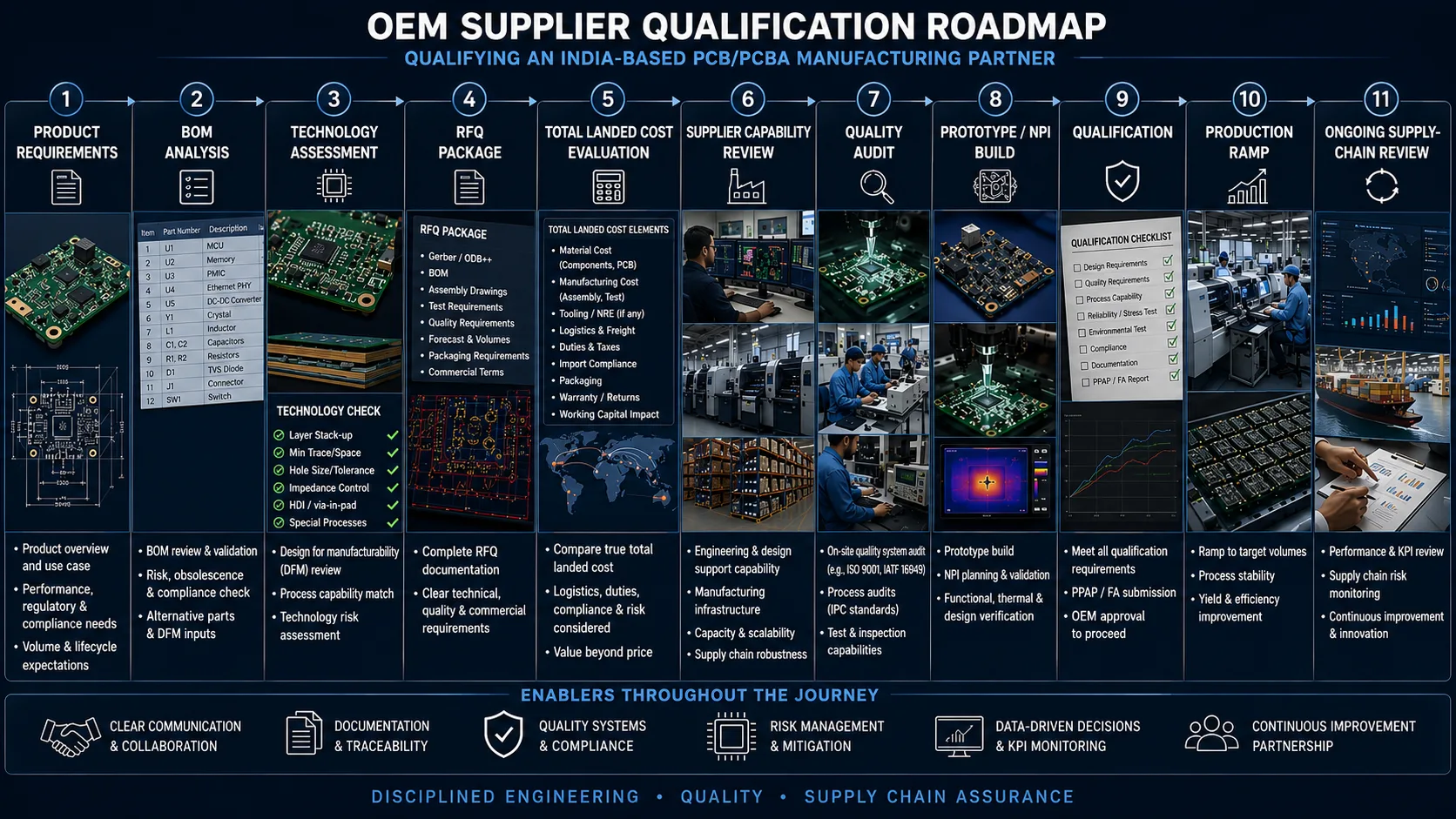
India sourcing should follow the same disciplined engineering and supplier-qualification process expected from any global manufacturing location.
India may be worth evaluating when an international buyer is looking for:
But the final decision should always be based on specific supplier capability and product requirements.
56. Final Procurement Checklist
Before selecting an India-based PCB/PCBA manufacturing partner:
Product
☐ What PCB technology is required?☐ What assembly complexity is involved?☐ What testing is required?
BOM
☐ Are MPNs validated?☐ Are critical components available?☐ Are approved alternates available?☐ Is lifecycle risk understood?☐ Is international component sourcing required?
Manufacturing
☐ Can the supplier meet the PCB specification?☐ Can assembly support the package mix?☐ Is the required inspection available?☐ Is functional testing available?☐ Can the supplier support the required volume?
Engineering
☐ Is DFM available?☐ Is DFT support available?☐ Is NPI support available?☐ Is engineering change control robust?
Cost
☐ PCB cost understood?☐ Component cost understood?☐ Assembly cost understood?☐ Tooling/test costs understood?☐ Freight included?☐ Duties/taxes understood?☐ Total landed cost calculated?
Supply Chain
☐ Which components require international sourcing?☐ Which components represent critical risk?☐ What is the alternate-sourcing strategy?☐ What is the lifecycle-monitoring process?☐ Who owns inventory risk?
Logistics
☐ Factory lead time known?☐ Component lead time known?☐ Transit time known?☐ Door-to-door schedule understood?☐ Incoterms defined?☐ Export documentation defined?
Quality
☐ Certifications current and applicable?☐ Traceability available?☐ Inspection records available?☐ Rework controlled?☐ Corrective-action process established?☐ Qualification builds supported?
Supplier
☐ Capability demonstrated—not just claimed?☐ Relevant international experience?☐ Engineering communication available?☐ Production scalability verified?☐ Factory audit completed where appropriate?
This combines the strongest procurement checklist from the cost/supply article with the supplier-qualification framework from the international-buyer article.
57. QUADRIONIX PERSPECTIVE
The value of an India-based manufacturing partner should not be reduced to:
“Lower manufacturing cost.”
The stronger proposition is an integrated manufacturing workflow connecting:
Global Sourcing
→ International component ecosystem
Engineering Coordination
→ DFM/DFA, BOM review and manufacturing-readiness assessment
Manufacturing
→ PCB fabrication and PCBA assembly
Quality
→ Inspection, validation and controlled production
Supply-Chain Management
→ Component availability and alternate sourcing
International Fulfillment
→ Packaging, dispatch and global logistics coordination
The objective is to provide the customer with one coordinated manufacturing workflow rather than a collection of disconnected activities.
For international customers, the manufacturing chain can therefore span:
→ PCB
→ BOM Validation
→ Component Sourcing
→ SMT/THT Assembly
→ Inspection
→ Testing
→ NPI
→ Production
→ International Delivery
That is broader than simply placing components onto a PCB. It connects engineering, sourcing, manufacturing and quality into one controlled process.
The strongest case for India is not:
“India is cheaper.”
It is:
“India is becoming a meaningful electronics manufacturing and supply-chain location that deserves to be evaluated alongside other global manufacturing options.”
The opportunity is broader than labor arbitrage.
It includes:
Whether you are evaluating India as:
the right starting point is a technical evaluation of the actual product.
Evaluate our product. Qualify the supplier. Validate the economics. Then scale with confidence.
57. Final Takeaway
Sourcing PCBA from India should not be approached simply as a country-level purchasing decision.
It should be treated as a manufacturing-partner qualification exercise.
Before placing an order, evaluate:
1. Engineering
Can the supplier understand and manufacture your design?
2. BOM & Sourcing
Can it source the right components and manage supply-chain risk?
3. Manufacturing
Can its PCB and SMT/THT processes handle your board?
4. Quality
Can it consistently control and document production quality?
5. Testing
Can it appropriately verify the assembled product?
6. NPI
Can it move the product from prototype to production?
7. Scalability
Can it support your expected growth?
8. International Execution
Can it manage communication, documentation and export logistics?
9. Commercial Transparency
Can you understand the actual total landed cost?
10. Long-Term Partnership
Can it support the product beyond the first production run?
The strongest sourcing decision is rarely about finding the cheapest factory.
It is about finding the right manufacturing system for your product and supply-chain strategy.
Ready to manufacture your electronics project?
Upload your Gerber files & BOM for automated DFM review, engineering feedback, and guaranteed delivery timelines.