How to Reduce Risk When Moving PCB Production to a New Supplier
A practical engineering and procurement framework for transferring PCB/PCBA production without introducing avoidable quality, supply-chain, documentation, cost or delivery risk
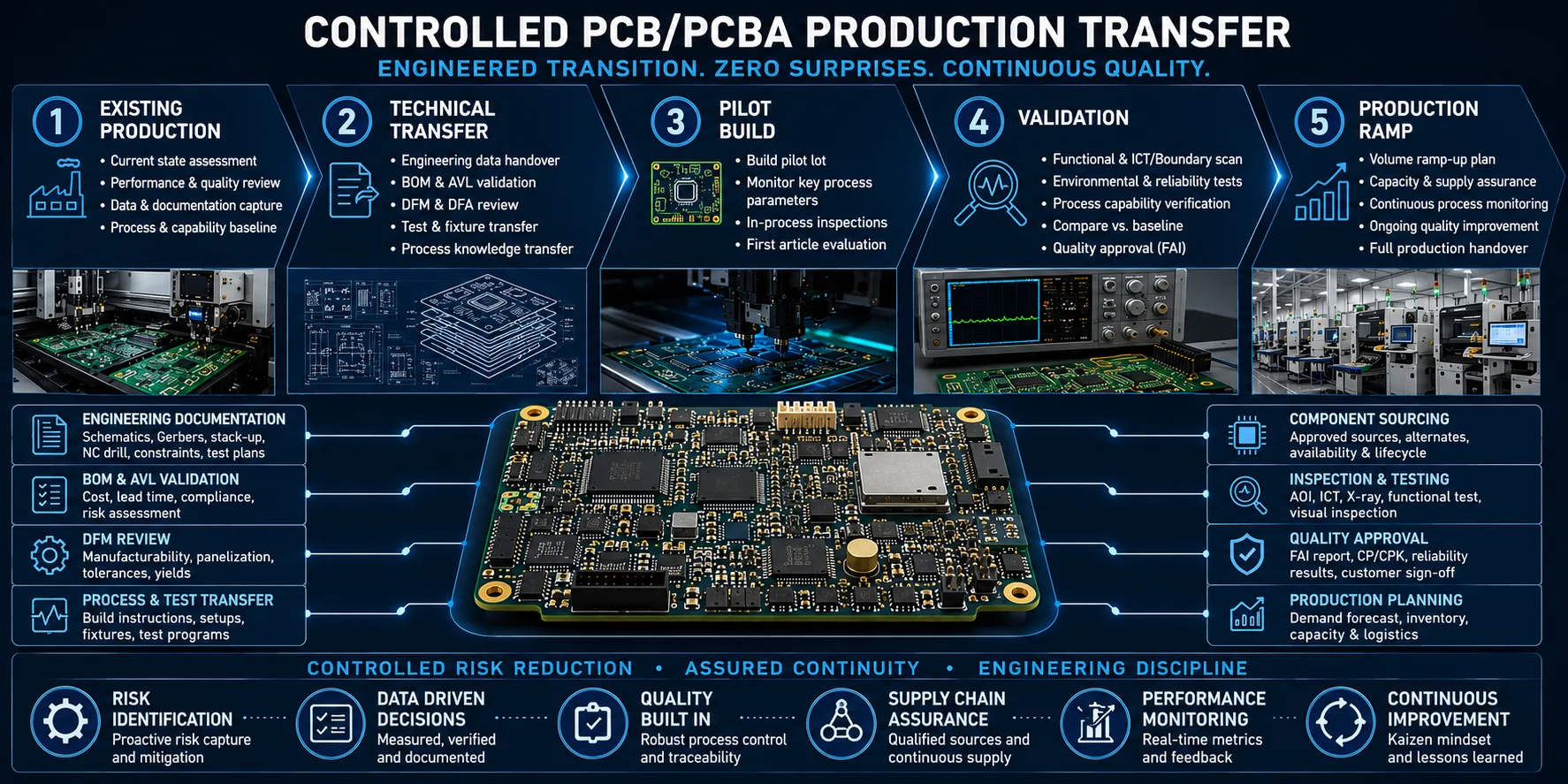
Changing a PCB or PCBA manufacturing supplier is rarely just a matter of sending the same files to a different factory.
The design may be unchanged.
The BOM may appear unchanged.
The finished product may look identical.
Yet the manufacturing process behind that product can change significantly.
Different suppliers may use different:
That means a supplier transfer can introduce risk even when the product design itself has not changed.
The safest approach is therefore not:
"Move the files and see whether the new supplier can build it."
It is:
"Control the transfer as an engineering and manufacturing change."
This article explains how.
1. Why Changing a PCB Supplier Creates Risk
A production transfer can affect multiple parts of the manufacturing system simultaneously.
Consider a typical PCBA:
→ PCB fabrication
→ Component sourcing
→ SMT assembly
→ THT assembly
→ Reflow / soldering
→ Inspection
→ Testing
→ Programming
→ Final inspection
Even when the design remains unchanged, the processes used to produce the board can change.
Potential risks include:
Technical risk
The new supplier may interpret manufacturing data differently or identify previously tolerated design characteristics as manufacturing constraints.
Quality risk
Different processes or controls can produce different defect rates, soldering results or assembly consistency.
Component risk
The new supplier may source components through different channels or encounter different availability conditions.
Testing risk
Existing test fixtures, programs or procedures may not transfer cleanly.
Documentation risk
Incomplete or outdated manufacturing documentation can create ambiguity.
Delivery risk
The new supplier may require more time than expected for engineering setup, component procurement or process qualification.
Cost risk
The quoted unit price may not represent the complete transition and production cost.
A supplier transfer should therefore be treated as a controlled manufacturing transition, not merely a purchasing decision.
2. First Decide Why You Are Changing Suppliers
Before starting the transfer, clearly document the reason for the change.
Common reasons include:
This matters because the reason for the transfer should determine what you validate most carefully.
For example:
If the primary problem is quality, quality and process validation deserve particular attention.
If the primary problem is capacity, production scalability and capacity planning become critical.
If the primary problem is supply continuity, component sourcing and supply-chain resilience should receive greater emphasis.
3. Build a Transfer Plan Before Sending the First RFQ
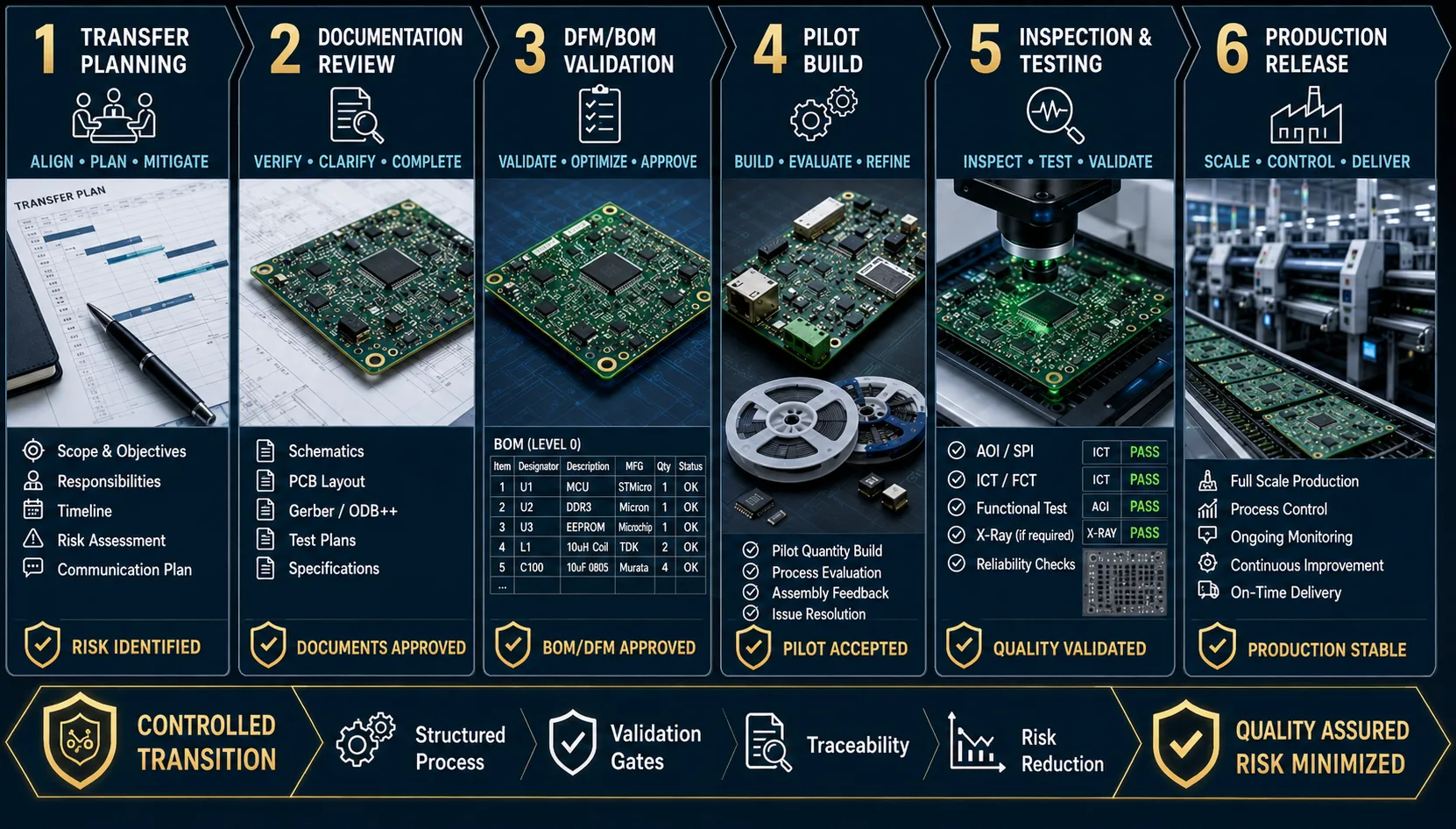
A structured supplier-transfer process creates validation gates before production is released to the new manufacturing partner.
A controlled supplier transfer should have a defined plan.
At minimum, identify:
This converts an open-ended supplier change into a manageable project.
4. Freeze the Product Baseline
Before transferring production, establish exactly what is being manufactured.
This is your baseline.
The baseline should identify the approved versions of relevant manufacturing information, such as:
Without a controlled baseline, it becomes difficult to determine whether a problem came from:
A clean baseline creates a reference point.
5. Don't Assume Your Manufacturing Files Are Complete
One of the most important steps in a supplier transfer is reviewing the manufacturing package.
A design team may believe it has supplied "everything."
But production may depend on information that was previously communicated informally.
For example:
When moving to a new supplier, these hidden dependencies need to become explicit.
6. Review the BOM Before the Transfer
The BOM deserves particular attention.
Do not simply send the existing BOM to the new supplier and assume it will be sourced identically.
Review:
A supplier transfer is an opportunity to identify BOM risks that may have been hidden by the previous supplier's sourcing process.
7. Identify Critical Components
Not every component deserves the same level of attention.
Identify components where substitution or sourcing failure could create significant risk.
Examples can include:
For each critical component, understand:
Source → Availability → Lifecycle → Alternate strategy → Approval requirement
8. Control Component Substitutions
One of the most important rules during a supplier transition is:
Do not allow an uncontrolled component substitution simply because the new supplier can source it.
A component that appears similar may differ in:
If an alternate is necessary, define the approval process before production.
9. Perform a Fresh DFM/DFA Review
Even if the PCB has already been manufactured successfully, a new supplier should perform its own manufacturing review.
Why?
Because manufacturing processes differ.
The new supplier may have different:
The objective is not to redesign the board unnecessarily.
It is to identify whether the existing design creates any manufacturing risk in the new production environment.
10. Pay Particular Attention to PCB Fabrication Changes
For PCB fabrication, compare the existing and proposed manufacturing approaches.
Review:
If the product has controlled impedance or other critical PCB characteristics, ensure that the new supplier understands and can control the relevant requirements.
11. Review Assembly Process Differences
The same PCBA can be assembled using different process configurations.
Review:
The goal is not to force the new supplier to reproduce every historical process parameter.
The goal is to ensure that the validated manufacturing outcome remains equivalent to the product requirement.
12. Transfer Testing—Not Just Manufacturing
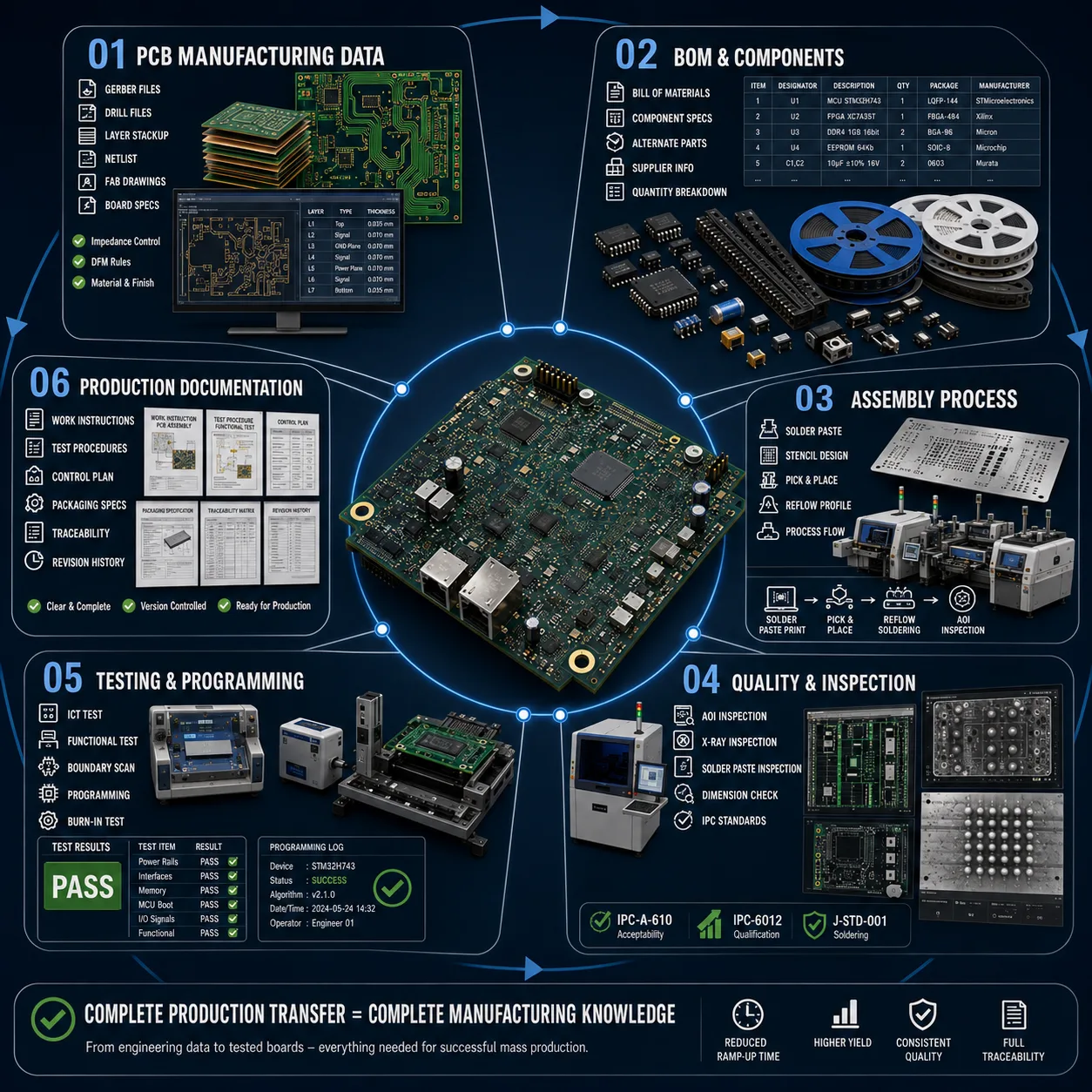
A successful supplier transfer moves the complete manufacturing knowledge required to reproduce the product—not simply the PCB design files.
Testing is sometimes overlooked during supplier transfers.
That can be a serious mistake.
Determine what testing is required and how it will be reproduced.
This may include:
If the existing supplier uses a custom test fixture or test software, determine exactly what needs to be transferred.
13. Establish a Clear Quality Baseline
The new supplier needs to understand what constitutes an acceptable product.
Define the applicable:
Where appropriate, use objective acceptance criteria rather than informal descriptions such as:
"The previous supplier always built it this way."
The new supplier needs requirements that can be understood, measured and controlled.
14. Transfer Historical Quality Knowledge
The previous supplier may possess valuable manufacturing knowledge.
For example:
Where this information is available and appropriate to share, incorporate it into the transfer.
This can significantly reduce the learning curve.
A supplier transition should not mean throwing away years of accumulated manufacturing knowledge.
15. Establish Traceability Requirements
Determine what production information must be traceable.
Depending on the product, this may include:
The required level of traceability should be defined before production starts.
16. Run a Pilot Build Before Full Production
One of the strongest ways to reduce transfer risk is to avoid going directly from:
Old Supplier → Full Production at New Supplier
Instead:
Old Supplier → New Supplier Pilot → Validation → Production Release
The pilot build gives the engineering and manufacturing teams an opportunity to identify problems while the production quantity and exposure are still limited.
17. Define What the Pilot Must Prove
A pilot should not simply answer:
"Did the supplier produce the boards?"
It should answer:
"Has the new manufacturing process demonstrated that it can repeatedly produce an acceptable product?"
Depending on the product, evaluate:
PCB
PCBA
Testing
Production
18. Compare Pilot Results With the Existing Baseline
Where historical production data is available, compare the new supplier's results against it.
For example:
| Metric | Existing Supplier | New Supplier Pilot | Assessment |
|---|---|---|---|
| First-pass yield | — | — | — |
| Defect rate | — | — | — |
| Rework | — | — | — |
| Test failures | — | — | — |
| Delivery | — | — | — |
| Component shortages | — | — | — |
The actual metrics will vary by product and manufacturing process.
The important principle is to compare equivalent measurements.
19. Don't Hide Problems Found During the Pilot
A pilot build is supposed to expose problems.
Finding issues does not necessarily mean the supplier is unsuitable.
Instead, classify them.
Category A — Critical
Problems affecting safety, functionality, regulatory compliance or fundamental product performance.
Category B — Major
Problems requiring process or engineering correction before production release.
Category C — Minor
Issues that can be corrected without affecting product functionality or production readiness.
Then assign:
Issue → Root cause → Corrective action → Owner → Verification → Closure
20. Validate the Supply Chain Before Production Release
A technically successful pilot can still fail because components are unavailable.
Before production release, confirm:
The production plan should reflect actual component availability, not only the PCB assembly capacity.
21. Review the New Supplier's Capacity
The pilot may involve 20, 50 or 100 boards.
Production may require thousands.
Ask whether the supplier's process can scale.
Review:
A successful pilot proves technical feasibility.
It does not automatically prove production scalability.
22. Validate Lead Time End-to-End
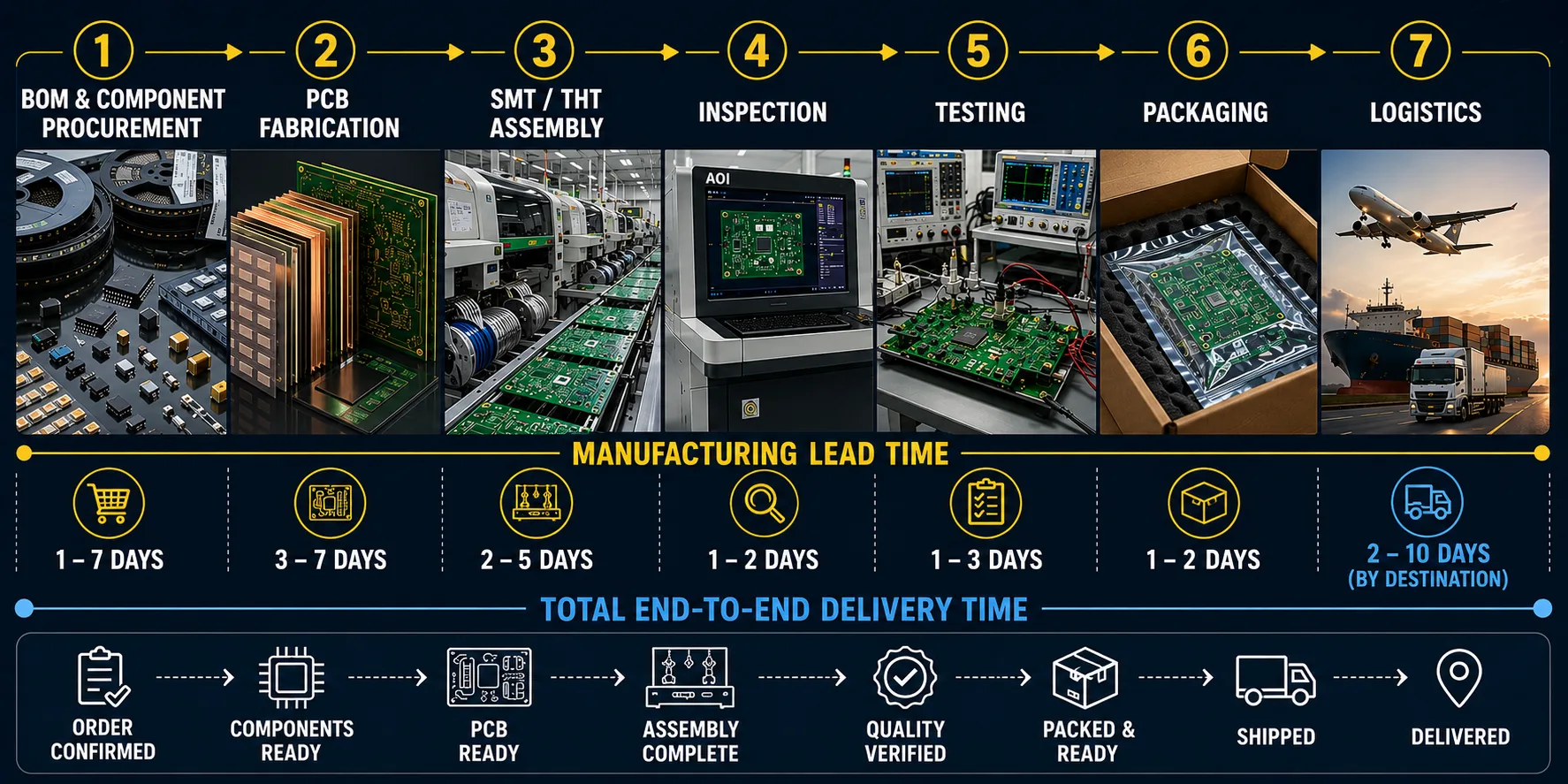
When transferring production, evaluate the complete end-to-end lead time—not only the assembly operation.
A supplier may quote:
"10-day PCBA lead time."
But the actual production cycle may involve:
→ BOM validation
→ Component procurement
→ PCB fabrication
→ Assembly
→ Testing
→ Packaging
→ Shipping
Therefore, clarify what the quoted lead time actually includes.
Also determine:
This prevents unrealistic production planning.
23. Control Engineering Changes During the Transfer
A supplier transfer is already a period of change.
Avoid introducing unnecessary product changes at the same time.
If engineering changes are unavoidable, clearly distinguish:
Supplier-transfer changes
from
Product-design changes
This makes troubleshooting significantly easier.
Where possible, freeze the product baseline during the initial transfer and introduce subsequent changes through a controlled engineering-change process.
24. Protect Revision Control
One of the simplest ways to create a transfer problem is to build the wrong revision.
Use controlled identification for:
Every production release should clearly identify the approved versions.
25. Transfer Tooling and Fixtures Carefully
Some products require supplier-specific tooling or fixtures.
These may include:
Determine:
A fixture that worked perfectly at one supplier may require adaptation for another manufacturing environment.
26. Review Packaging and Shipping Requirements
Packaging can affect product quality after manufacturing.
Consider:
The supplier transition is not complete until the finished product can move through the intended logistics chain without introducing new risks.
27. Keep the Existing Supplier During the Transition Where Practical
For critical products, consider maintaining the existing supplier until the new supplier has demonstrated production readiness.
This can provide a controlled fallback during the transition.
The exact strategy depends on:
The principle is simple:
Avoid creating a single point of failure during the supplier transition itself.
28. Use a Formal Production-Release Gate
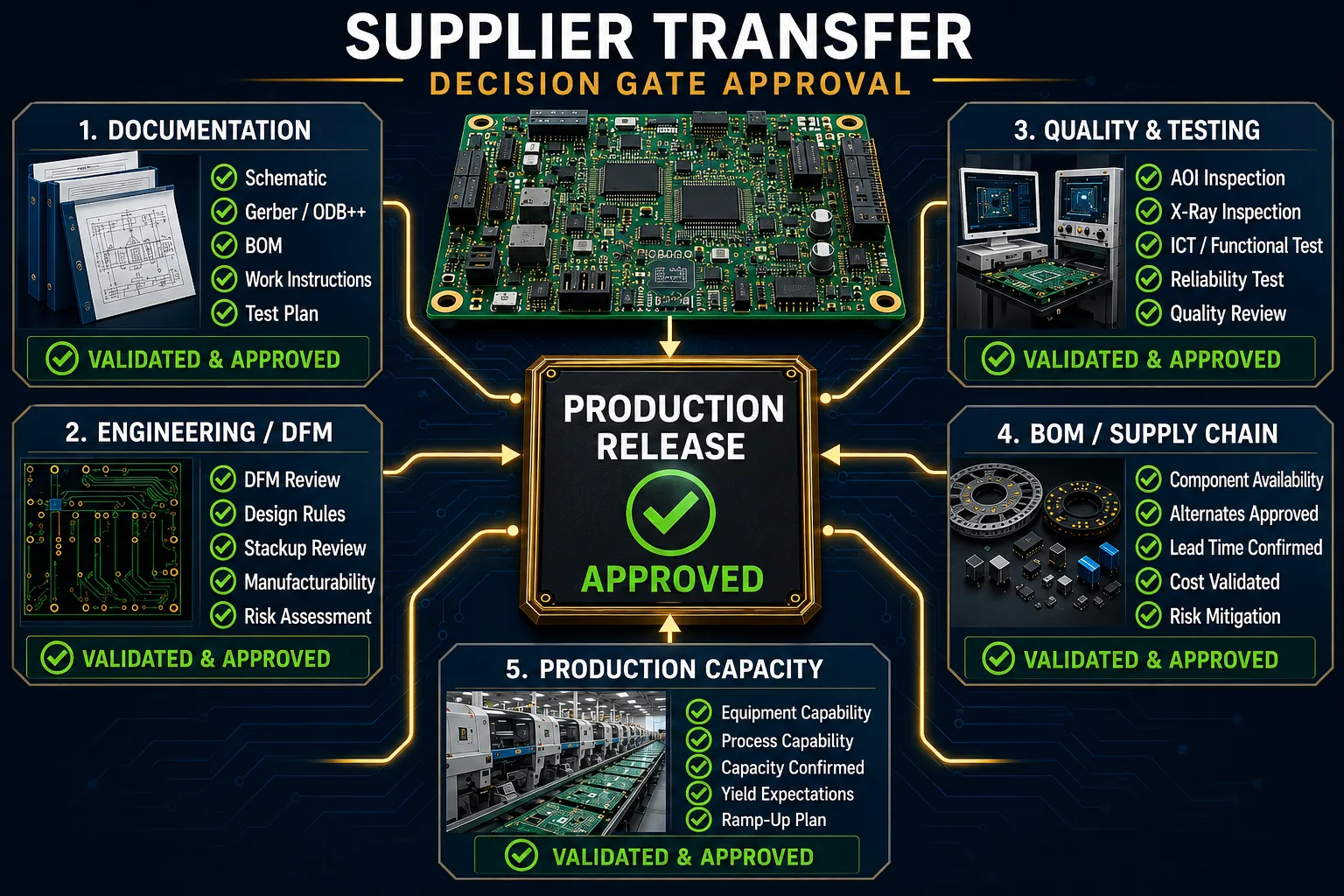
Full production should follow defined validation gates covering documentation, engineering, quality, supply chain and production readiness.
Do not release full production simply because the first pilot boards look acceptable.
Establish a formal release gate.
For example:
Documentation
Engineering
Quality
Supply Chain
Production
Only after the relevant release criteria are met should full production begin.
29. Build a Supplier-Transfer Risk Register
For complex products, create a risk register.
A practical format is:
| Risk | Probability | Impact | Mitigation | Owner | Status |
|---|---|---|---|---|---|
| Component unavailable | — | — | Approved alternate | — | — |
| DFM issue | — | — | Engineering review | — | — |
| Test fixture incompatibility | — | — | Fixture validation | — | — |
| Pilot yield issue | — | — | Process correction | — | — |
| Capacity constraint | — | — | Capacity confirmation | — | — |
| Documentation gap | — | — | Baseline review | — | — |
This makes risk visible and assigns responsibility.
30. Common Mistakes When Changing PCB Suppliers
Mistake 1: Selecting the new supplier solely on price
A low quotation does not guarantee low total cost.
Mistake 2: Assuming identical files guarantee identical results
Manufacturing processes differ between suppliers.
Mistake 3: Skipping the pilot
This transfers unresolved uncertainty directly into production.
Mistake 4: Allowing uncontrolled component substitutions
This can introduce electrical, mechanical or reliability risk.
Mistake 5: Forgetting test transfer
Manufacturing a board successfully does not prove that the product can be tested correctly.
Mistake 6: Transferring files without manufacturing knowledge
Critical process information can remain undocumented if the previous relationship depended on informal knowledge.
Mistake 7: Changing the product and supplier simultaneously
This makes root-cause analysis much harder.
Mistake 8: Assuming prototype success proves production readiness
A small pilot and sustained production are different manufacturing challenges.
31. A Practical PCB/PCBA Supplier-Transfer Checklist
Before Transfer
New Supplier Qualification
Pilot Build
Production Release
32. The Safest Transfer Strategy: Stage the Change
A controlled supplier transfer can be thought of as five stages:
Stage 1 — Understand
Understand the existing product, manufacturing process and supplier dependencies.
Stage 2 — Prepare
Prepare the complete technical, quality, BOM and test package.
Stage 3 — Validate
Conduct DFM, BOM, process and supplier reviews.
Stage 4 — Prove
Run a pilot build and validate the results.
Stage 5 — Scale
Release production gradually and monitor early production performance.
This approach reduces the amount of uncertainty introduced at any one time.
33. What Should You Measure After the Transfer?
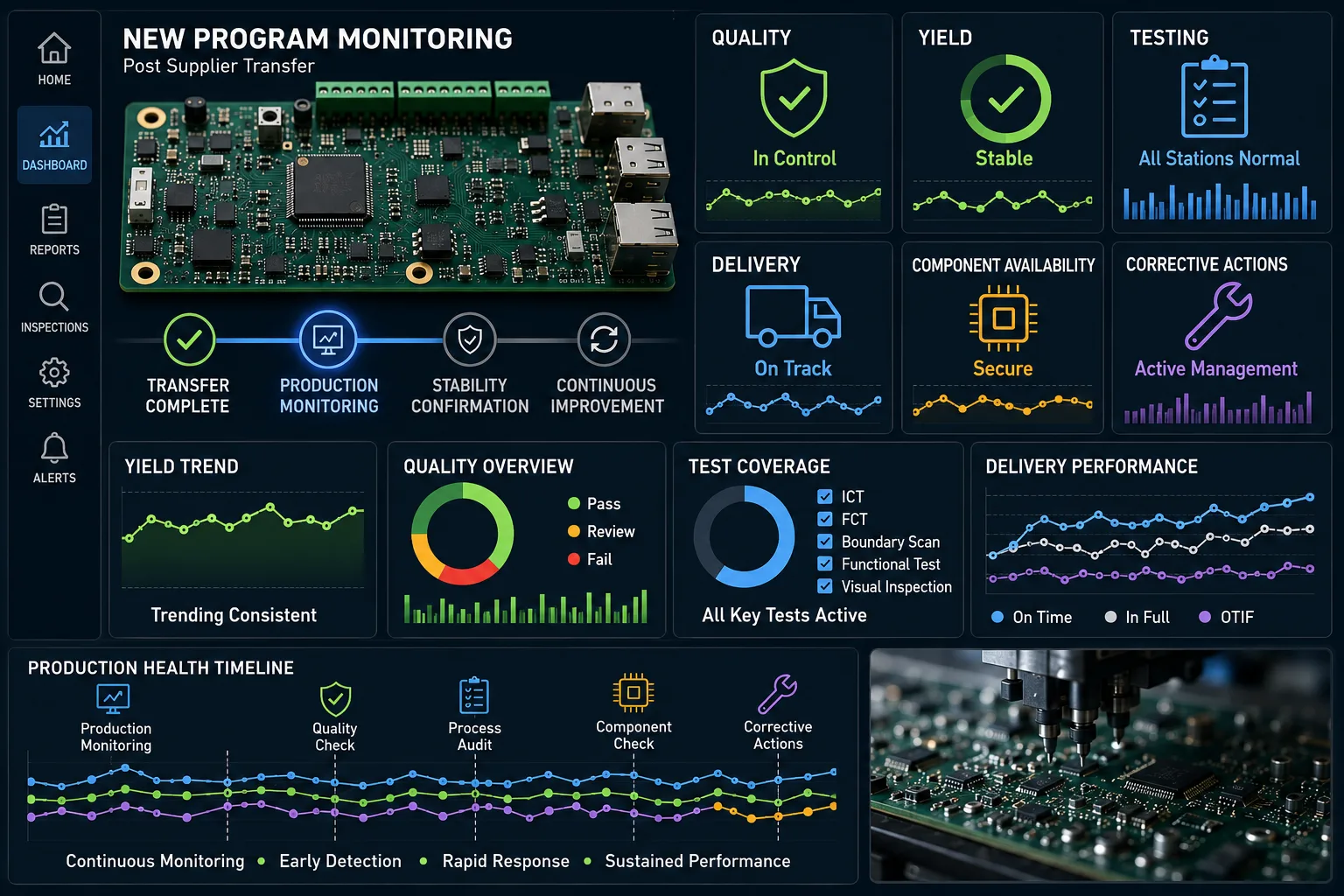
Supplier-transfer risk continues after production release; early production performance should be monitored to confirm process stability.
Supplier qualification should not end when the first production order ships.
Monitor early production performance.
Potential indicators include:
The initial production period provides valuable evidence about whether the new supplier is performing as expected.
34. When Should You Consider a Second Source Instead of a Full Supplier Transfer?
Sometimes the objective is not to completely replace the existing supplier.
It may be to create a second source.
This can provide benefits such as:
However, dual sourcing also creates additional qualification and supply-chain-management requirements.
The appropriate strategy depends on the product, volumes, risk profile and commercial objectives.
35. How QUADRIONIX Approaches Supplier Transition
A successful supplier transition should be structured around continuity and controlled validation.
For an international buyer, that means connecting the key elements of the manufacturing chain:
→ Engineering Review
→ PCB Manufacturing
→ BOM Validation
→ Component Sourcing
→ PCBA
→ Inspection & Testing
→ Pilot Build
→ Production
The goal is not simply to provide another factory.
The goal is to create a controlled manufacturing pathway in which technical requirements, sourcing decisions, quality expectations and production requirements remain visible throughout the transition.
36. QUADRIONIX PERSPECTIVE
For international buyers considering a PCB/PCBA supplier change, the most important question is not simply:
"Can the new supplier manufacture our board?"
It is:
"Can the new supplier reproduce the required product reliably while managing the engineering, component, quality, testing and production risks associated with the transition?"
QUADRIONIX approaches PCB/PCBA manufacturing with this broader perspective—connecting engineering, PCB fabrication, BOM and component sourcing, assembly, testing and production support into a coordinated manufacturing process.
37. Final Takeaway
Moving PCB/PCBA production to a new supplier does not have to be a high-risk event.
The greatest risk usually comes from treating the transfer as a simple procurement change.
A controlled transition instead:
The central principle is simple:
Do not transfer uncertainty directly into production.
Identify it.
Validate it.
Control it.
Then scale.
A successful supplier change is therefore not simply about finding a manufacturer that can build the board.
It is about ensuring that the product, process, components, testing, quality and supply chain remain controlled throughout the transition.
Ready to manufacture your electronics project?
Upload your Gerber files & BOM for automated DFM review, engineering feedback, and guaranteed delivery timelines.