How to Evaluate a PCB/PCBA Manufacturing Supplier: The Complete Buyer’s Guide
A practical framework for evaluating technical capability, turnkey scope, BOM sourcing, quality, testing, NPI, scalability, supply-chain resilience, delivery and total manufacturing risk

How to Evaluate a PCB/PCBA Manufacturing Supplier: The Complete Buyer’s Guide
Selecting a PCB/PCBA manufacturing supplier is not simply a procurement exercise.
For a simple prototype, the process may appear straightforward:
Send the files → receive a quotation → select a manufacturer → build the boards.
But as an electronic product moves toward NPI, pilot production and recurring manufacturing, the supplier becomes part of the product's manufacturing system.
The supplier may influence:
For turnkey PCBA, the responsibility can extend even further—from PCB procurement and component sourcing through assembly, inspection, testing, programming, packaging and delivery.
That makes the real question not:
“Who can manufacture this PCB at the lowest price?”
but:
“Which manufacturing partner can reliably build this product to specification, at the required quality and volume, while managing technical, supply-chain and commercial risk?”
This guide provides a structured way to answer that question.
1. Start With the Product, Not the Supplier
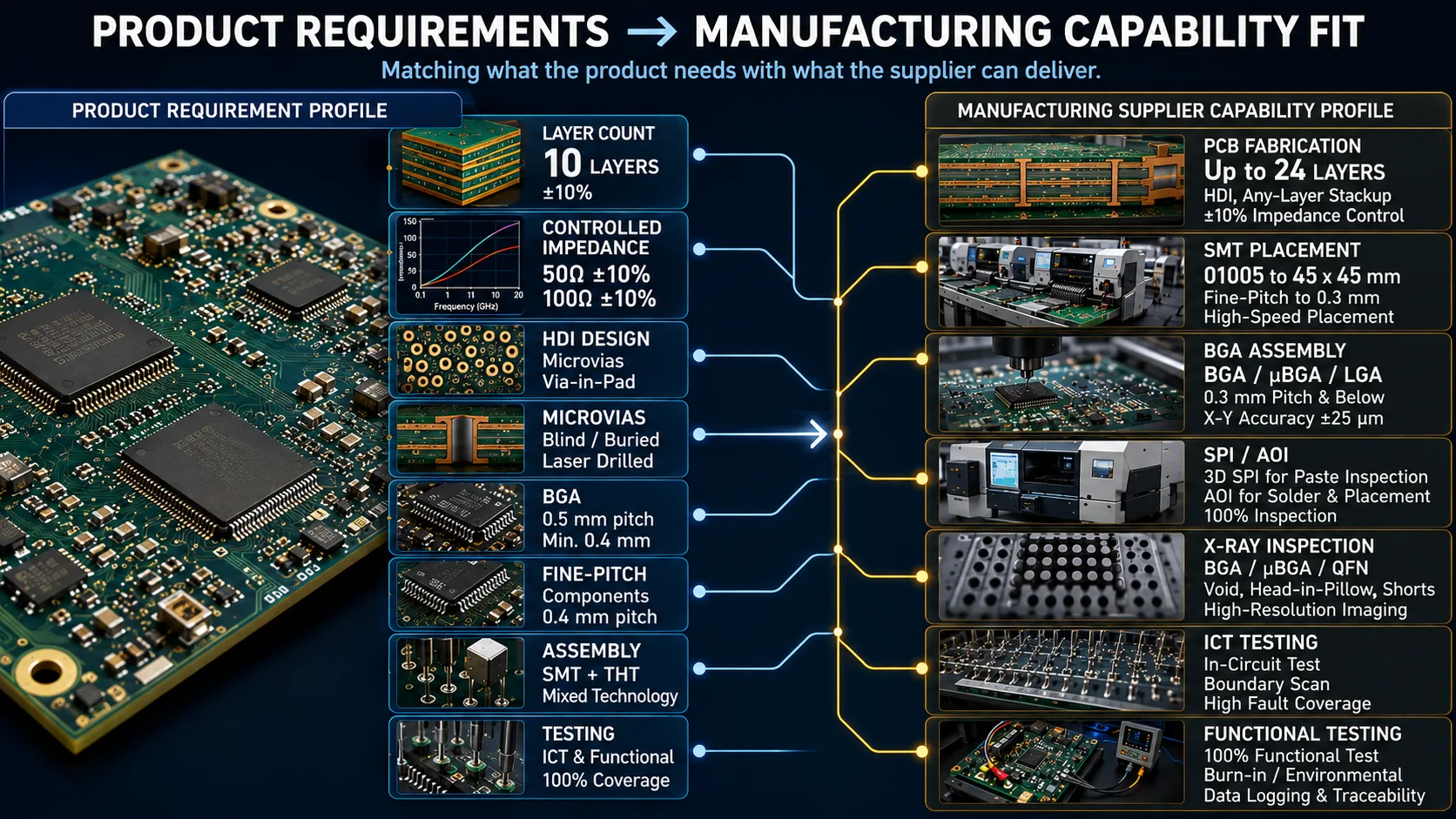
Supplier capability should be evaluated against the actual technical requirements and risks of the product—not against a generic capability list.
One of the most common supplier-selection mistakes is evaluating manufacturers before clearly defining the manufacturing requirement.
The right supplier depends on the product.
A simple two-layer control board and a high-density multilayer industrial controller may require completely different capabilities.
Before evaluating suppliers, document the actual manufacturing requirements.
PCB Requirements
Consider:
Assembly Requirements
Consider:
Component Requirements
Consider:
Testing Requirements
Consider:
Production Requirements
Define:
Only after these requirements are defined can supplier capability be evaluated properly.
2. First Clarify What the Supplier Actually Provides
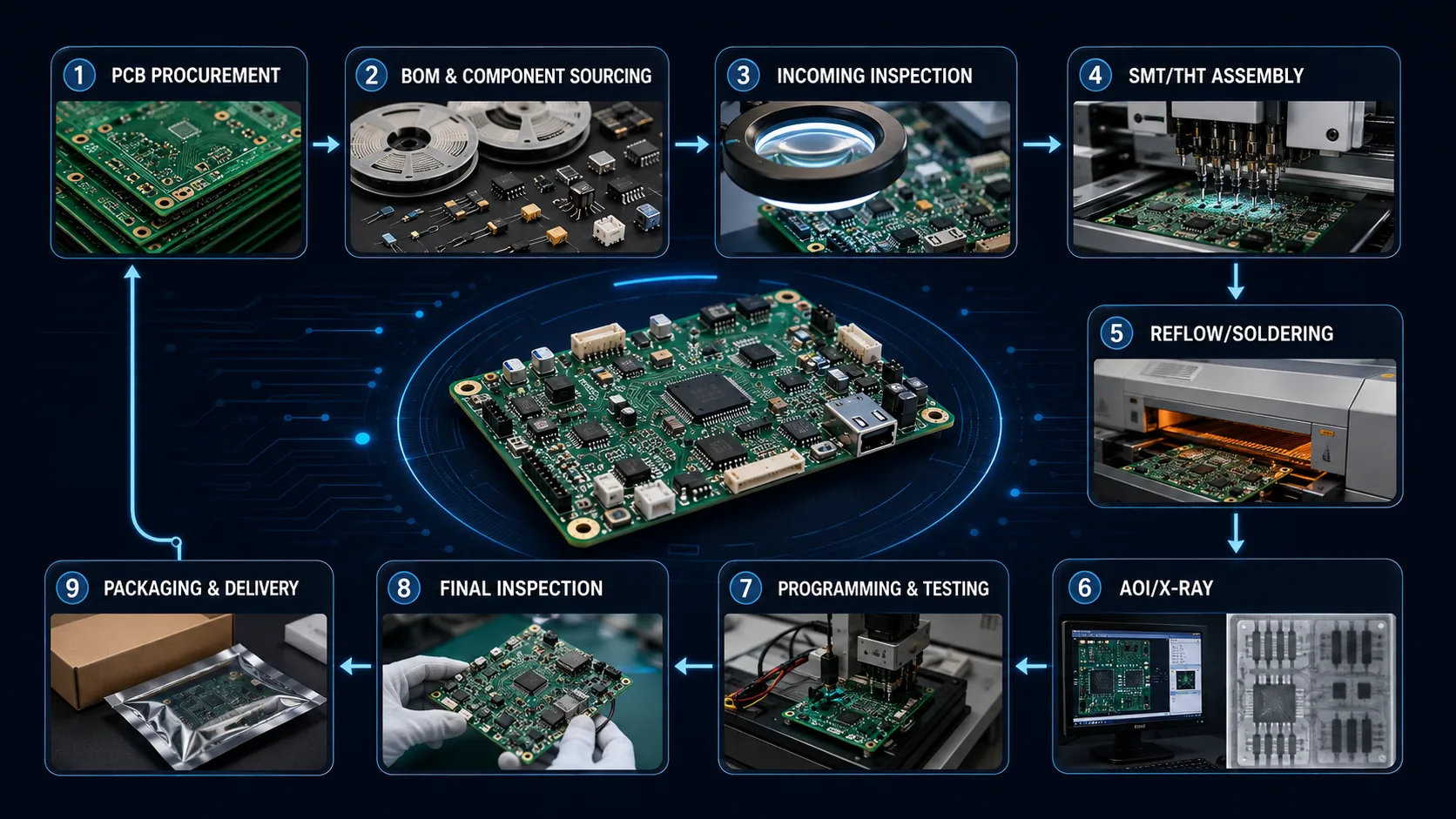
A turnkey PCBA relationship can cover the manufacturing chain from PCB procurement and component sourcing through assembly, testing and delivery. Confirm the exact scope with every supplier.
This becomes especially important when evaluating turnkey PCBA suppliers.
“Turnkey PCBA” does not necessarily mean exactly the same thing from one supplier to another.
A typical turnkey arrangement may include:
→ PCB procurement
→ BOM management
→ Component sourcing
→ Incoming inspection
→ SMT/THT assembly
→ Reflow/soldering
→ AOI/X-ray
→ Programming
→ Testing
→ Final inspection
→ Packaging
→ Delivery
But buyers should never assume that every supplier includes the same scope.
Ask:
“Please define everything included in your turnkey PCBA service.”
Clarify whether the quotation includes:
A supplier may call itself “turnkey” while subcontracting or excluding important operations.
The objective is therefore to establish the actual manufacturing responsibility matrix in writing.
3. Evaluate Technical Capability Against Your Actual Design
A supplier may advertise broad PCB/PCBA capabilities.
That does not automatically mean it is the right supplier for your product.
The critical question is:
Can the supplier reliably manufacture my specific design?
For example, if your PCB uses:
evaluate those capabilities specifically.
Look at:
4. Do Not Confuse Equipment With Manufacturing Capability
This is one of the most important distinctions in supplier evaluation.
A supplier may own sophisticated equipment.
But equipment alone does not guarantee manufacturing performance.
For example, owning an advanced SMT placement machine does not automatically demonstrate competence in:
Instead of asking only:
“What machines do you have?”
also ask:
“What process controls do you use to consistently produce the required result?”
The second question reveals considerably more about manufacturing maturity.
5. Evaluate PCB Fabrication Capability
Depending on the product, assess:
Ask the supplier to explain how its manufacturing process accommodates the critical characteristics of your PCB, rather than simply asking whether the capability exists.
6. Evaluate PCBA Process Capability
For assembly, assess:
The key question is not:
“Can you assemble a board?”
It is:
“Can you establish a repeatable production process for our board?”
7. Evaluate Quality as a Manufacturing Process
Quality should not be reduced to:
“Do you have ISO certification?”
Certifications can be useful indicators of organizational discipline, but supplier evaluation should go further.
Ask how quality is controlled throughout the manufacturing process.
Incoming
PCB Fabrication
Assembly
Final
A strong supplier should be able to explain not only where defects are detected, but how they are prevented.
8. Ask About Defect Handling and Corrective Action
Every manufacturing process can experience defects.
What differentiates suppliers is often how they respond.
Ask:
A supplier's response to a problem can reveal as much about its manufacturing maturity as its normal production process.
A mature process should connect:
→ Detection
→ Root Cause
→ Corrective Action
→ Verification
→ Prevention.
9. Evaluate Inspection and Testing Capability
Do not simply ask:
“Do you provide testing?”
Ask:
“Which defects can your current inspection and testing process detect?”
Potential methods include:
Different methods identify different categories of problems.
The correct inspection and test strategy should therefore be matched to the product.
10. Ask Specifically About BGA and Hidden Solder Joints
For assemblies containing BGA or other hidden solder joints, ask:
The appropriate inspection method depends on the package, process and product requirements.
11. Clarify the Test Strategy and Test Fixture
Testing capability is not just about owning a tester.
Ask:
For dedicated testing, fixture ownership and revision control should be defined before production begins.
12. Evaluate BOM and Component-Sourcing Capability
For turnkey PCBA, component sourcing can become one of the supplier's most important responsibilities.
Evaluate whether the supplier can manage:
A supplier that can manufacture the board but cannot reliably manage its component supply chain may not be suitable for long-term production.
13. Ask Who Owns the BOM
Ask:
“Will you manage component sourcing and BOM procurement, and who is responsible for BOM validation?”
A supplier should be able to explain how it handles:
The cheapest available component should not automatically become the selected component.
14. Ask How the BOM Is Validated
A good BOM review should go beyond checking whether a part number exists.
Ask whether the supplier checks:
Part Number Accuracy
Is the MPN valid and correctly specified?
Availability
Can the component be sourced reliably?
Lifecycle
Is it active, NRND or obsolete?
Package
Does the physical package match the PCB?
Quantity
Are sufficient quantities available?
Alternate Sources
Are technically suitable alternatives available?
Lead Time
Could any component constrain production?
15. Ask Where Components Are Sourced
For turnkey PCBA, component sourcing is a major supplier-qualification issue.
Ask:
You do not necessarily need every component to come from a single distributor.
You do need to understand how sourcing risk is controlled.
16. Control Component Substitutions
Ask:
“What happens if one of our approved components becomes unavailable?”
A controlled process should look approximately like:
Component Shortage
↓
Alternate Identified
↓
Technical Comparison
↓
Engineering Review
↓
Customer Approval
↓
BOM/Document Revision
↓
Controlled Production
An unapproved substitute should not enter production merely because it is available.
17. Examine Component Traceability
Depending on product requirements, determine whether the supplier can maintain:
For finished assemblies, traceability may also include:
The required depth should match the product, industry and applicable requirements.
18. Evaluate DFM and DFT Support
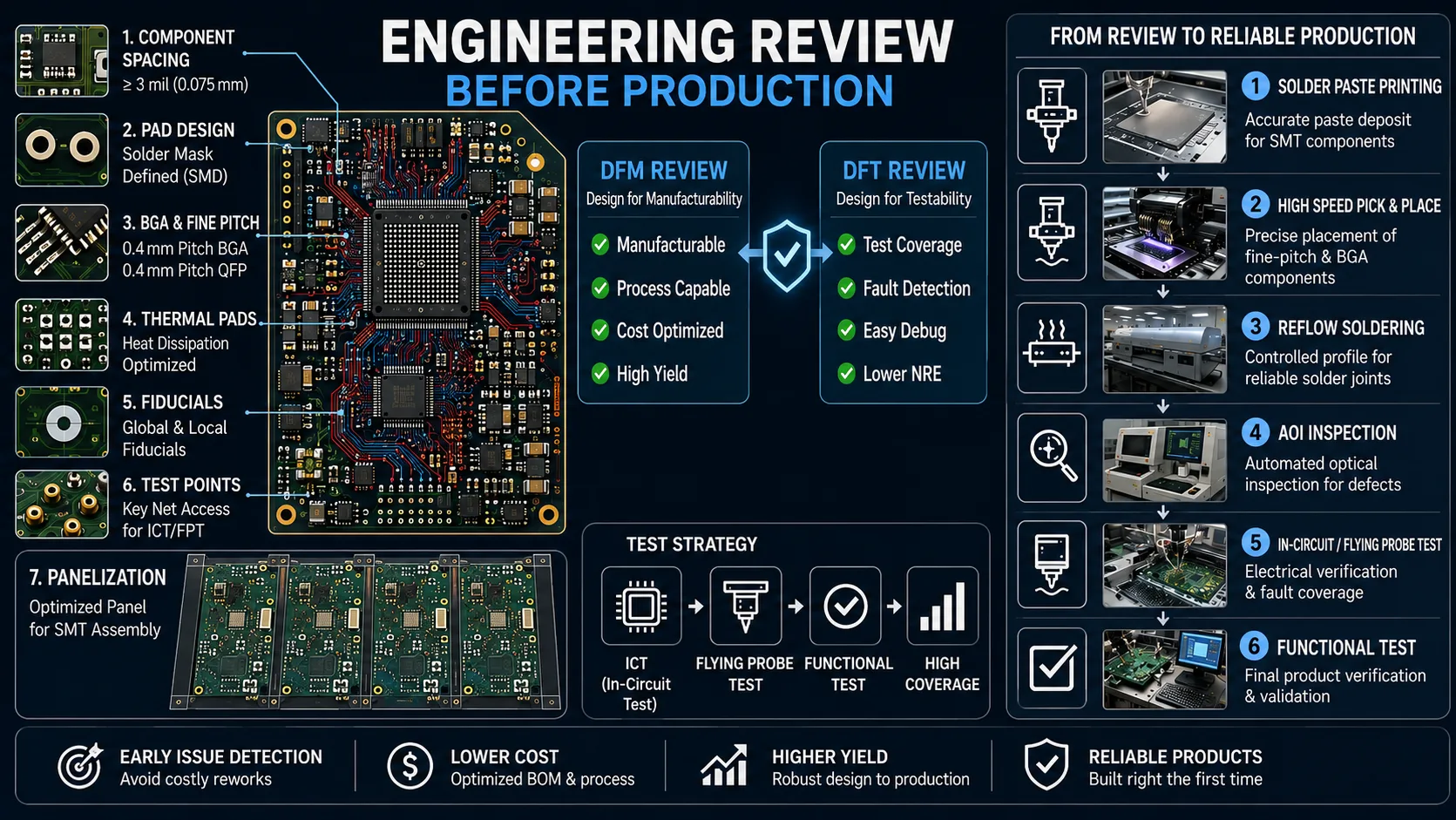
A capable manufacturing partner should identify manufacturability and testability risks before production begins.
A manufacturing supplier should ideally contribute engineering value before production.
Ask whether the supplier reviews:
DFM
DFT
A good DFM/DFT process should identify potential production problems before they become production problems.
19. Ask What Happens After You Send the Files
This is one of the best ways to understand actual supplier maturity.
Ask:
“Can you walk me through what happens from the moment you receive our Gerbers and BOM until the first production-ready PCBA is shipped?”
A structured answer may include:
→ Data Review
→ BOM Validation
→ DFM/DFT
→ Quotation
→ Procurement
→ PCB Fabrication
→ Assembly
→ Inspection
→ Testing
→ Pilot/NPI
→ Quality Release
→ Production
→ Shipment.
This question effectively reveals whether the supplier sees manufacturing as an integrated process or merely as an assembly transaction.
20. Evaluate NPI Capability
Prototype manufacturing and production manufacturing are not identical.
During NPI, the supplier may need to support:
Ask:
“What happens between receiving our design files and releasing the first production-ready process?”
The answer can reveal actual NPI maturity.
21. Can the Supplier Support Prototype Through Production?
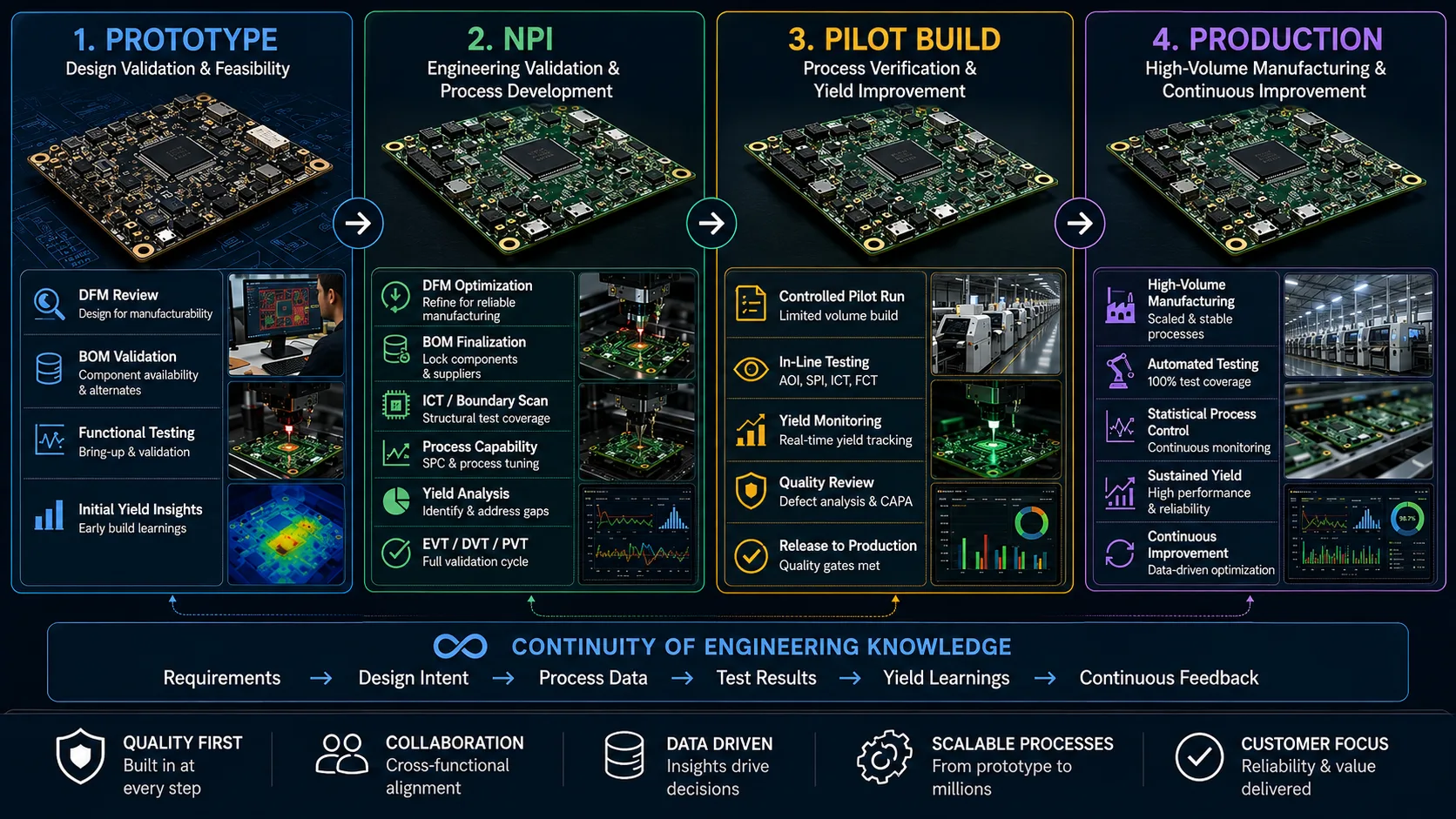
A strong manufacturing partner can maintain continuity as a product moves from prototype through production.
Ask:
“Can you support us from prototype through NPI and production?”
Then ask:
The goal is to avoid unnecessary supplier transitions as the product matures.
22. Assess Production Scalability
A supplier may be excellent for prototypes but unsuitable for production ramp.
Evaluate:
Prototype → NPI → Pilot → Production → Ramp
Ask about:
The objective is to avoid selecting a supplier that becomes a bottleneck as demand increases.
23. Ask About Real, Allocatable Capacity
Do not ask only:
“What is your factory capacity?”
Ask:
“What capacity can realistically be allocated to our product at our expected production volumes?”
Then ask:
A headline factory-capacity number is far less useful than capacity that can actually be committed to your program.
24. Evaluate Lead Time Realistically
Do not evaluate lead time based only on PCB fabrication.
Total PCBA lead time can include:
Engineering Review
→ Component Sourcing
→ PCB Fabrication
→ Assembly
→ Testing
→ Packaging
→ International Shipping
Ask:
“What assumptions is this lead time based on?”
Component availability can have a major effect on the final schedule.
Also ask for separate estimates for:
25. Examine Supply-Chain Resilience
A supplier's manufacturing capability is only one part of production continuity.
Evaluate how it handles:
A structured supply-chain risk-management approach can reduce production interruptions.
26. Ask What Happens If a Critical Component Is Late
Ask:
“If a critical component is delayed, what options will you present to us?”
Possible responses may include:
The important point is that the supplier should communicate the risk early.
27. Evaluate Geographic and Logistics Fit
For international production, consider:
The objective is not simply to choose the geographically closest supplier.
It is to determine whether the supplier's location and logistics model work effectively for your supply chain.
28. Understand What the Supplier Actually Controls
This is particularly important if the supplier uses qualified manufacturing partners.
Ask:
External manufacturing partners are not inherently problematic.
The critical issue is:
Who owns the final manufacturing outcome?
29. Manage Excess, Shortage and Inventory
Ask how the supplier handles:
These factors can materially affect total manufacturing cost.
30. Clarify Component and Product Ownership
Define ownership of:
Documenting ownership in advance helps prevent disputes later.
31. Evaluate Commercial Transparency
A supplier quotation should clearly identify:
The objective is not necessarily to force every supplier into an identical pricing format.
It is to understand what the quoted price actually represents.
32. Understand NRE, Tooling and Fixture Costs
Projects may require:
Ask:
“Which non-recurring engineering or tooling costs apply, and who owns the resulting tooling?”
This prevents unexpected costs later.
33. Understand MOQ at Multiple Levels
Ask separately about:
A supplier may accept a small assembly order while certain components still require larger procurement quantities.
34. Price Should Not Be the First Question
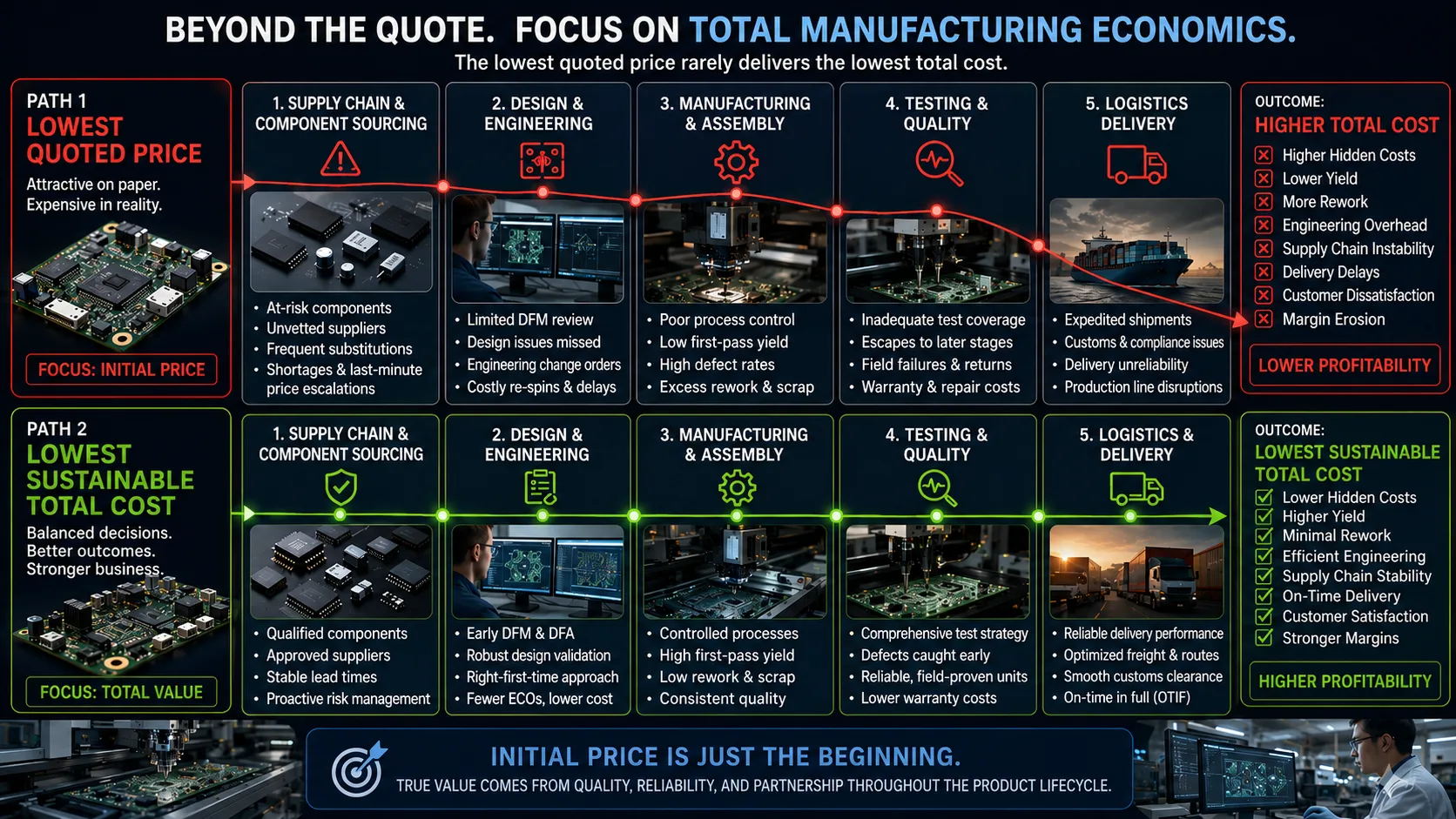
The lowest quotation is not necessarily the lowest sustainable manufacturing cost.
Price matters.
But it should be evaluated after understanding:
Scope + Quality + Engineering + Supply Chain + Testing + Delivery + Risk
A lower assembly price may still produce higher total costs through:
The objective is:
Lowest sustainable total cost at the required quality and delivery performance.
35. Evaluate Communication Before Production Starts
Communication during the RFQ stage can be an early indicator of how the supplier may operate later.
Observe:
A supplier that simply returns a price without understanding the design may create problems later.
36. Look for Engineering Questions, Not Just Commercial Questions
A strong supplier may ask:
These questions demonstrate that the supplier is evaluating the manufacturing problem, rather than merely processing an RFQ.
37. Ask Who Will Own the Project
Ask:
“Who will manage our project from quotation through production?”
Clarify access to:
For complex products, engineering communication should not become impossible once the purchase order is issued.
38. Ask Whether Engineers Can Speak Directly to Engineers
Ask:
“Can our engineers communicate directly with your manufacturing engineers during NPI and production?”
Direct technical communication can accelerate:
39. Ask for Evidence, Not Just Capability Claims
Instead of asking:
“Can you handle BGA?”
ask:
“Can you describe your BGA assembly and inspection process for this type of package?”
Instead of:
“Can you support production?”
ask:
“What is your approach to capacity planning and production ramp for our expected volume?”
Instead of:
“Can you manage component shortages?”
ask:
“What is your process for identifying, communicating and approving component alternatives?”
Specific questions produce more useful answers.
40. Ask for a Sample DFM Report
An anonymized DFM report can be particularly useful evidence.
Look for:
A supplier that provides meaningful DFM documentation is demonstrating engineering capability rather than simply claiming it.
41. Ask for Evidence of Similar Manufacturing Experience
You do not necessarily need confidential customer information.
Instead ask for relevant experience with:
The important word is:
Similar.
A supplier may have extensive manufacturing experience and still be a poor fit for your specific product.
42. Evaluate the Supplier's Response to Risk
A strong manufacturing partner should not be afraid to identify potential problems.
For example:
“This component has a long lead time.”
“This PCB feature may require additional fabrication review.”
“Functional testing will require a fixture.”
“This alternate component requires engineering approval.”
These are useful conversations.
A supplier that identifies risk early can help the customer make better decisions.
43. Conduct a Technical Review Before Final Selection
Before awarding production, conduct a structured review.
Design
Manufacturing
Supply Chain
Commercial
This review can reveal differences invisible in a simple quotation comparison.
44. Consider an Audit or Capability Assessment
For important production programs, a supplier audit or capability assessment may be appropriate.
Depending on product risk, review:
The depth of assessment should correspond to:
Product Risk + Production Importance.
45. Evaluate IP and Confidential-Information Protection
For international electronics companies, IP protection can be an important supplier-qualification criterion.
Ask about:
Requirements should match the sensitivity of the product.
46. Evaluate Long-Life Product Support
Industrial, medical, infrastructure and other long-life products require a different supplier-management approach from short-lifecycle products.
Ask:
47. Evaluate Long-Term Partnership Potential
If the product will remain in production for years, ask:
The best supplier for the first 100 boards may not necessarily be the best partner for the next 100,000.
48. Ask What Happens After the First Production Run
Ask:
“What ongoing support do you provide after production starts?”
This may include:
The strongest supplier relationships evolve beyond the first purchase order.
49. Red Flags During Supplier Evaluation
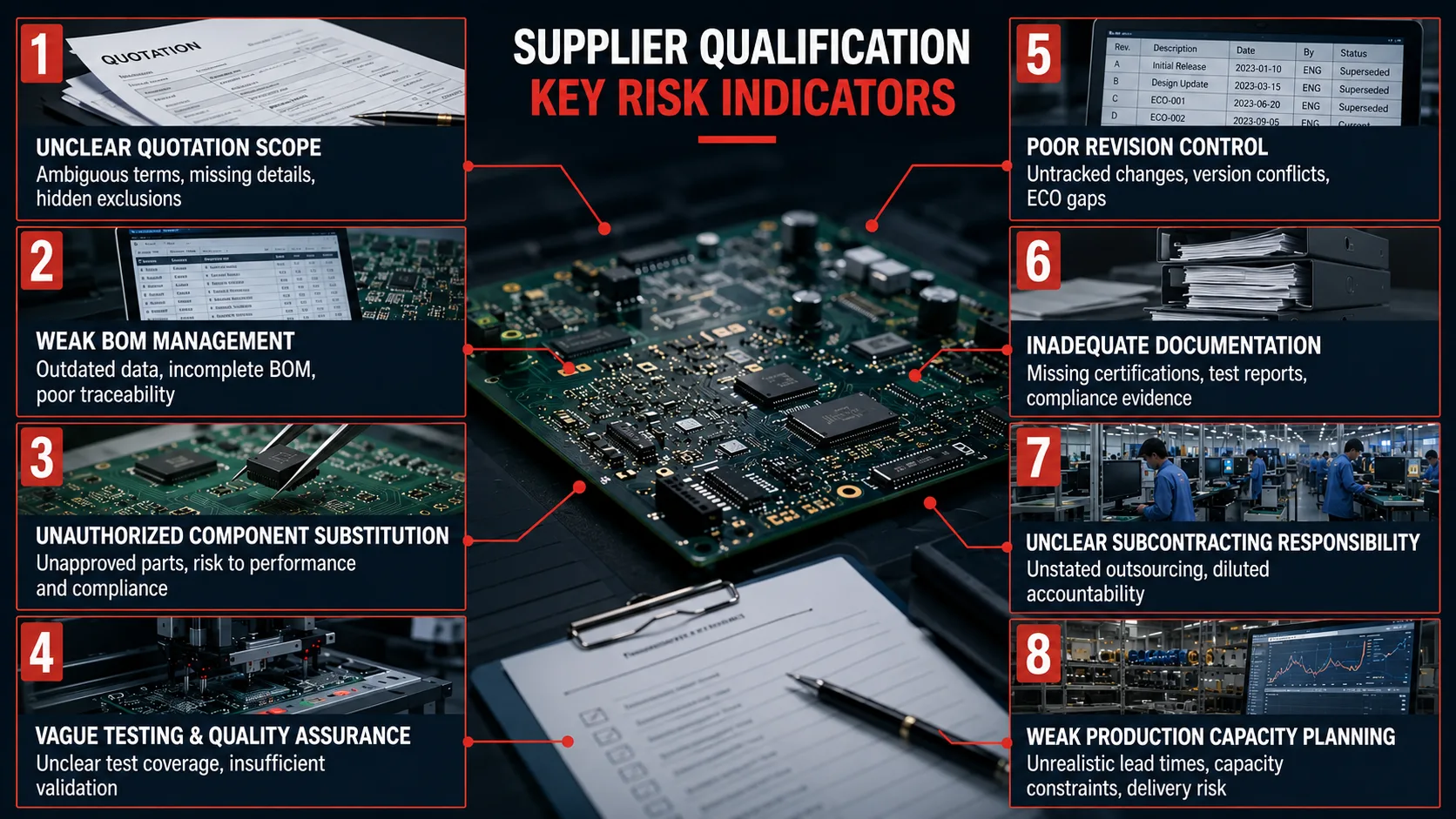
Supplier red flags often appear in scope definition, technical communication, BOM control, testing, documentation and risk management.
Be cautious if a supplier:
1. Gives an unusually low quotation with unclear assumptions
The scope may not be equivalent.
2. Asks no meaningful technical questions
The RFQ may be treated primarily as a price exercise.
3. Has unclear component sourcing
This can create substantial turnkey-PCBA supply-chain risk.
4. Has no clear substitution process
This creates engineering and quality risk.
5. Provides a vague testing scope
“100% tested” is meaningless unless the test method is defined.
6. Cannot explain subcontracted processes
The buyer should understand who owns quality and delivery.
7. Provides lead time without assumptions
Component availability and production capacity can materially affect schedules.
8. Has poor documentation
Weak documentation can become a major problem during NPI and production.
9. Treats BOM sourcing purely as purchasing
Component availability does not necessarily mean technical suitability.
10. Avoids discussing yield or defects
Mature suppliers should understand how manufacturing variation is controlled.
11. Cannot explain revision control
This creates the risk of manufacturing the wrong product configuration.
12. Focuses entirely on price
The cheapest quotation is not necessarily the lowest-risk manufacturing solution.
50. Use a Structured Supplier Evaluation Scorecard
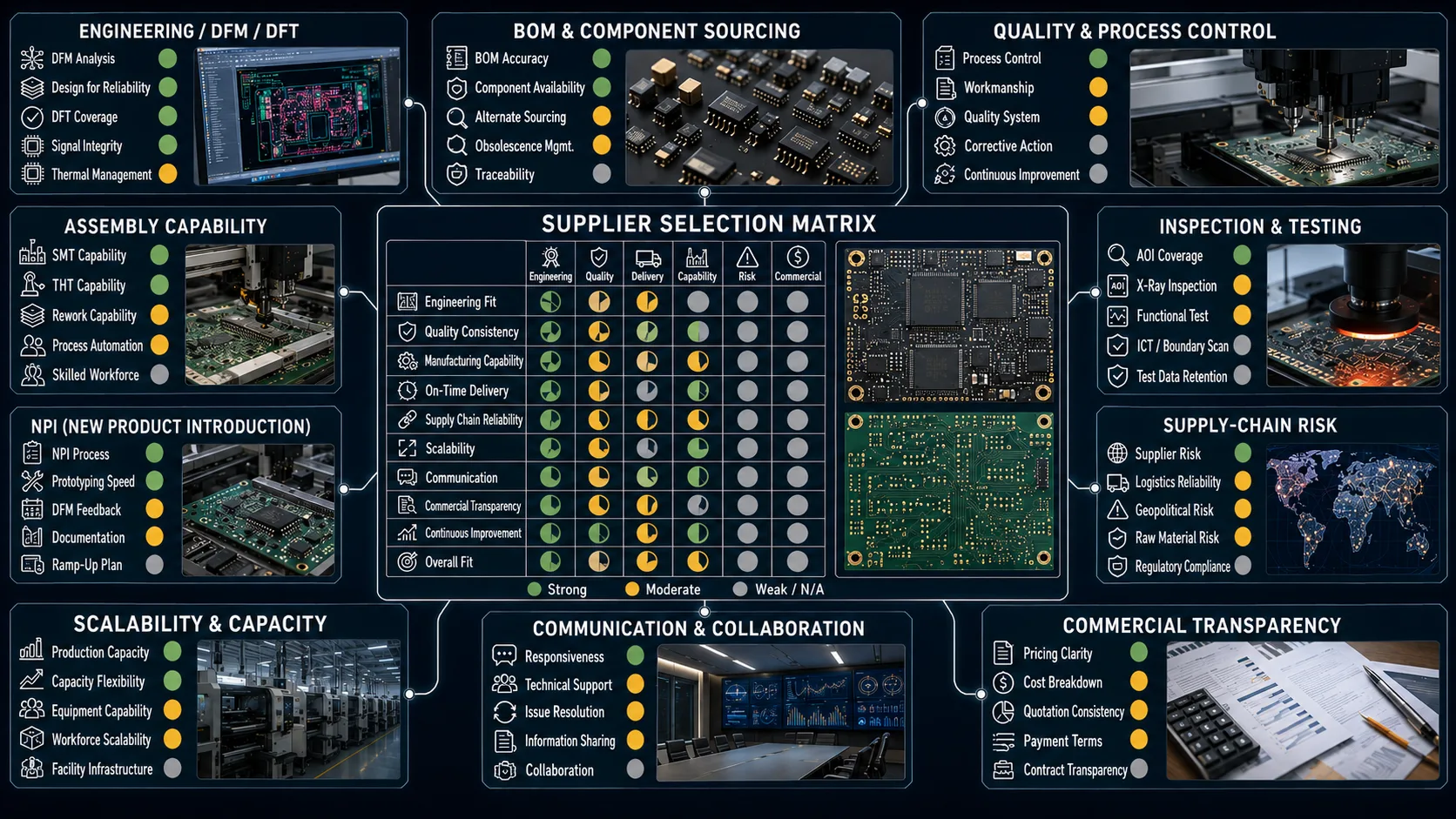
A structured supplier scorecard makes PCB/PCBA supplier selection more objective, transparent and repeatable.
A structured scorecard reduces the risk of choosing a supplier because of one attractive quotation.
A useful starting framework is:
| Evaluation Area | Suggested Weight |
|---|---|
| Engineering / DFM / DFT | 15% |
| BOM & Component Sourcing | 15% |
| Quality & Process Control | 15% |
| Assembly Capability | 10% |
| Inspection & Testing | 10% |
| NPI / Prototype / Pilot Capability | 10% |
| Supply-Chain Risk Management | 10% |
| Production Scalability | 5% |
| Communication / Project Management | 5% |
| Commercial Competitiveness | 5% |
These are starting weights, not universal requirements.
For a highly complex product, engineering and testing may deserve greater weight.
For a high-volume product, scalability and supply-chain capability may become more important.
The purpose is not to create a mathematically perfect supplier ranking.
It is to make the decision:
Transparent + Repeatable + Defensible.
51. The 40 Questions to Ask a Turnkey PCBA Supplier
Rather than losing the detailed questionnaire from the second article, I recommend retaining it as a practical buyer tool inside the master article.
Technical Capability
Quality & Testing
BOM & Supply Chain
Engineering & NPI
Production
Commercial & Logistics
This combines the detailed questions from both original articles without maintaining two competing checklists.
52. The 10 Questions That Matter Most
If a sourcing team does not have time to ask all 40 questions during the first discussion, start here:
These provide a surprisingly effective first-level supplier screen.
53. The Five Questions That Matter Most
For an even faster initial screen, ask:
1. Can this supplier reliably manufacture our design?
Technical fit
2. Can they control quality consistently?
Manufacturing reliability
3. Can they secure and manage our BOM?
Supply-chain capability
4. Can they support us from prototype through production?
Lifecycle capability
5. Will they provide predictable total cost and delivery?
Commercial and operational fit
If the answer to any of these remains unclear, the supplier requires further evaluation.
54. For International Buyers, Add These Questions
International manufacturing introduces another layer of supplier qualification.
Ask:
International manufacturing involves coordination, documentation and predictability—not just production.
55. India as a Sourcing Option: Evaluate the Supplier, Not Just the Country
For buyers evaluating India—or any manufacturing geography—the same principle applies:
Do not select a manufacturing destination solely because of country-level advantages.
Evaluate the individual supplier's:
A capable Indian PCBA partner can potentially provide an attractive combination of manufacturing capability, engineering support and supply-chain flexibility.
But supplier qualification must determine whether that potential translates into a suitable manufacturing relationship for the specific product.
56. Practical Final Supplier Qualification Checklist
Before selecting a supplier, confirm:
Technical
☐ PCB technology matches requirements☐ Assembly capability matches component packages☐ DFM/DFA support available☐ DFT support available☐ Required testing available☐ NPI capability demonstrated
Quality
☐ Quality system reviewed☐ Inspection process understood☐ Test process understood☐ Traceability understood☐ Corrective-action process understood☐ Yield/rework controls understood
BOM & Components
☐ BOM validation process established☐ Critical components identified☐ Lifecycle risks reviewed☐ Alternate approval process defined☐ Sourcing channels understood☐ Counterfeit-risk controls understood
Production
☐ Prototype capability confirmed☐ NPI process reviewed☐ Pilot capability assessed☐ Production capacity evaluated☐ Ramp capability assessed☐ Lead time validated☐ Recurring production capability confirmed
Commercial
☐ Quote scope normalized☐ Assumptions and exclusions understood☐ NRE/tooling identified☐ MOQ understood☐ Component ownership defined☐ Logistics understood☐ Payment terms reviewed☐ Quality/warranty responsibility understood
Relationship
☐ Communication is responsive☐ Technical discussions are meaningful☐ Project owner identified☐ Engineering access available☐ Escalation process is clear☐ Long-term production fit is credible
These are directly aligned with the qualification checklist in the source material.
57. Supplier Selection Is Ultimately a Risk-Management Decision
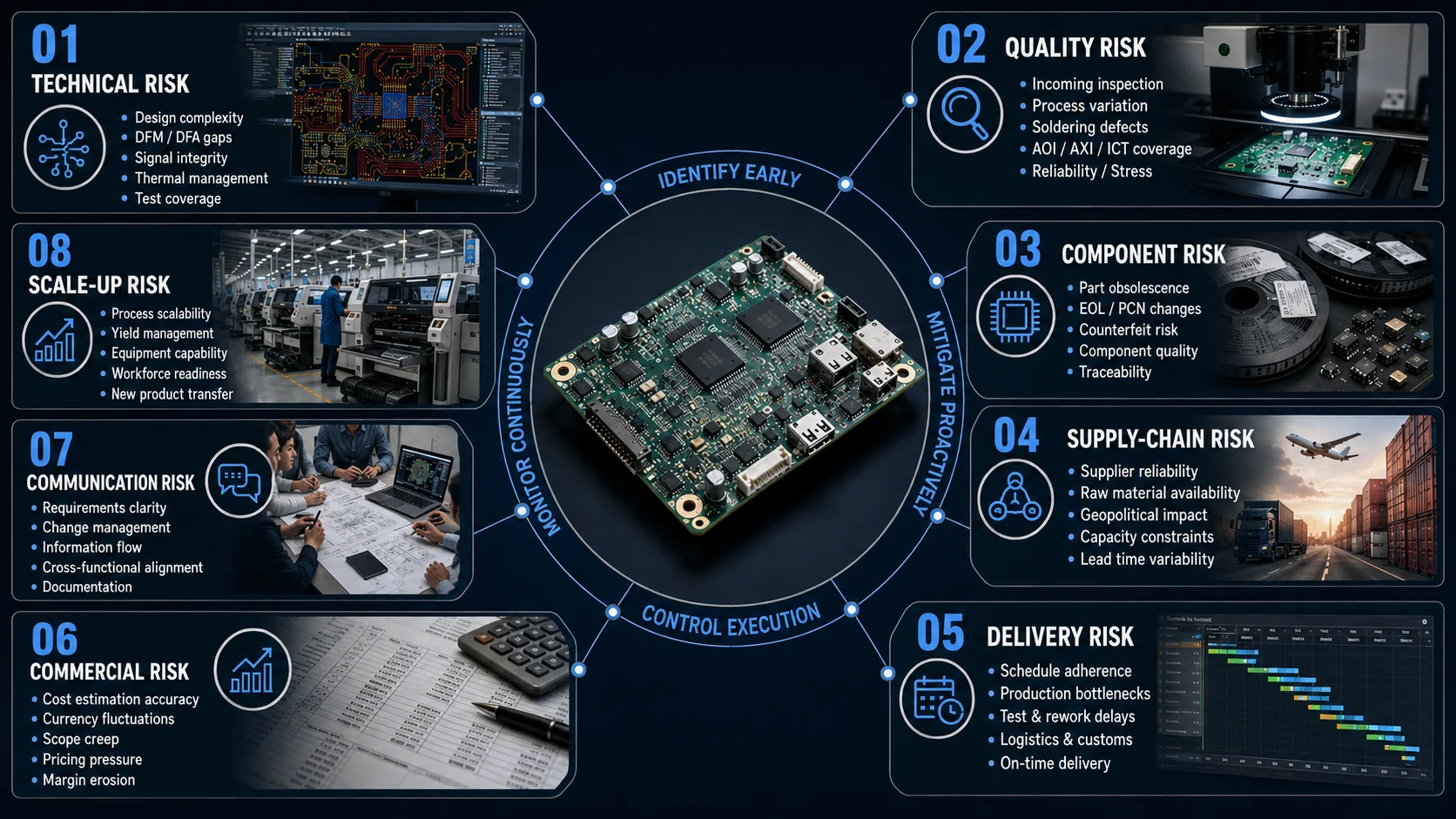
The goal of supplier qualification is not zero risk—it is understanding and controlling the risks that matter.
Every supplier introduces some combination of:
The objective is not necessarily to find a supplier with zero risk.
That is rarely realistic.
The objective is to determine:
Which risks exist, how significant are they, and does the supplier have credible processes to manage them?
This is a much stronger basis for supplier selection than price alone.
58. What Makes a Strong PCB/PCBA Manufacturing Partner?
A strong manufacturing partner should be able to connect:
Engineering
↓
DFM/DFA + DFT
↓
BOM & Supply Chain
↓
Component Validation
↓
PCB Fabrication
↓
PCBA
↓
Inspection & Testing
↓
NPI
↓
Production Ramp
↓
Ongoing Manufacturing Support
The value is not simply in having machines.
It is in being able to manage the complete manufacturing process reliably and transparently.
59. What a Strong Turnkey PCBA Supplier Should Be Able to Demonstrate
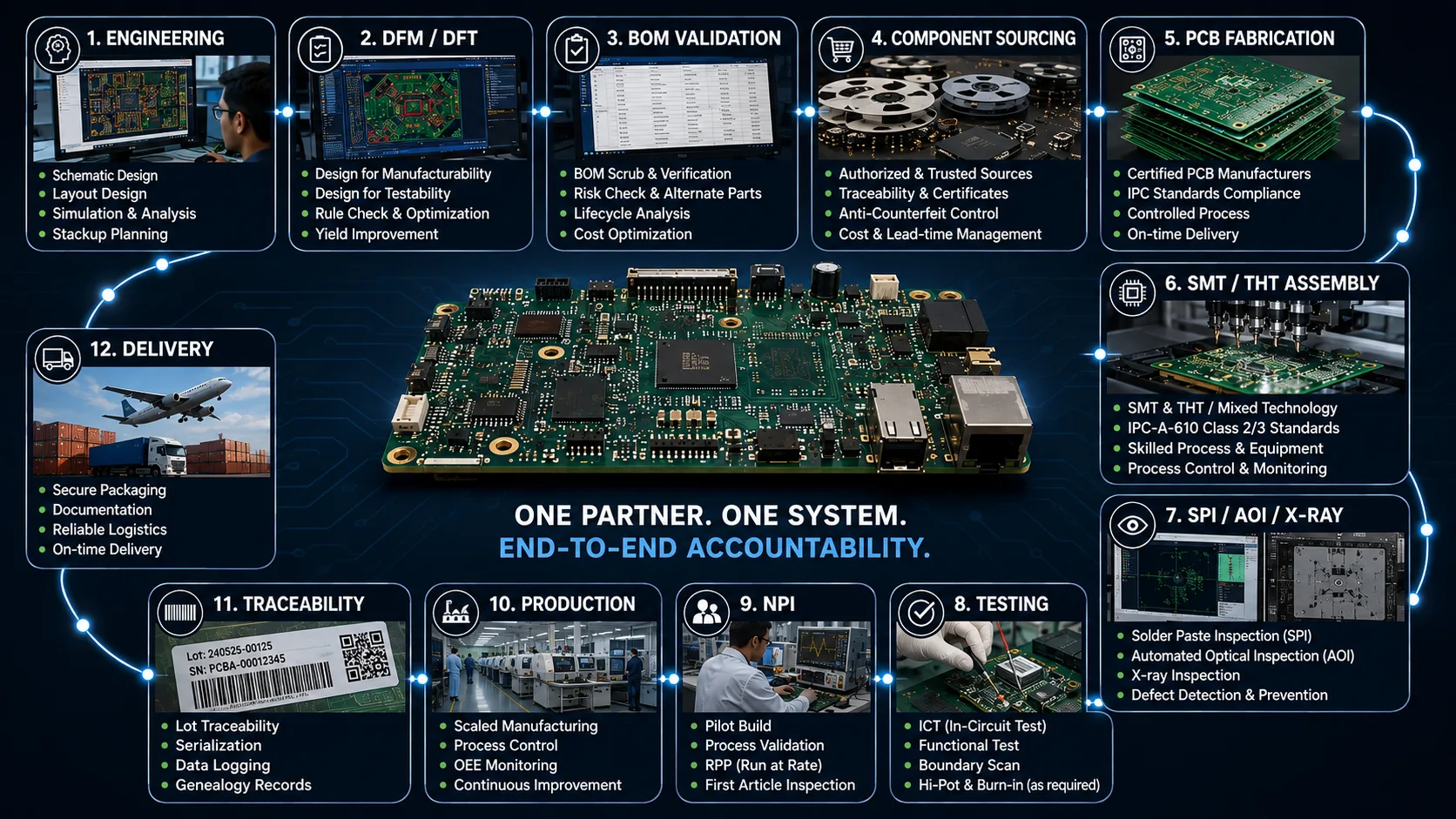
A true turnkey PCBA capability connects engineering, sourcing, manufacturing, quality, testing and delivery into one controlled system.
By the end of qualification, you should have evidence that the supplier can manage:
Engineering
Design → DFM → DFT
Supply Chain
BOM → Sourcing → Availability → Alternates
Manufacturing
PCB → SMT/THT → Reflow → Process Control
Quality
SPI/AOI/X-ray → Inspection → Corrective Action
Testing
Programming → ICT/Flying Probe → Functional Testing
NPI
Prototype → Pilot → Yield → Production Release
Production
Capacity → Scheduling → Traceability → Delivery
This is what turns “turnkey” from a marketing term into an actual manufacturing capability.
60. QUADRIONIX PERSPECTIVE
For international electronics buyers, supplier selection becomes easier when PCB fabrication, component sourcing, PCBA, testing and production support are evaluated as parts of one connected manufacturing requirement.
At QUADRIONIX, the objective is to support that decision with a manufacturing approach that connects:
→ PCB
→ BOM
→ Components
→ Assembly
→ Testing
→ Production
rather than treating each requirement as an isolated transaction.
For turnkey PCBA, that philosophy extends across:
→ Engineering
→ BOM & Supply Chain
→ PCB Fabrication
→ Assembly
→ Inspection
→ Testing
→ NPI
→ Production
→ Quality
→ Delivery.
The goal is not simply to answer:
“Who can manufacture our board?”
It is:
“Who can manufacture our board reliably, manage the associated supply-chain risks and support us as the product moves into production?” Evaluate the design. Qualify the supplier. Understand the risks. Validate the economics. Then scale with confidence.
61. Final Takeaway
Evaluating a PCB/PCBA manufacturing supplier should be treated as a structured engineering and procurement decision.
The strongest evaluation considers:
Technical Capability
Can the supplier manufacture the actual design?
Quality
Can it consistently meet the required standards and specifications?
BOM & Component Sourcing
Can it secure, validate and manage the required components?
Engineering & NPI
Can it help move the product from design into repeatable production?
Testing
Can it detect the failure modes relevant to the product?
Supply Chain
Can it manage component and production continuity?
Capacity
Can it support the required production volume and future ramp?
Delivery
Can it meet the complete schedule—not merely the PCB fabrication lead time?
Commercial Transparency
Can the buyer clearly understand total cost, assumptions and exclusions?
Long-Term Fit
Can the supplier support the product throughout its manufacturing lifecycle?
The right supplier is therefore not necessarily:
the company with the lowest quotation.
It is the supplier that provides the strongest combination of:
Technical capability + Quality + Engineering support + Supply-chain reliability + Delivery + Commercial transparency.
That is what turns a PCB manufacturer into a manufacturing partner.
Ready to manufacture your electronics project?
Upload your Gerber files & BOM for automated DFM review, engineering feedback, and guaranteed delivery timelines.