How to Compare PCB/PCBA Supplier Quotes: What Buyers Should Look Beyond the Price
A Practical Guide for Engineering, Procurement and Sourcing Teams Evaluating PCB and PCBA Manufacturing Quotes
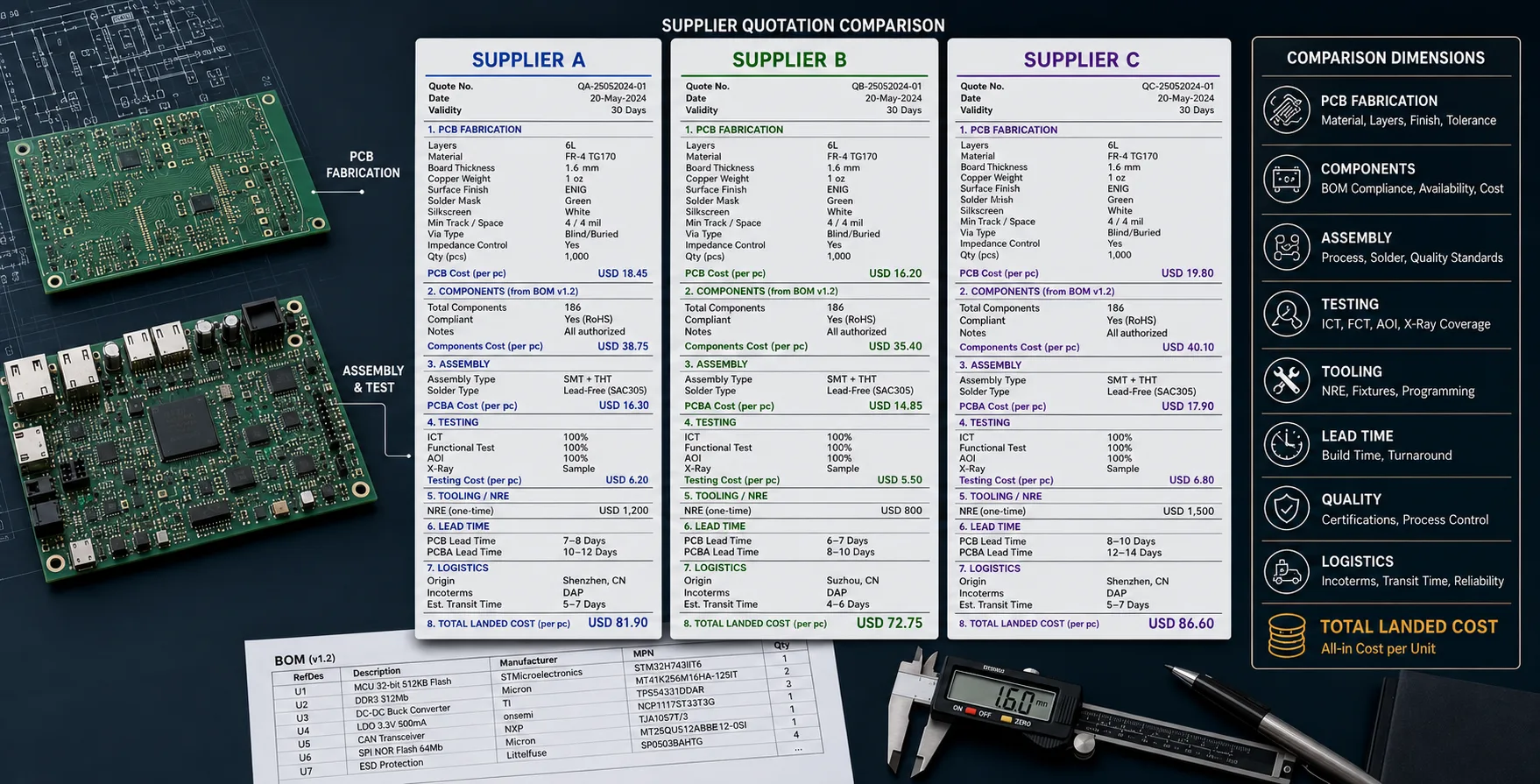
Comparing PCB and PCBA supplier quotations based on cost quality lead time testing and total landed cost
When an electronics company requests quotations from several PCB or PCBA manufacturers, the result can sometimes look deceptively simple.
Supplier A:
$8.40
Supplier B:
$10.20
Supplier C:
$13.10
At first glance, Supplier A appears to be the obvious choice.
But is it?
Not necessarily.
A PCB/PCBA quotation is only meaningful when the three suppliers are quoting the same technical scope, material specification, component scope, testing requirements, commercial terms and delivery conditions.
A lower quotation can sometimes represent a genuine cost advantage.
It can also represent:
This is why experienced sourcing teams do not simply ask:
"Who is cheapest?"
They ask:
"Which supplier provides the best combination of technical compliance, quality, delivery, supply-chain reliability and total landed cost for the required scope?"
1. Why PCB/PCBA Quotes Can Differ So Much
Two manufacturers can receive the same RFQ and return substantially different prices.
That does not automatically mean that one supplier is overcharging.
The difference may come from how each supplier interprets the requirement.
For example, a PCBA quotation may depend on:
Therefore, before comparing prices, establish whether the quotations are actually like-for-like.
2. The First Rule: Normalize the Scope Before Comparing Prices
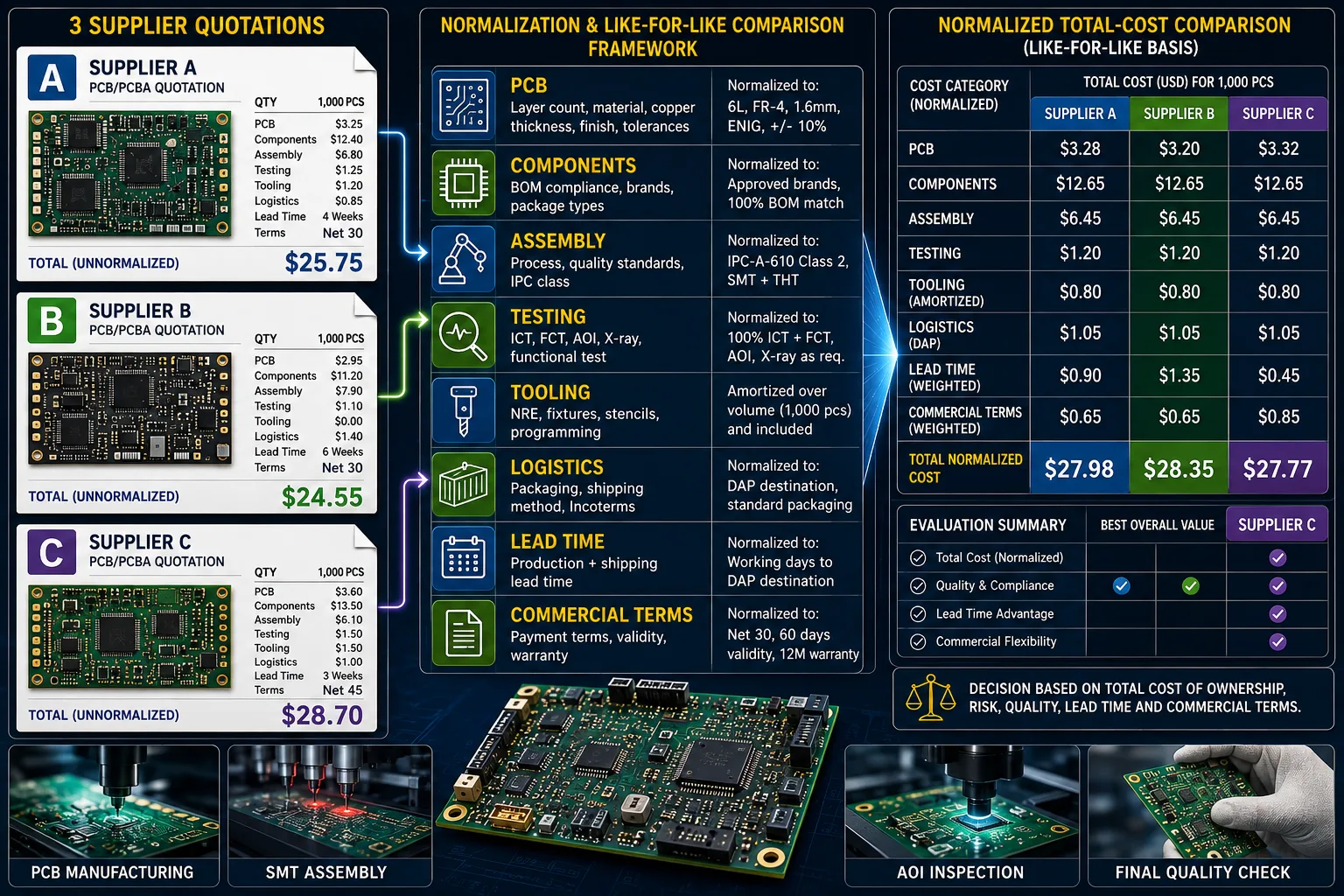
PCB/PCBA quotations should be normalized to the same technical and commercial scope before suppliers are compared on price.
This is the single most important step.
Create a comparison table with the same requirements for every supplier.
At minimum, normalize:
PCB
Assembly
Components
Commercial
Only after normalizing these items does price comparison become meaningful.
3. Understand What the PCB Price Actually Includes
A PCB fabrication quotation should be reviewed line by line.
Check whether the price includes:
For example, one supplier may include tooling within the unit price while another lists tooling separately.
Both quotations may ultimately have similar total costs.
The headline unit price alone does not tell the full story.
4. Compare PCB Material Specifications Carefully
Material differences can create significant quotation differences.
Check:
A quotation for a standard FR-4 board should not be directly compared against one using a specialized high-speed laminate unless the specification requires it.
Likewise, simply writing:
"FR-4"
may not provide enough information for a demanding application.
The material specification should match the engineering requirement.
5. Surface Finish Can Affect the Quote
Common PCB surface finishes include:
They have different cost and application implications.
Therefore, if Supplier A quotes HASL and Supplier B quotes ENIG, the prices are not directly comparable.
The buyer should first establish:
What surface finish does the design actually require?
6. Copper Weight Matters
Copper weight affects both performance and manufacturing cost.
Check whether the quotation assumes:
A supplier quoting lower-cost standard copper construction may not be equivalent to another supplier quoting heavier copper required by the design.
7. Controlled Impedance Can Change the Scope
If the PCB contains controlled-impedance traces, confirm whether the quotation includes:
A low-cost quotation that does not include the required impedance-control process should not be compared directly with a quotation that does.
8. PCBA Quotes Are More Complicated Than PCB Quotes
A PCBA quotation contains multiple cost layers.
A useful model is:
PCBA Cost = PCB + Components + Assembly + Testing + Tooling/NRE + Logistics + Other Services
But each of those categories can contain additional assumptions.
For example:
Components
Assembly
Testing
This is why a PCBA quotation requires significantly more scrutiny than a bare-board quotation.
9. Component Pricing Can Dominate PCBA Cost
For many PCB assemblies, the PCB itself represents only a fraction of the total product cost.
The BOM can be much more significant.
Therefore, compare:
A supplier offering a lower PCBA price because it assumes cheaper or different components may not be providing the same product.
10. Verify the BOM Before Comparing PCBA Prices
One of the most important questions to ask is:
"Are you quoting exactly the same BOM revision?"
Confirm:
Even a single major component substitution can materially affect the quotation.
11. Watch for "Equivalent" Components
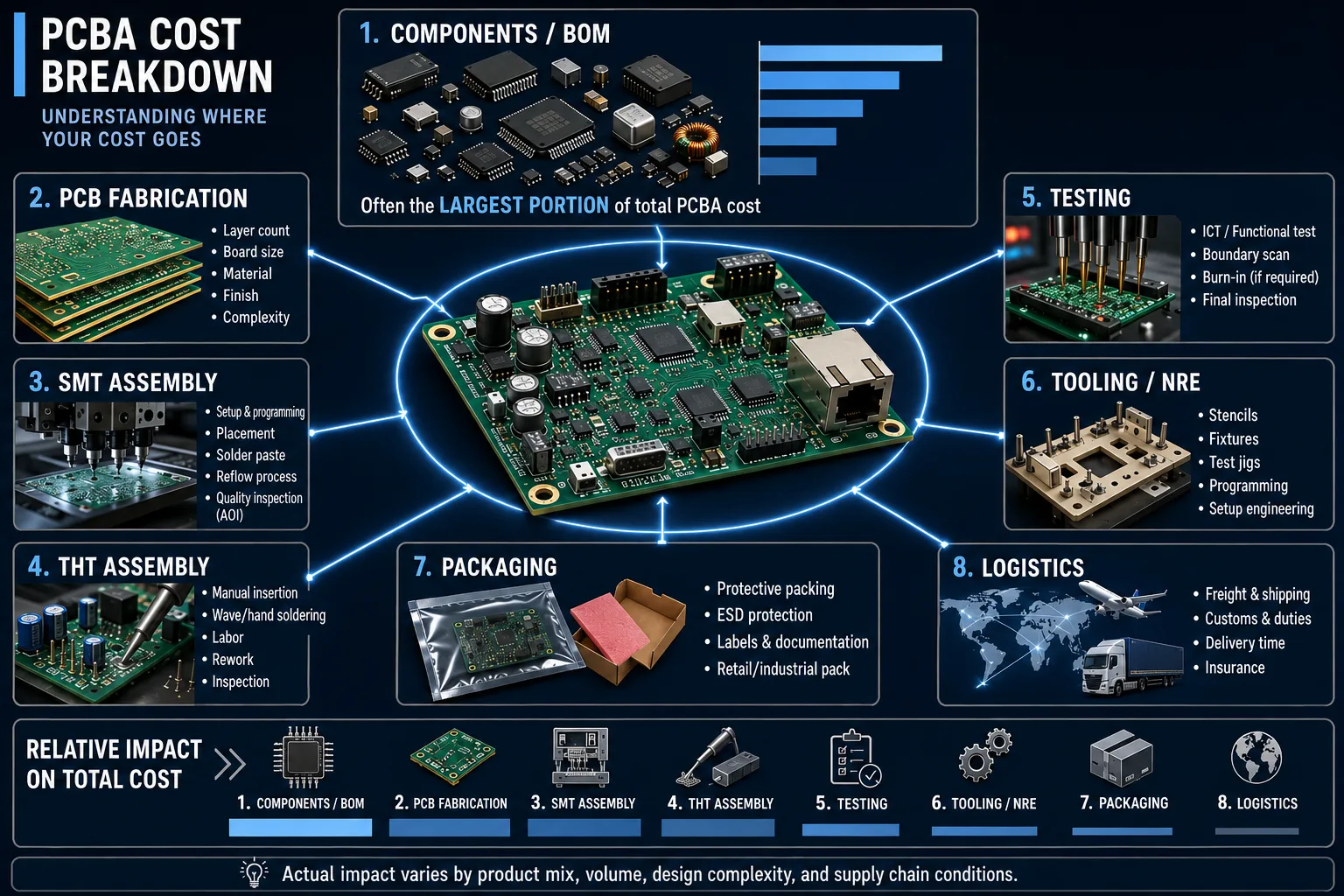
A PCBA quotation is a combination of several cost elements, with the BOM often representing a significant portion of total manufacturing cost.
"Equivalent" does not necessarily mean "identical."
An alternate component can have differences in:
Therefore:
A lower PCBA quotation achieved through unapproved component substitution is not necessarily a lower-cost equivalent solution.
The alternate must be technically validated and approved.
12. Authorized vs Independent Component Sourcing
When components are included in a turnkey PCBA quotation, ask how they will be sourced.
Possible channels include:
These sourcing channels can have different implications for:
The lowest component price should not automatically win.
For critical components, sourcing integrity may be more important than a small unit-price difference.
13. Ask About Component Traceability
For important assemblies, ask whether the supplier can provide appropriate traceability.
Depending on the product, this may include:
Traceability becomes particularly important for:
The exact requirements depend on the product and applicable standards.
14. Check Whether Testing Is Included
A PCBA quotation should clearly identify testing scope.
Possible services include:
Do not assume that "tested PCBA" means the same thing across suppliers.
Ask:
What exactly is tested, how is it tested, and what is included in the quoted price?
15. Functional Testing Can Be a Separate Cost
Functional testing can require:
Therefore, if one supplier includes functional testing and another quotes only AOI, the prices are not directly comparable.
16. Tooling and NRE: The Costs That Can Hide Outside the Unit Price
Common additional costs may include:
Ask suppliers to separate:
One-time costs
from
Recurring unit costs.
This makes supplier comparison much easier.
17. Prototype Pricing vs Production Pricing
A prototype quotation should not automatically be compared with a mass-production quotation.
Prototype quantities often have:
Production pricing benefits from:
Therefore, compare quotations at the same quantity and production stage.
18. Quantity Breaks Can Change the Decision
Request pricing at meaningful production volumes.
For example:
| Quantity | Supplier A | Supplier B | Supplier C |
|---|---|---|---|
| Prototype | — | — | — |
| 100 | — | — | — |
| 500 | — | — | — |
| 1,000 | — | — | — |
| 5,000 | — | — | — |
The supplier that is cheapest at 100 units may not be cheapest at 5,000.
This is particularly relevant when evaluating long-term manufacturing partnerships.
19. Lead Time Is Part of the Quote
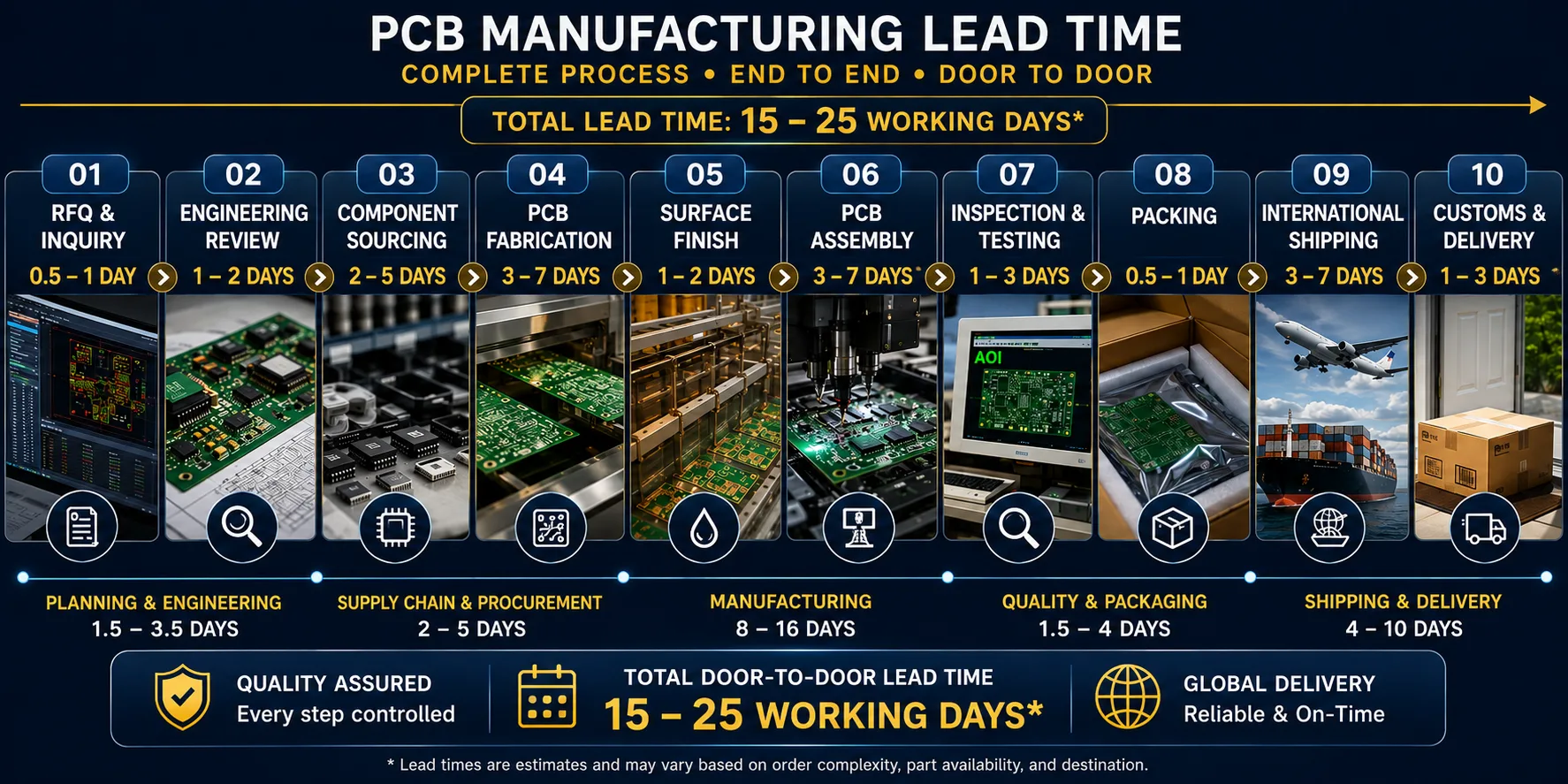
For international PCB/PCBA sourcing, total door-to-door lead time is more meaningful than PCB fabrication time alone.
A quotation should not be evaluated only on price.
Compare:
A supplier offering a lower unit price but requiring substantially longer delivery may create higher overall business cost.
20. Compare Incoterms and Logistics
Two suppliers can quote the same unit price while offering very different landed costs.
Check:
The exact commercial structure should be clearly documented.
For international buyers, compare the landed cost, not simply the factory price.
21. Taxes and Duties Should Be Understood
Depending on the sourcing country and transaction structure, the buyer may incur:
These should be identified separately where applicable.
A quotation that appears cheaper at the factory level may not remain cheaper after import and logistics costs are included.
22. Payment Terms Affect Total Commercial Risk
Compare:
Payment terms can materially affect working capital.
Therefore, the best quotation is not necessarily the one with the lowest unit price.
It may be the quotation offering the best overall combination of:
Price + risk + payment structure + delivery + quality.
23. Quote Validity Matters in Component-Heavy PCBA
Component pricing can change rapidly.
Therefore, a PCBA quotation should state:
A quote valid for a short period may be entirely reasonable for a component-heavy assembly.
The buyer should understand what happens when the quote expires.
24. Ask What Happens if Components Become Unavailable
This is especially important for production programs.
Ask:
What happens if a quoted component becomes unavailable between quotation and purchase?
Possible approaches include:
The supplier's change-control process matters.
25. Quality Should Be Compared as a Cost Factor
Two quotations may differ because the suppliers operate different quality-control processes.
Evaluate:
The objective is not necessarily to select the supplier with the greatest number of inspections.
It is to select the process appropriate for the product's risk.
26. Yield and Rework Should Not Be Ignored
Ask how the supplier handles:
For high-volume production, even a small difference in manufacturing yield can materially affect total cost.
This is another reason that:
Quoted unit price ≠ true manufacturing cost.
27. Compare Warranty and Quality Responsibility
Clarify:
These terms can become extremely important when production volumes increase.
28. Review the Supplier's Engineering Capability
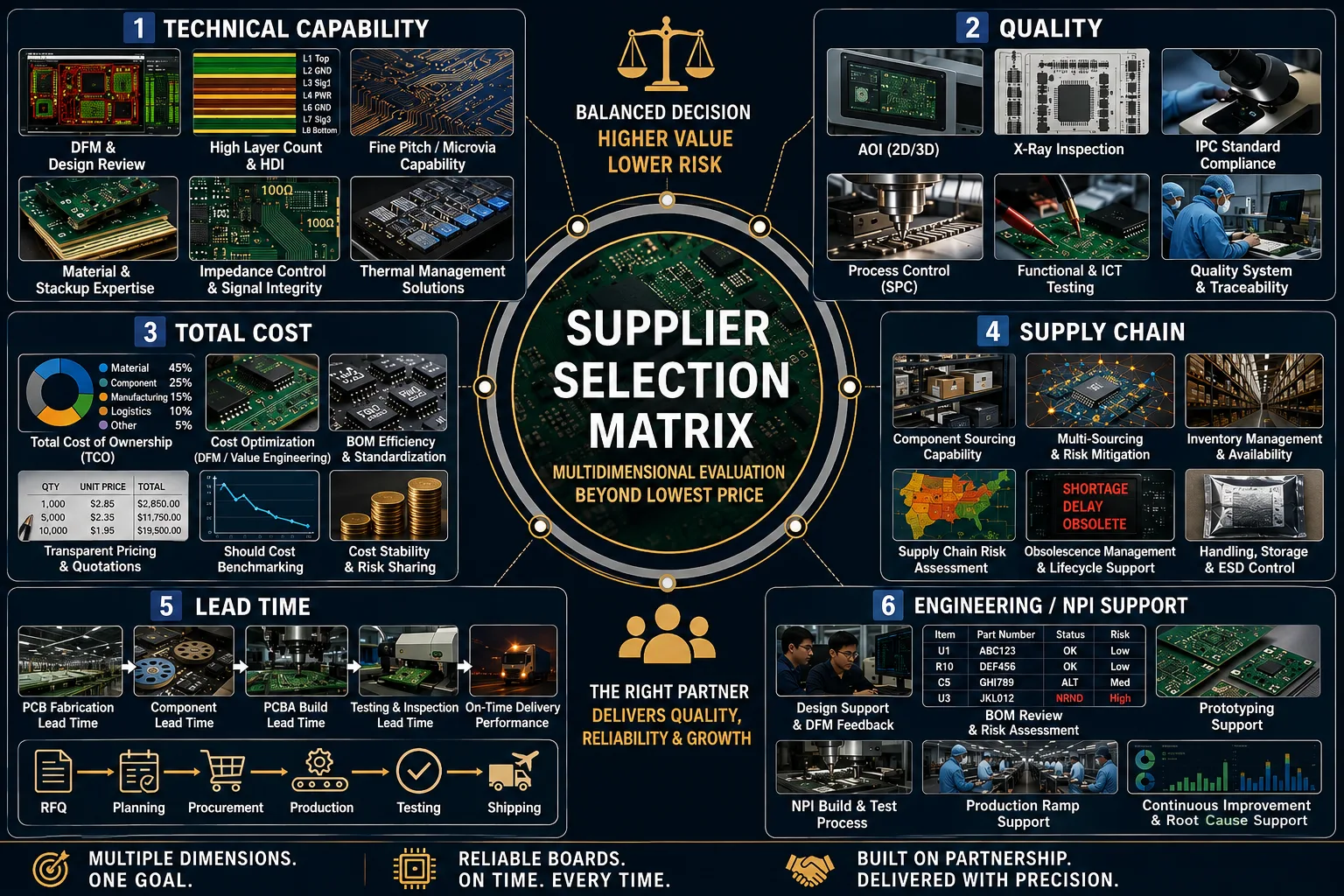
A strong PCB/PCBA supplier evaluation balances price with technical capability, quality, supply-chain resilience, lead time and engineering support.
A supplier should not be evaluated solely as a factory.
For complex PCBA programs, assess whether the supplier can support:
A supplier that identifies a manufacturability problem before production can create considerably more value than a supplier that simply provides a lower quotation.
29. Look at the Supplier's Manufacturing Scope
Ask:
What exactly does the supplier manufacture themselves, and what is externally sourced?
Understand the supplier's capabilities across:
This helps establish who is actually responsible for each part of the manufacturing chain.
30. Understand Partner-Network Dependencies
A manufacturing company may use qualified partners for certain processes.
That is not automatically a weakness.
The important question is whether the supplier maintains control over:
For the buyer, the important issue is not simply:
"Is every process performed under one roof?"
It is:
"Who owns the manufacturing outcome and who is accountable to me?"
31. Evaluate Communication and Change Control
A quotation is the beginning of the relationship.
During production, the buyer may need decisions on:
Evaluate whether the supplier has a structured process for:
Poor communication can create costs that never appear in the original quotation.
32. Don't Compare Suppliers Using Only a Spreadsheet
A spreadsheet is useful.
But supplier evaluation should combine:
Commercial data + technical evaluation + operational evidence.
For example:
Commercial
Technical
Operational
This creates a much more reliable supplier decision.
33. A Practical PCB/PCBA Quote Comparison Scorecard
A sourcing team can create a weighted scorecard.
| Evaluation Area | Suggested Consideration |
|---|---|
| Technical compliance | Does the quotation meet the exact specification? |
| PCB quality | Material, fabrication and process capability |
| PCBA quality | Assembly and inspection capability |
| Component sourcing | Availability, authenticity and traceability |
| Testing | Required testing included? |
| Lead time | Total production + logistics time |
| Total landed cost | Complete cost to buyer |
| NRE/tooling | Clearly identified? |
| Engineering support | DFM, BOM, NPI and change support |
| Supply-chain resilience | Alternatives and continuity |
| Communication | Responsiveness and clarity |
| Commercial terms | Payment, validity and warranty |
The weighting should reflect the product.
A safety-critical product should not necessarily give price the highest weighting.
34. A Simple Example
Suppose three suppliers quote:
| Supplier A | Supplier B | Supplier C | |
|---|---|---|---|
| PCBA unit price | $10.20 | $10.80 | $11.40 |
| Testing | Basic | Required | Required |
| Components | Mixed assumptions | Exact BOM | Exact BOM |
| Tooling | Extra | Included | Included |
| Freight | Extra | Extra | Included |
| Lead time | 7 weeks | 5 weeks | 4 weeks |
Supplier A appears cheapest.
But once the scope is normalized, Supplier C may offer the strongest overall proposition.
This is why quotation comparison should focus on:
Total cost of ownership and manufacturing risk.
Not merely the first number on the quotation.
35. The "Too Good to Be True" Quote
A quotation dramatically below the market range deserves investigation.
Ask:
A very low quote may be legitimate.
But it should be understood before being accepted.
36. Questions to Ask Before Accepting a PCB/PCBA Quote
Technical
BOM
Testing
Commercial
Delivery
Quality
37. The Procurement Principle: Compare Risk-Adjusted Cost
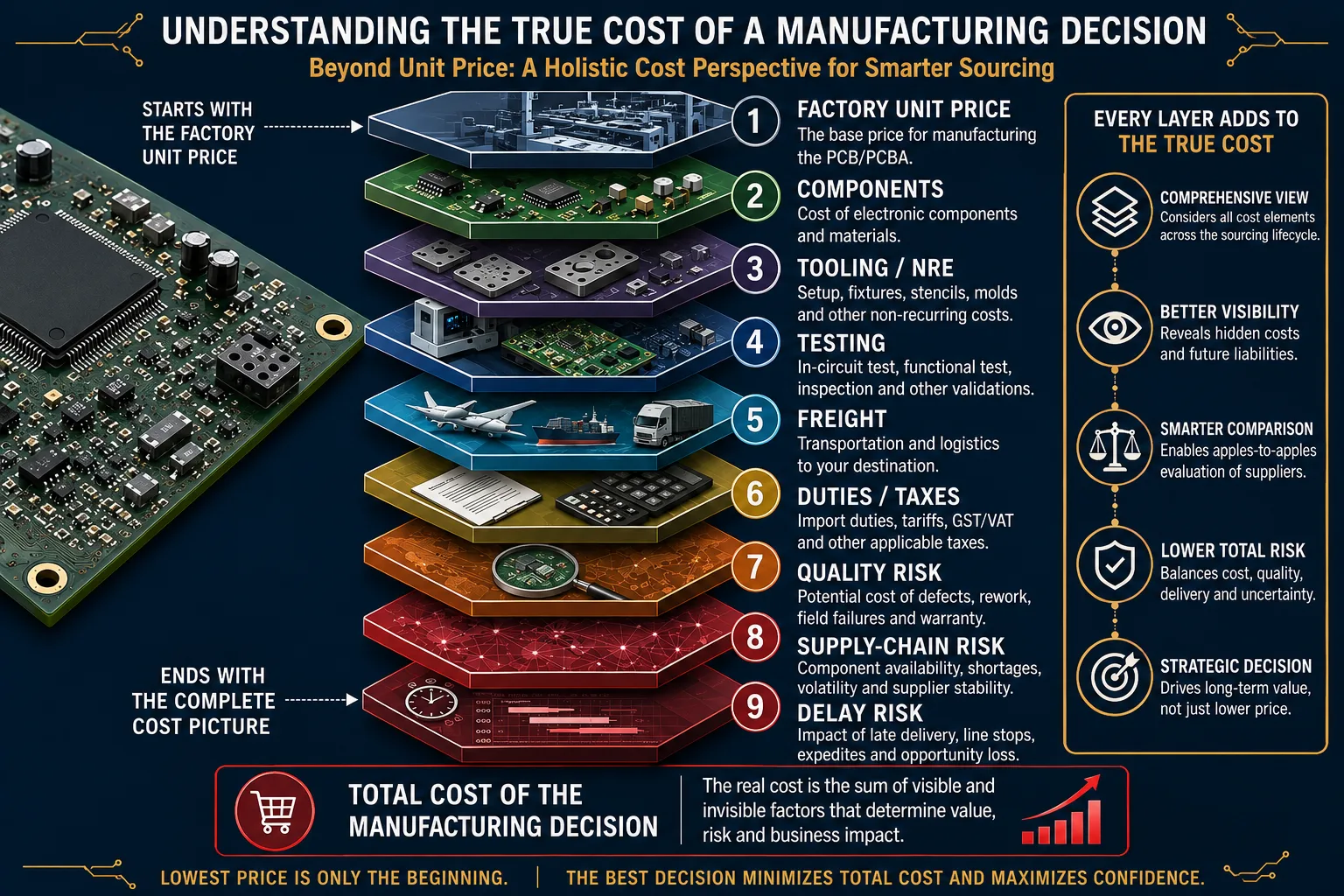
The lowest quoted unit price does not necessarily represent the lowest total cost or lowest manufacturing risk.
The most useful way to think about supplier quotations is:
Headline Price
↓
+ Missing/Additional Costs
↓
+ Logistics
↓
+ Quality Risk
↓
+ Supply-Chain Risk
↓
+ Delay Risk
↓
+ Engineering/Management Cost
↓
True Cost of the Manufacturing Decision
A supplier with a slightly higher quoted price may produce a lower overall business cost if it delivers:
38. What a Good PCB/PCBA Quotation Should Look Like
A strong quotation should make it relatively easy for the buyer to understand:
What is included
What is excluded
What assumptions were made
What happens if assumptions change
Transparency is itself a useful supplier-selection signal.
39. The Best Quote Is the One You Can Actually Understand
A complicated quotation is not necessarily a bad quotation.
PCB/PCBA manufacturing is technically complicated.
But the buyer should still be able to determine:
What am I paying for?
What am I receiving?
What assumptions were made?
What could change the price?
Who is responsible if something goes wrong?
If those questions cannot be answered clearly, the quotation requires further clarification before approval.
40. PCB/PCBA Quote Comparison Checklist
Before selecting a supplier:
Technical Scope
BOM
Cost
Delivery
Quality
Supplier Capability
41. Final Takeaway
Comparing PCB/PCBA suppliers purely on unit price is one of the easiest ways to make a sourcing decision look objective while actually leaving major variables unexamined.
A better approach is:
1. Normalize the technical scope
Make sure every supplier is quoting the same product.
2. Validate the BOM
Confirm exact manufacturer part numbers, quantities and approved alternates.
3. Separate recurring and one-time costs
Understand tooling, stencil, fixtures and NRE.
4. Compare testing
Make sure the same inspection and test requirements are included.
5. Calculate total landed cost
Include logistics and applicable import-related costs.
6. Compare lead time
Look at the complete journey from RFQ to delivered product.
7. Evaluate quality and engineering capability
A supplier should be able to manufacture the product reliably—not merely quote it cheaply.
8. Evaluate supply-chain risk
Component availability and alternate sourcing can be just as important as PCB fabrication cost.
9. Look at the long-term relationship
The right manufacturing partner should be able to support prototype, NPI, production ramp and ongoing engineering changes.
The goal is therefore not:
Find the cheapest PCB/PCBA quotation.
It is:
Find the supplier offering the strongest combination of technical compliance, quality, delivery, supply-chain reliability and total cost for the product's requirements.
That is the difference between buying a PCB and making a sound manufacturing decision.
42. Quadrionix Perspective
At QUADRIONIX, the objective of an RFQ is more than generating a number.
A technically meaningful quotation should connect the customer's:
PCB design → BOM → component availability → manufacturing requirements → assembly → testing → delivery
into one coherent manufacturing scope.
For international buyers, this can make supplier comparison considerably easier because technical and commercial assumptions are clarified before production begins.
Ready to manufacture your electronics project?
Upload your Gerber files & BOM for automated DFM review, engineering feedback, and guaranteed delivery timelines.