How to Choose Alternate Components Without Creating New Design Risk
A practical engineering and sourcing framework for qualifying component alternatives without compromising electrical performance, PCB compatibility, reliability or production continuity
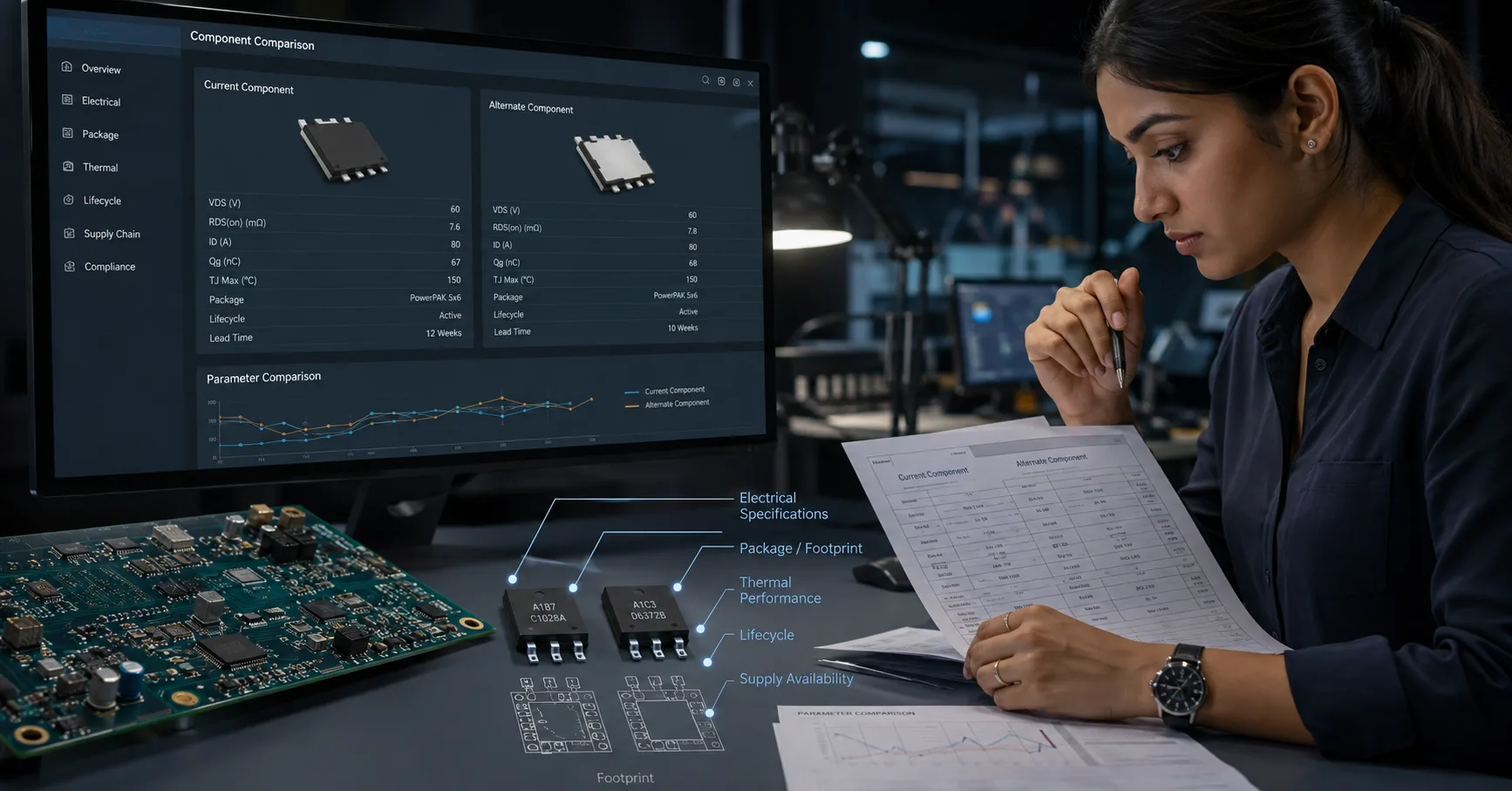
Engineer evaluating alternate electronic components for PCB design and manufacturing
Component shortages, lifecycle changes, long lead times and unexpected price increases are now familiar challenges for electronics manufacturers.
When a critical component becomes difficult to source, the obvious response is:
Find another component.
But that seemingly simple decision can introduce a new set of risks.
A replacement component may have:
In some cases, the substitute may work perfectly.
In others, a component that appears equivalent on paper can create failures during validation or production.
That is why alternate-component selection should be treated as an engineering qualification process—not simply a purchasing exercise.
The objective is not merely to find a component that is available.
The objective is to find one that is:
Technically suitable + physically compatible + manufacturable + reliable + available + commercially viable.
1. What Is an Alternate Component?
An alternate component is a component that can potentially replace the originally specified component in a PCB design or product BOM.
The level of compatibility can vary.
An alternate may be:
Pin-to-pin compatible
The pin functions and physical arrangement are compatible.
Footprint compatible
The component can potentially use the existing PCB footprint.
Functionally equivalent
It performs the same fundamental function but may require engineering changes.
Form-fit-function equivalent
It is sufficiently similar in physical form, interface and function to potentially replace the original component with limited or no PCB modification.
These categories should not be treated as interchangeable.
A component being advertised as an "equivalent" does not automatically mean it is a qualified production alternate.
2. Why Component Substitution Creates Risk
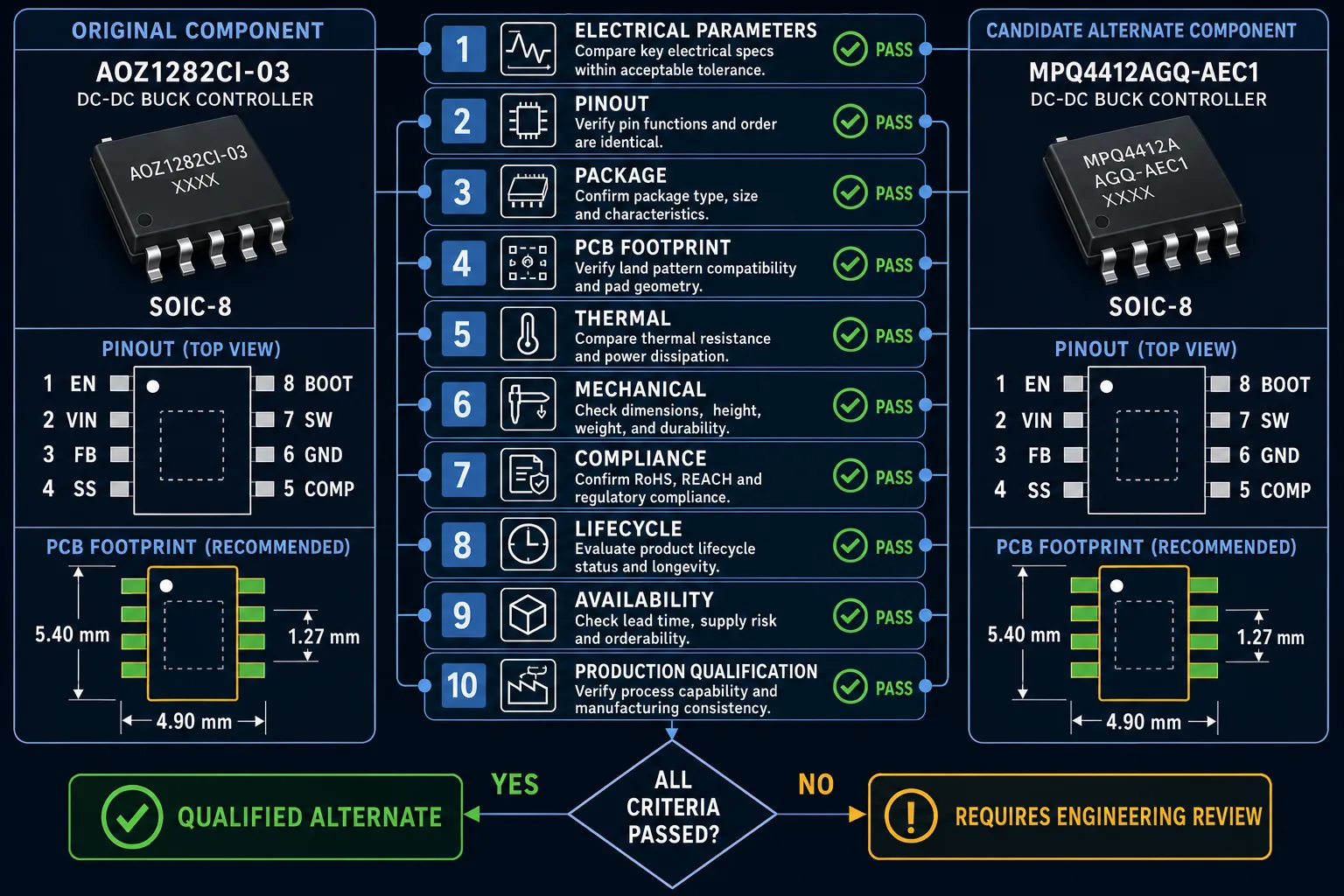
A component alternate should pass multiple qualification gates before becoming an approved production substitute.
Consider a simple example.
An original voltage regulator has:
An alternate regulator may have the same:
At first glance, it looks equivalent.
But other characteristics could differ:
The result?
The replacement may fit the PCB and still fail to perform identically.
That is the fundamental problem with superficial component substitution.
3. Start With the Function, Not the Part Number
Before searching for an alternate, understand what the original component actually does in the circuit.
Identify:
For example, replacing a resistor may be relatively straightforward.
Replacing a:
may require substantially deeper analysis.
The first question should therefore be:
Which characteristics are essential to the circuit's operation?
Only then should the sourcing team begin searching for alternatives.
4. Identify the Original Component's Critical Parameters
The datasheet contains far more information than the headline specification.
For each component, identify the parameters that could affect the actual design.
Depending on the component, these may include:
Electrical
Mechanical
Thermal
Environmental
Manufacturing
The correct alternate must be evaluated against the parameters that actually matter to the product.
5. Pinout Is One of the First Checks
Two components can have identical package dimensions and completely different pin assignments.
For example:
Component A
Pin 1 = GND
Pin 2 = IN
Pin 3 = OUT
Component B
Pin 1 = IN
Pin 2 = GND
Pin 3 = OUT
They may look almost identical.
They are not interchangeable without PCB changes.
Therefore, always verify:
Rule:
Never assume pin compatibility from package similarity.
6. Package Compatibility
Package compatibility goes beyond the package name.
For example:
can have multiple dimensional variants.
Even within the same package family, differences may exist in:
Therefore, the actual package drawing should be compared.
7. PCB Footprint Compatibility
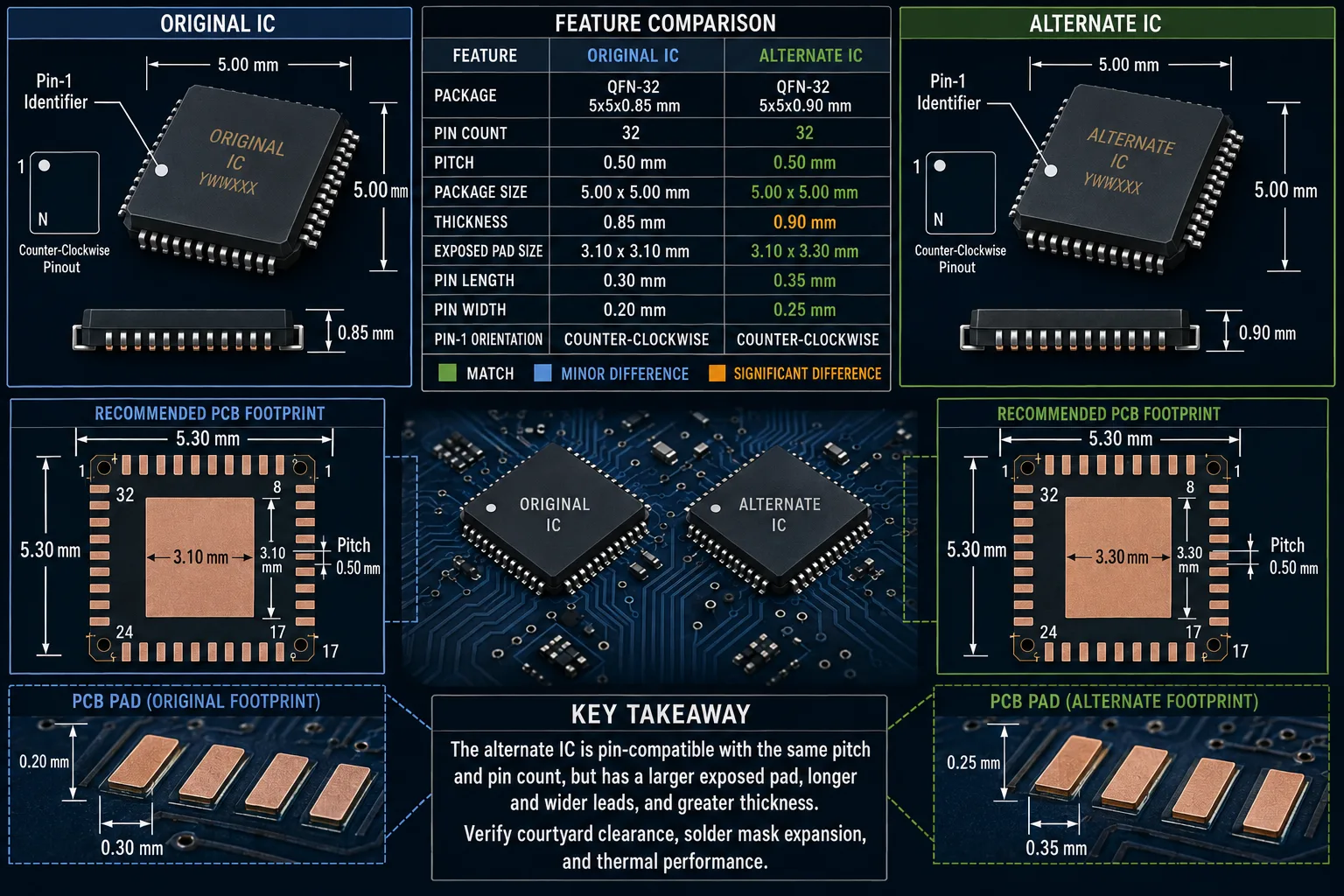
Package similarity does not guarantee pinout or PCB-footprint compatibility.
The next question is:
Can the alternate physically use the existing PCB footprint?
Check:
A component that requires a different footprint may still be usable—but the PCB may need modification.
That changes the risk profile significantly.
8. Electrical Equivalence
Electrical equivalence is often the most important part of alternate qualification.
Depending on the component, compare:
| Parameter | Original | Alternate |
|---|---|---|
| Operating voltage | — | — |
| Maximum voltage | — | — |
| Current rating | — | — |
| Tolerance | — | — |
| Temperature range | — | — |
| Frequency | — | — |
| Timing | — | — |
| Leakage | — | — |
| Power dissipation | — | — |
But simply matching the nominal values is not enough.
For example:
3.3 V output
does not tell you whether two regulators behave identically under:
The engineer should therefore compare the operating characteristics, not just the headline specifications.
9. Absolute Maximum Ratings vs Recommended Operating Conditions
This distinction is frequently overlooked.
Recommended operating conditions
Describe where the component is intended to operate.
Absolute maximum ratings
Describe limits that should generally not be exceeded.
An alternate should be evaluated based on the actual operating conditions of the circuit.
For example, if a circuit normally operates at:
85°C
an alternate rated for:
105°C
may provide greater temperature margin than one rated for:
85°C
even though both may technically satisfy the nominal requirement.
The comparison should therefore consider design margin, not just minimum compliance.
10. Thermal Compatibility
Thermal performance can change significantly between alternatives.
Important parameters may include:
A substitute with higher resistance or lower power capability may create thermal problems.
This is particularly important for:
A component may pass bench testing at room temperature and still fail under production operating conditions.
11. Timing and Dynamic Behavior
For active components, static specifications often tell only part of the story.
Compare characteristics such as:
These differences can matter in:
For such components, functional equivalence requires dynamic evaluation.
12. Passive Components Are Not Always Simple
Passive components are often considered easy to substitute.
Sometimes they are.
But even apparently simple substitutions can affect circuit behavior.
For capacitors, relevant parameters can include:
For resistors:
For inductors:
The correct alternate therefore depends on the application, not simply the nominal value.
13. Component Manufacturer Matters
Two manufacturers can produce components with similar specifications but different:
For critical applications, evaluate the manufacturer's suitability as part of the alternate-qualification process.
Questions include:
14. Lifecycle Is a Major Reason to Qualify Alternates
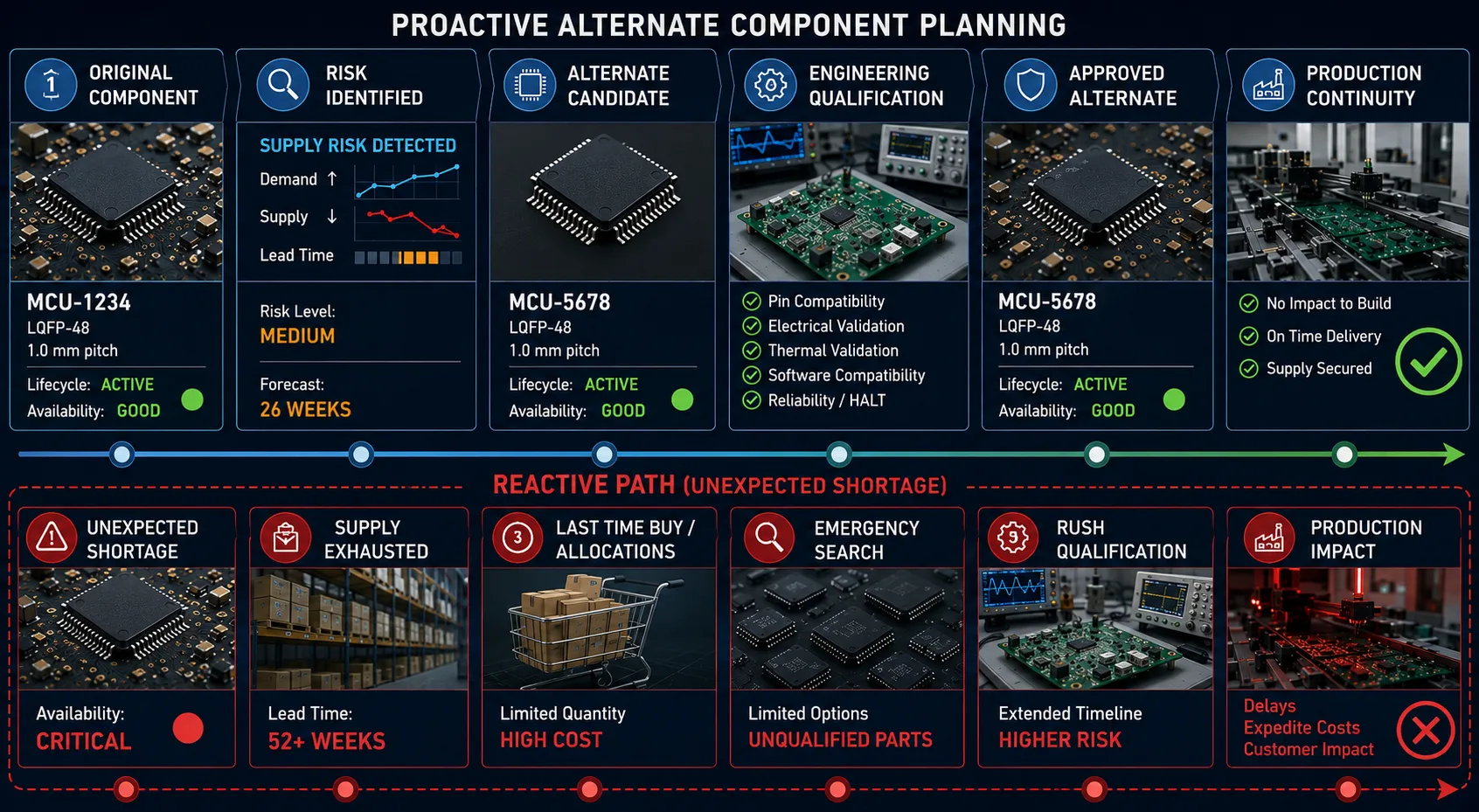
Qualifying alternates before a shortage occurs provides significantly more flexibility than emergency substitution.
Alternate planning is particularly valuable when the original component is:
Waiting until the component becomes unavailable is usually the worst time to begin qualification.
A better approach is:
Risk identified
↓
Alternate candidate identified
↓
Engineering qualification
↓
Approved alternate
↓
Production continuity
This transforms substitution from an emergency response into proactive supply-chain management.
15. "Drop-In Replacement" Does Not Mean "Risk-Free"
The phrase drop-in replacement is useful—but it should not end the engineering evaluation.
A manufacturer may describe a component as compatible because it matches:
But the system-level design may depend on parameters that are not immediately obvious.
Therefore:
Treat "drop-in replacement" as a qualification starting point—not the final approval.
16. Firmware and Software Dependencies
This becomes critical for:
An alternate component may require:
A hardware substitute can therefore create software-development risk.
Before approving an alternate, determine whether the component is truly hardware-only or whether the product's software depends on it.
17. Certification and Compliance
Component substitutions can affect product-level certification.
Depending on the application, consider:
Even if the alternate performs correctly, documentation may need to be updated.
For regulated products, substitution approval should therefore involve the appropriate quality and compliance functions.
18. Manufacturing Compatibility
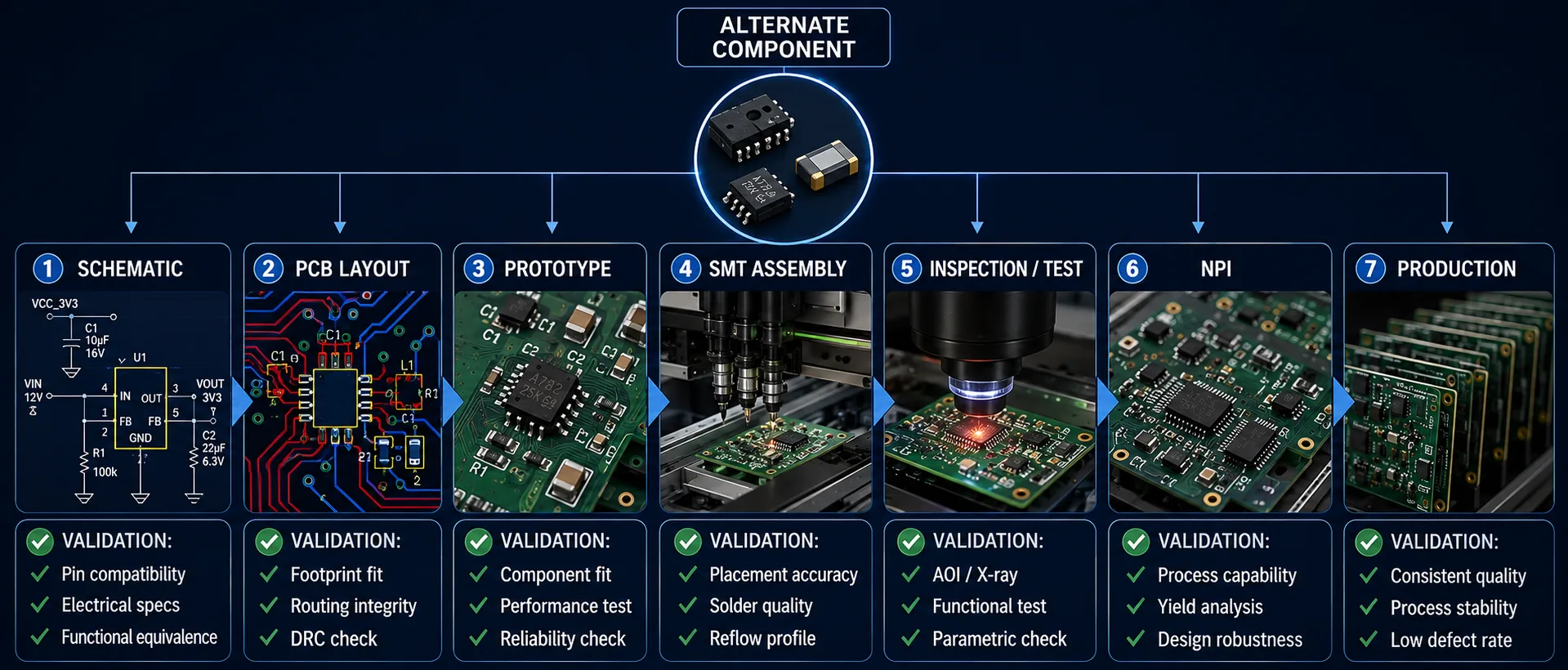
A robust alternate-component strategy evaluates compatibility from design through production.
An alternate can be electrically correct and still create an assembly problem.
Check:
This is especially important for:
A component alternate should therefore be evaluated from design through assembly, not only at the schematic level.
19. Supplier and Availability Validation
Once an alternate passes the engineering checks, sourcing risk still needs to be evaluated.
Ask:
An alternate that is technically excellent but impossible to source reliably does not solve the original problem.
20. Cost Should Come After Technical Suitability
Cost is obviously important.
But the order of decision-making matters.
A sensible sequence is:
Technical suitability
↓
Physical compatibility
↓
Manufacturing compatibility
↓
Reliability/compliance
↓
Availability
↓
Lifecycle
↓
Cost
The cheapest available component should not automatically become the preferred alternate.
21. Build an Alternate Qualification Matrix
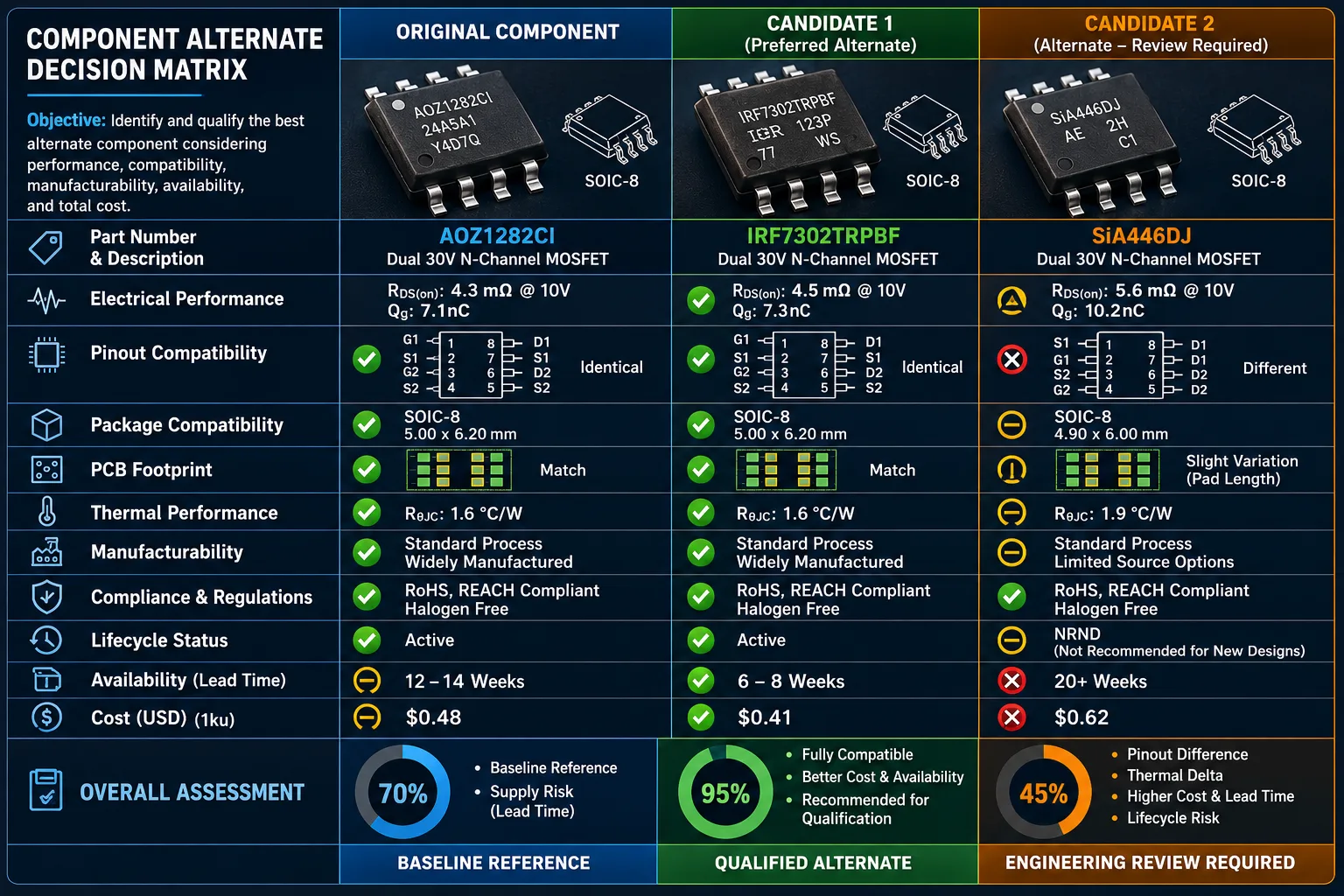
A structured qualification matrix makes alternate-component decisions transparent and repeatable.
A simple matrix can make decisions much easier.
| Qualification area | Check |
|---|---|
| Function | Same intended function? |
| Electrical | Required parameters satisfied? |
| Pinout | Compatible? |
| Package | Compatible? |
| Footprint | Existing footprint usable? |
| Thermal | Adequate margin? |
| Mechanical | Dimensions/height acceptable? |
| Manufacturing | SMT/reflow compatible? |
| Firmware | Software impact assessed? |
| Compliance | Requirements satisfied? |
| Lifecycle | Suitable for product life? |
| Availability | Reliable supply? |
| Supplier | Credible source? |
| Cost | Commercially acceptable? |
| Qualification | Testing completed? |
The result should be one of:
Approved
Approved with conditions
Requires engineering change
Rejected
22. When Does an Alternate Require PCB Redesign?
A PCB change may be required when:
If the PCB requires modification, the alternate should no longer be treated as a simple purchasing substitution.
It becomes an engineering change.
That may require:
23. When Should You Test the Alternate?
Testing requirements depend on the component's criticality.
Low-risk passive
A datasheet and engineering review may sometimes be sufficient, subject to the product's requirements.
Moderate-risk component
Bench testing and functional validation may be appropriate.
High-risk active component
Testing may include:
The more critical the component, the stronger the evidence required for qualification.
24. Prototype Qualification vs Production Qualification
An alternate that works in a prototype should not automatically be considered production-approved.
During production qualification, consider:
This helps distinguish:
"It worked once."
from
"It is suitable for repeatable production."
25. Maintain an Approved Alternate List
For products with long production lifecycles, maintaining an approved alternate list can significantly improve supply resilience.
For each approved alternate, maintain:
This reduces the need to restart the entire analysis whenever the original component becomes unavailable.
26. Common Mistakes in Alternate Component Selection
Mistake 1 — Choosing based only on price
Lowest price does not equal lowest risk.
Mistake 2 — Choosing based only on availability
A component in stock today may not be suitable for the next production run.
Mistake 3 — Assuming the same package means compatibility
Pinout and electrical behavior can differ.
Mistake 4 — Ignoring thermal characteristics
Power components can behave very differently under load.
Mistake 5 — Ignoring firmware
Digital components may create software changes.
Mistake 6 — Skipping production validation
Prototype success does not guarantee production performance.
Mistake 7 — Waiting until EOL
Emergency substitution gives engineering and sourcing teams fewer options.
27. A Better Alternate-Component Workflow
A robust workflow can be summarized as:
1. Identify the original component
Confirm exact manufacturer and MPN.
2. Understand the circuit function
Determine which parameters are critical.
3. Define alternate requirements
Create technical and manufacturing acceptance criteria.
4. Search for candidate components
Use manufacturers, authorized distributors and qualified sourcing channels.
5. Compare specifications
Evaluate electrical, mechanical and thermal characteristics.
6. Check pinout and footprint
Determine whether PCB changes are required.
7. Check lifecycle and availability
Confirm that the alternate actually reduces supply risk.
8. Assess compliance
Verify applicable requirements.
9. Perform engineering validation
Test according to component criticality.
10. Approve and document
Add the component to the approved alternate list.
11. Monitor
Continue tracking availability and lifecycle.
28. The Most Important Principle
The most important principle in component substitution is:
An alternate should reduce one risk without creating another.
If the original component is unavailable and you select a replacement that introduces:
then the original problem has simply been replaced with a different problem.
The objective is risk reduction—not risk transfer.
29. What International Buyers Should Ask Their PCBA Supplier
Before allowing a manufacturing partner to substitute components, ask:
Engineering
Sourcing
Qualification
Manufacturing
Documentation
These questions can reveal the maturity of a supplier's engineering and sourcing processes.
30. Alternate Components and BOM Risk Management
Alternate qualification should not exist as a separate activity.
It should be part of broader BOM risk management.
The ideal relationship is:
BOM
↓
Risk Assessment
↓
Critical Component Identification
↓
Alternate Strategy
↓
Qualification
↓
Approved BOM
↓
Production Monitoring
This makes component continuity part of the product's manufacturing strategy.
31. FINAL TAKEAWAY
Selecting an alternate component is not simply about finding another part with a similar specification.
A production-ready alternate should be evaluated across:
Function
Electrical performance
Pinout
Package
PCB footprint
Thermal characteristics
Mechanical compatibility
Manufacturing process
Firmware dependencies
Compliance
Lifecycle
Availability
Supplier quality
Cost
Only after these factors have been evaluated should a component become an approved production alternate.
The best alternate is therefore not necessarily the cheapest, most available or most similar-looking component.
It is the component that provides the best overall combination of:
Technical equivalence + manufacturing compatibility + supply continuity + acceptable commercial risk.
32. QUADRIONIX PERSPECTIVE
At QUADRIONIX, alternate-component selection is approached as a cross-functional engineering and supply-chain decision.
When a component becomes difficult to source, the objective should not be to substitute it as quickly as possible.
The objective should be to understand:
Why the original component is at risk
→ Which specifications are critical
→ Which alternatives are technically suitable
→ Whether the existing PCB can support the alternate
→ What qualification is required
→ Whether the alternate provides better long-term supply continuity
→ Whether it can be reliably sourced for production
This approach helps prevent a common manufacturing mistake: solving an immediate component shortage while unintentionally introducing a new engineering or production problem.
For international OEMs, hardware companies and product teams, a capable PCBA manufacturing partner should be able to connect engineering validation, component sourcing and production execution rather than treating component substitution as a simple procurement transaction.
If you need Help Evaluating Component Alternatives, Don't wait until a component shortage forces an emergency substitution. Use Quadrionix review to identify potential alternate-component and sourcing risks before production. Better alternatives. Better qualification. Lower manufacturing risk.
Frequently Asked Questions
Ready to manufacture your electronics project?
Upload your Gerber files & BOM for automated DFM review, engineering feedback, and guaranteed delivery timelines.