PCB Cost Drivers for Global Sourcing
Understanding the Engineering, BOM, Manufacturing, Volume and Supply-Chain Factors That Determine the Real Cost of PCB and PCBA Procurement
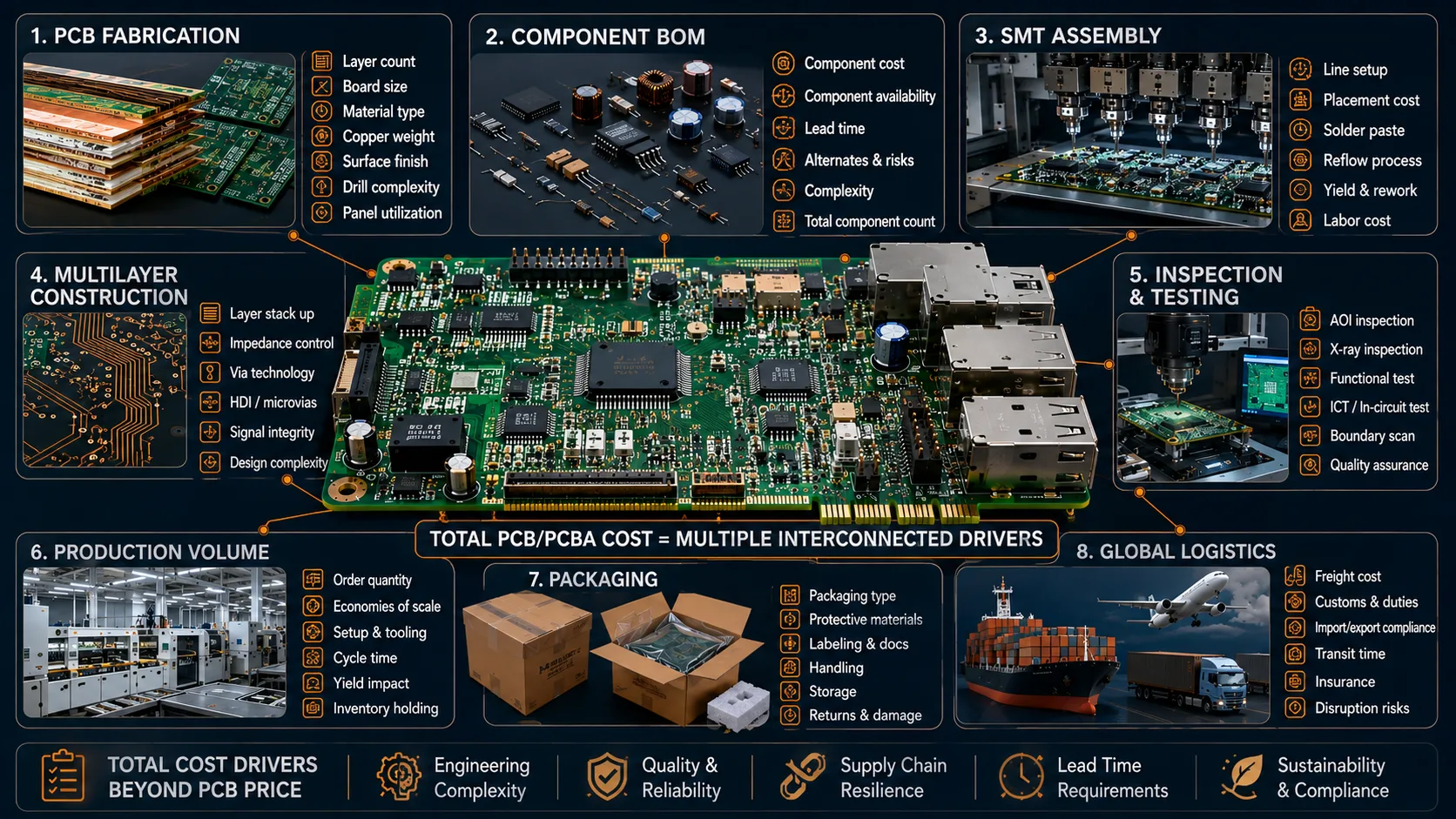
Exact AI Prompt
Introduction
When procurement teams compare PCB suppliers, the first number they usually see is the unit price.
That number can be useful.
But it can also be misleading.
A PCB or PCBA quotation is the result of multiple interacting variables:
A lower quoted unit price does not automatically mean a lower procurement cost.
For global sourcing, the more useful question is:
What is the total landed and sustainable cost of producing this PCBA at the required quality, volume, lead time and supply-chain risk?
That distinction is important for both engineers and procurement teams.
PCB cost estimation generally needs to separate fabrication, assembly, components and fixed/NRE costs, because each is driven by different variables.
1. The Four Major Cost Buckets
For a turnkey PCBA, think of total manufacturing cost as four interconnected buckets:
1. Bare PCB fabrication
The cost of manufacturing the physical circuit board.
2. Components
The BOM cost of all electronic and mechanical components supplied with the assembly.
3. Assembly and testing
The cost of placing, soldering, inspecting and testing those components.
4. Global supply-chain costs
The costs associated with sourcing, logistics, packaging, inventory, lead time and international movement.
There can also be fixed or non-recurring costs such as:
The relative contribution of these categories changes significantly with board complexity and production volume.
2. PCB Fabrication Cost Drivers
The bare PCB is not simply priced according to its physical size.
Its manufacturing complexity is a major factor.
Important variables include:
A board with a simple two-layer FR-4 construction can have a very different manufacturing cost from a high-density multilayer board with fine geometry and controlled impedance.
3. Layer Count
Layer count is one of the most obvious PCB fabrication cost drivers.
A two-layer PCB generally has a simpler construction than:
Additional layers introduce additional material and manufacturing operations.
But reducing layers purely to lower cost is not necessarily good engineering.
A higher layer count may be required for:
Therefore:
The objective is not minimum layer count. It is the minimum technically appropriate layer count.
4. Board Size and Panel Utilization
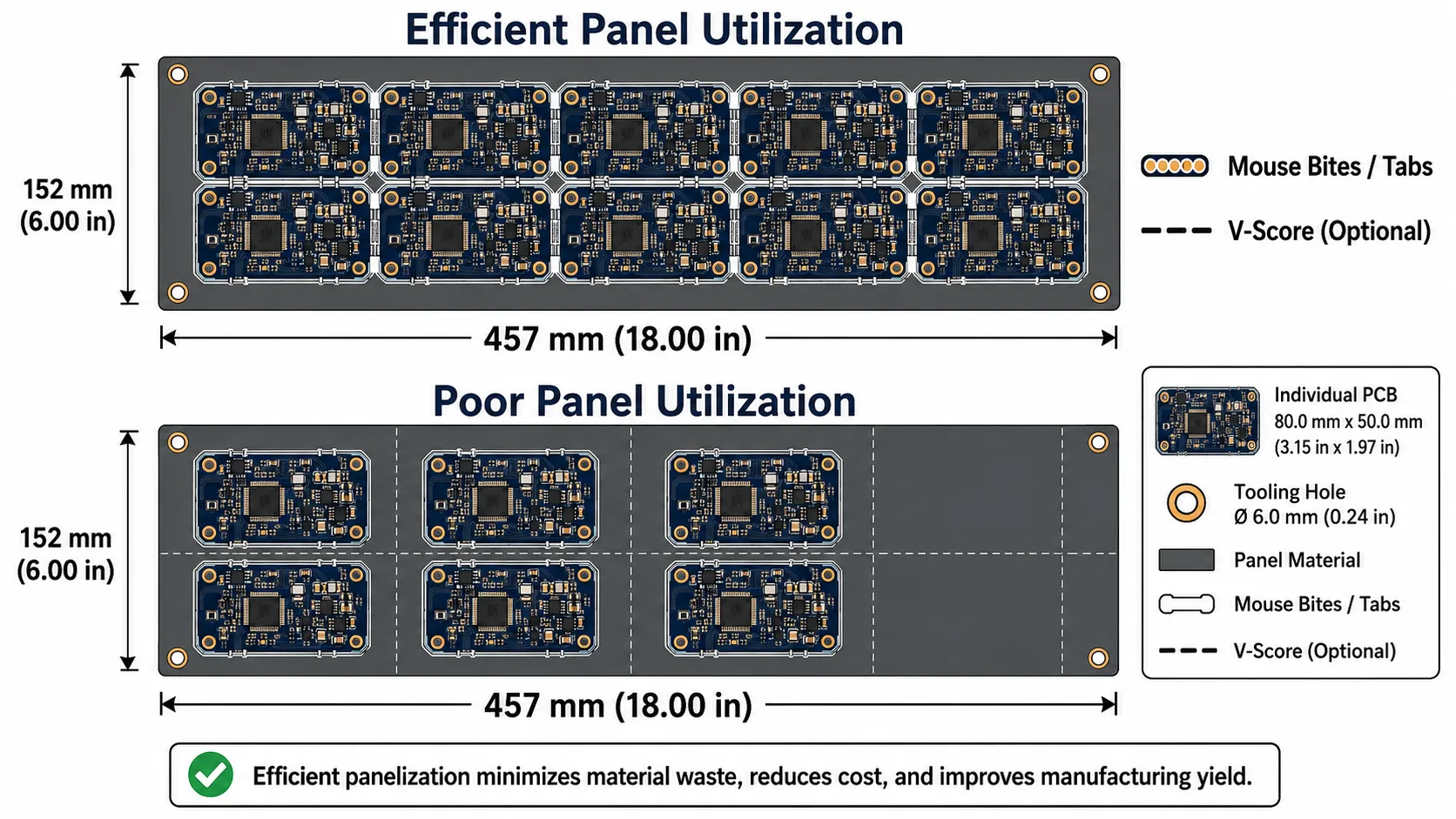
Board dimensions and panel utilization can influence how efficiently PCB material and manufacturing capacity are used.
PCB manufacturers typically fabricate multiple individual boards within larger production panels.
Therefore, the relationship between:
individual PCB size
and
panel utilization
can influence cost significantly.
Consider two boards:
Board A
100 × 100 mm
Board B
50 × 100 mm
Depending on the panel dimensions and manufacturing constraints, the second design may allow more efficient panel utilization.
Better utilization can reduce material waste and improve production efficiency.
5. Material Selection
Material choice can have a substantial effect on fabrication cost.
Standard FR-4 is widely used for general-purpose electronic assemblies.
But specialized applications may require:
The material should be selected according to the electrical, thermal and mechanical requirements of the product.
Choosing an unnecessarily expensive material increases cost.
Choosing an inadequate material can create much greater problems later.
6. Copper Weight
Copper thickness also affects PCB construction.
Common requirements may include different copper weights for:
Higher copper thickness can increase manufacturing complexity and material requirements.
But increasing copper weight may be necessary for:
Again, cost optimization should not compromise the electrical design.
7. Trace Width and Spacing
Fine-line PCB fabrication generally requires tighter process control.
If the design uses very small:
the fabrication process can become more demanding.
Where the electrical design allows it, using more conventional geometry can improve manufacturability.
This is one reason DFM review should happen before production.
8. Via Technology
Not all vias have the same manufacturing requirements.
Common structures include:
Advanced via structures can support high-density routing but may require more sophisticated fabrication processes.
For example, HDI structures using microvias can increase fabrication complexity compared with conventional through-hole vias.
Therefore:
Use advanced PCB technology where the design requires it—not simply because it is available.
9. Surface Finish
Surface finish affects both PCB manufacturing cost and application suitability.
Common finishes include:
The correct finish depends on factors such as:
For example, fine-pitch packages may impose requirements that make a flatter surface finish more appropriate.
Cost should therefore be considered together with assembly requirements.
10. Controlled Impedance
Controlled impedance is common in designs involving:
Impedance requirements can influence:
A procurement team should therefore be careful when comparing a standard PCB quote with a quote for a board requiring controlled impedance.
They may not represent equivalent manufacturing specifications.
11. The BOM Can Dominate PCBA Cost
Once components are included, the economics change significantly.
For many PCBAs, the BOM can represent the largest variable portion of total manufacturing cost. Current industry cost models commonly identify components as a major—and often dominant—cost category.
The BOM cost is influenced by:
This is why BOM optimization can sometimes produce greater savings than negotiating the PCB fabrication price alone.
12. Component Availability Is a Cost Variable
Suppose an engineer selects a technically excellent component.
But that component has:
The nominal unit price may not reflect its true procurement cost.
A delayed component can create:
Therefore:
Component availability is part of cost management.
13. Manufacturer Part Number Matters
A BOM that says:
10 kΩ resistor, 1%, 0603
does not fully define procurement cost.
Different manufacturers may offer different:
The same applies even more strongly to ICs, connectors and electromechanical components.
A robust BOM should identify the intended MPN and define acceptable alternatives where appropriate.
14. BOM Complexity
Two PCBAs may contain the same number of components but have different BOM complexity.
Example A
200 placements using a relatively small number of standardized part families.
Example B
200 placements using many unique MPNs and package types.
The second assembly may require greater sourcing effort and more feeder/setup complexity.
Reducing unnecessary part diversity can therefore help both:
15. Component Standardization
Where technically appropriate, standardizing component packages and values can simplify sourcing and manufacturing.
For example:
Instead of unnecessarily using many resistor package sizes:
an engineering team may be able to standardize certain functions around fewer package families.
But this should only be done when:
16. Alternate Sourcing
An important BOM optimization strategy is identifying technically acceptable alternatives.
For suitable components, this could mean:
Primary MPN
↓
Approved Alternate A
↓
Approved Alternate B
This can improve supply resilience.
However, alternates should not be treated as simple drop-in replacements without engineering validation.
Check:
17. Assembly Complexity
Assembly cost is affected by more than the number of components.
Important factors include:
A board with 300 simple passive placements can have a very different process profile from a board containing fewer but highly specialized components.
18. SMT vs THT
SMT is generally well suited to:
THT may be advantageous for:
Mixed-technology boards combine both.
The important cost question is not:
“Which technology is cheaper?”
It is:
Which assembly technology provides the appropriate technical and manufacturing outcome for the design?
Our previous article covers this topic in detail.
19. Double-Sided Assembly
A board populated on both sides can require additional process steps.
Depending on the design, this can involve:
However, double-sided assembly may also reduce overall PCB size.
Therefore, the correct comparison is not simply:
single-sided = cheap
double-sided = expensive
The actual question is whether the additional assembly complexity is offset by savings elsewhere in the product architecture.
20. Inspection and Testing
Quality requirements are part of manufacturing cost.
Potential requirements include:
Not every PCBA requires every test.
The appropriate test strategy should be determined by:
21. Testing Can Be an Investment, Not Just a Cost
Suppose a product requires functional testing.
Eliminating the test may reduce the quotation.
But if defective units reach the customer, the resulting costs can include:
Therefore, the objective should be:
Optimize the test strategy—not simply minimize testing.
22. NRE and Fixed Costs
New PCB programs often involve non-recurring engineering costs.
Examples include:
These costs behave differently from variable per-unit costs.
For example:
If a $500 setup cost is spread across:
10 boards → $50/unit
But across:
1,000 boards → $0.50/unit
This is why production volume changes the economics of PCB manufacturing significantly.
Fixed costs become less significant per unit as volume increases.
23. Production Volume
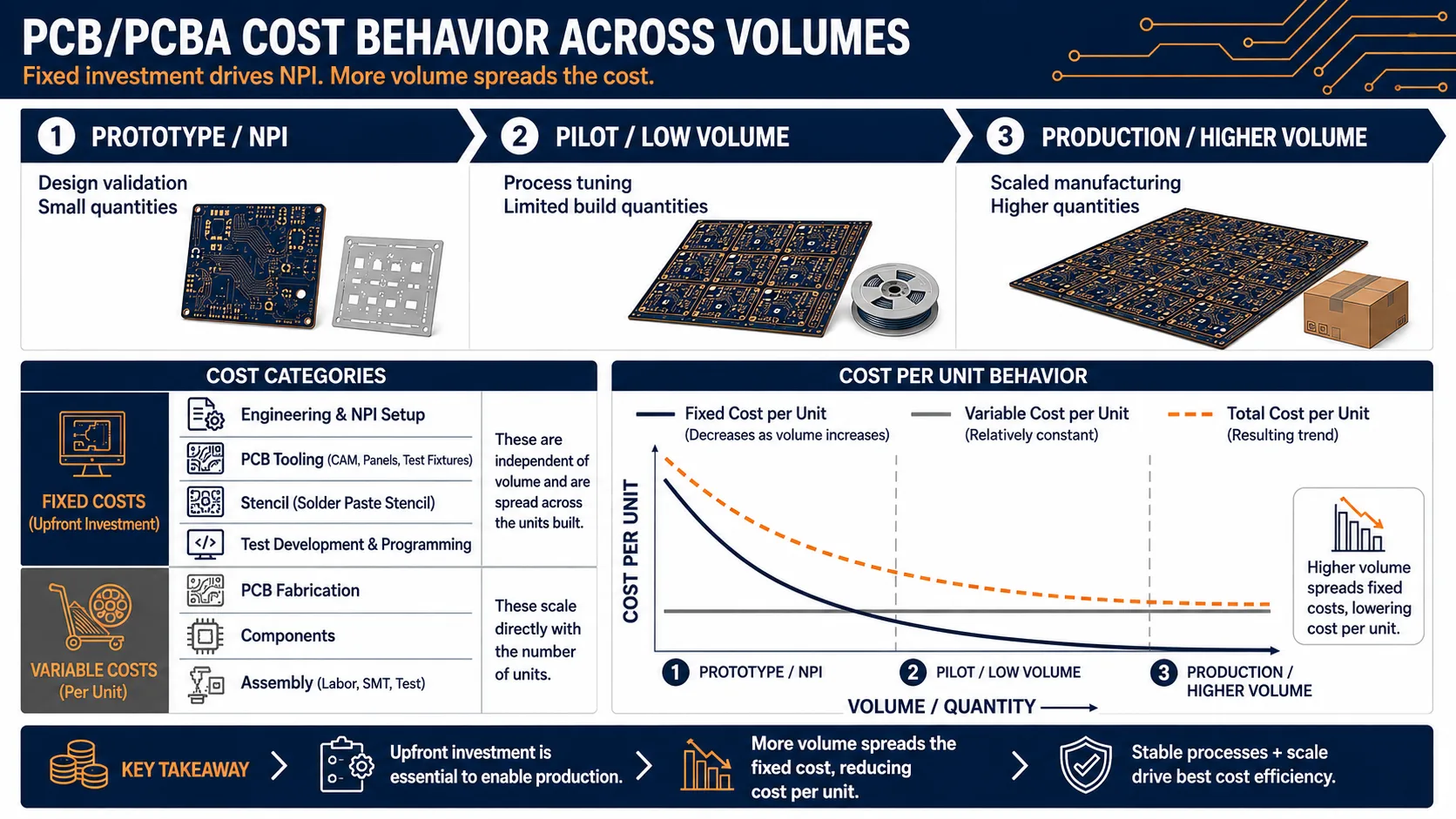
Fixed manufacturing and setup costs are distributed across production volume, while component and process costs remain variable.
Volume is one of the most important variables in sourcing strategy.
A procurement team should avoid comparing:
prototype pricing
with
production pricing
as though they are the same manufacturing scenario.
Different volume levels can affect:
24. Lead Time Is a Cost Driver
Procurement teams sometimes treat lead time as separate from cost.
In reality, they are connected.
A compressed schedule can require:
Conversely, poor planning can result in:
Therefore:
Lead-time planning is part of cost optimization.
25. Logistics and Freight
Global sourcing introduces costs beyond factory pricing.
These may include:
A supplier with a lower factory price may not necessarily produce the lower landed cost.
This is particularly important when comparing suppliers across different manufacturing regions.
26. Total Landed Cost
For international procurement, a more useful model is:
Total Landed Cost
=
PCB / PCBA Manufacturing Cost
Component Cost
NRE / Tooling Allocation
Testing
Packaging
Freight
Duties / Taxes
Other Import Costs
The exact structure varies by commercial terms and destination.
But the principle is important:
Compare equivalent landed-cost scenarios, not isolated factory unit prices.
27. Incoterms Matter
Commercial terms can change how logistics costs and responsibilities are allocated.
For example, the quotation should make clear whether the commercial basis is:
The same factory price can produce different landed costs depending on what is included.
Procurement teams should therefore compare quotations on an equivalent commercial basis.
28. Currency Risk
Global sourcing introduces currency exposure.
A quotation may be issued in:
If the supplier quotation remains fixed for only a limited period, currency movements can affect the effective procurement cost.
For longer production programs, sourcing teams should understand:
29. Payment Terms Also Affect Cost
Two suppliers may quote the same unit price but have different payment structures.
For example:
Payment terms influence:
Therefore, price should be evaluated together with commercial terms.
30. Quality Failures Have a Cost
A quotation that excludes adequate inspection may initially appear cheaper.
But quality failures create downstream costs.
Consider:
Supplier defect
↓
Incoming inspection
↓
Sorting
↓
Rework
↓
Production delay
↓
Customer shipment delay
The original unit-price saving may disappear quickly.
This is why sourcing decisions should consider Total Cost of Quality, not only purchase price.
31. Supply-Chain Risk Is a Cost
A component with one supplier and a long lead time may appear inexpensive.
But its risk profile can be high.
Procurement should consider:
The objective is not maximum supplier count.
It is:
Appropriate diversification of critical supply dependencies.
32. Why BOM Review Should Happen Before Quotation
A manufacturing supplier should ideally review the BOM before final commercial decisions are made.
The review can identify:
This can prevent a quotation from being built around a fragile supply chain.
33. Design Choices Can Create Hidden Costs
Consider a design using:
Every choice may be technically justified.
But collectively they can increase manufacturing complexity.
Therefore:
Cost optimization begins during engineering—not after the RFQ.
34. DFM and DFA as Cost-Control Tools
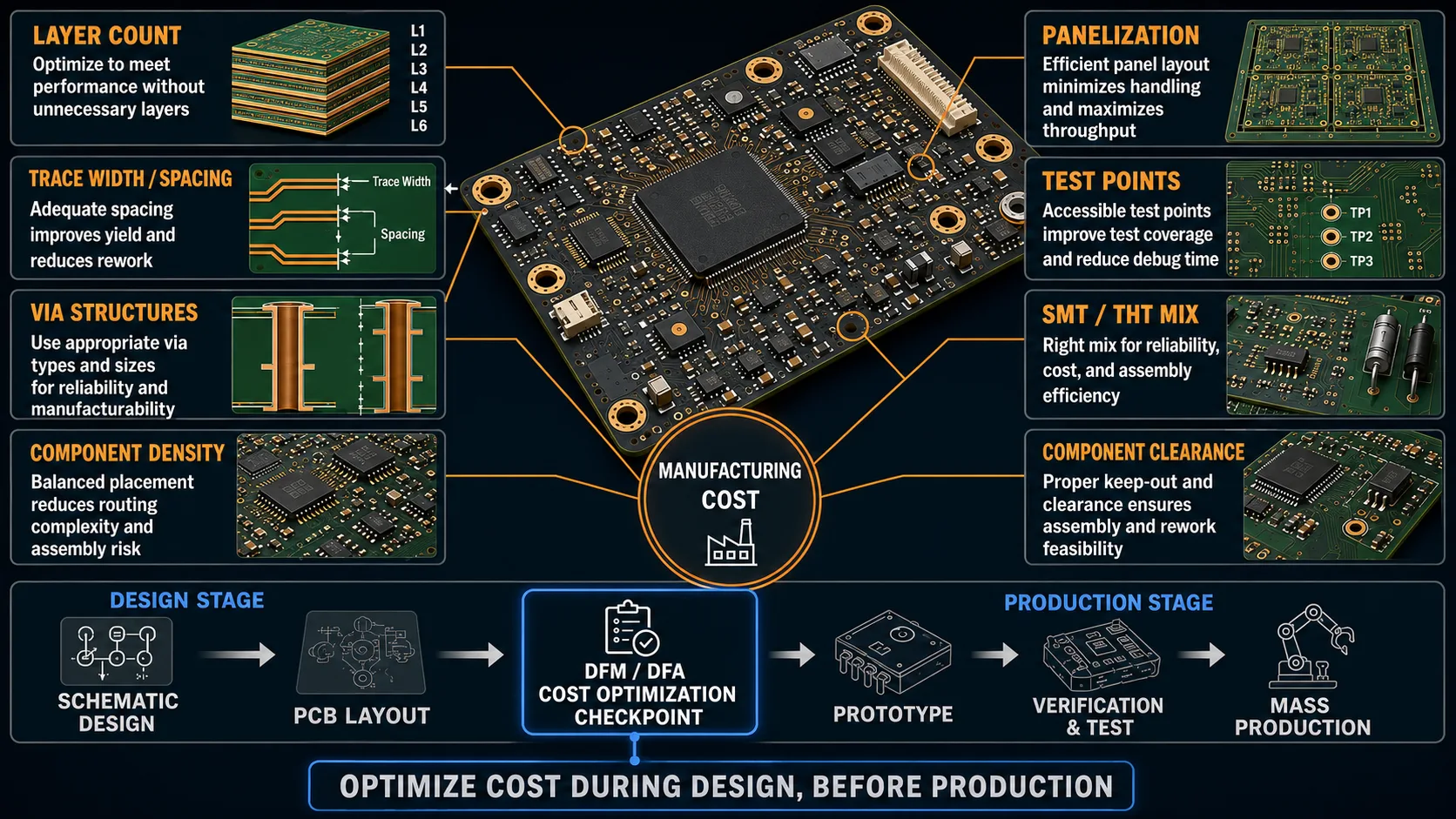
DFM/DFA review provides an opportunity to identify manufacturing cost drivers before the design reaches production.
DFM means:
Design for Manufacturability
DFA means:
Design for Assembly
They help identify manufacturing constraints before production.
A DFM/DFA review may evaluate:
This can reduce avoidable manufacturing complexity.
35. Should You Reduce PCB Cost or PCBA Cost?
This is an important distinction.
A procurement team may negotiate aggressively on the bare PCB price.
But if the PCB represents only one part of the total PCBA cost, a small PCB saving may have limited impact.
For example, depending on the design, greater savings may come from:
The correct question is:
Where is the largest controllable cost driver in the complete manufacturing chain?
36. Why the Cheapest Supplier May Not Be the Cheapest Source
Imagine two quotations.
Supplier A
Lower factory price.
But:
Supplier B
Slightly higher factory price.
But:
Supplier B may produce a lower total landed and operational cost.
This is why procurement should evaluate the entire sourcing model.
37. Global Sourcing Should Be Compared on Equivalent Specifications
When requesting quotations, ensure suppliers are quoting the same:
PCB specification
Assembly specification
BOM
Commercial specification
Without specification alignment, the cheapest quotation may simply be quoting a different product.
38. A Better RFQ Package
A strong RFQ should ideally include:
☐ Gerber / fabrication data☐ Drill files☐ Stack-up requirements☐ BOM with MPNs☐ Pick-and-place data☐ Assembly drawings☐ PCB revision☐ Quantity / volume forecast☐ Required delivery schedule☐ Inspection requirements☐ Testing requirements☐ Special process requirements☐ Packaging requirements☐ Commercial destination
This gives suppliers a common technical basis for quotation.
39. How Engineers Can Reduce Manufacturing Cost
1. Use standard PCB construction where technically appropriate
Avoid unnecessary fabrication complexity.
2. Optimize layer count
Use only the layers required by electrical and mechanical requirements.
3. Improve panel utilization
Consider board dimensions and panelization early.
4. Standardize components
Reduce unnecessary package and MPN diversity.
5. Validate alternate components
Improve sourcing flexibility.
6. Avoid unnecessary fine-pitch requirements
Use them where functionally required.
7. Design for automated assembly
Reduce unnecessary manual operations.
8. Plan test access
Avoid expensive test modifications late in NPI.
9. Review BOM lifecycle
Avoid building production around vulnerable components.
10. Plan production volume early
Allow fixed costs and component pricing to be evaluated correctly.
40. How Procurement Teams Can Reduce Total Cost
Procurement can improve sourcing outcomes by asking suppliers to provide:
Technical quotation
What exactly is being manufactured?
BOM quotation
Which MPNs are included?
Assembly quotation
What processes and inspection are included?
NRE
What one-time costs apply?
Lead time
What is the realistic production lead time?
Logistics
What shipping basis is being quoted?
Commercial terms
What payment and Incoterm assumptions apply?
Validity
How long is the quotation valid?
This creates a much more useful supplier comparison.
41. A Practical Supplier Comparison Matrix
| Cost / Risk Factor | Supplier A | Supplier B | Supplier C |
|---|---|---|---|
| Bare PCB cost | |||
| BOM cost | |||
| Assembly cost | |||
| Testing | |||
| NRE | |||
| Lead time | |||
| Component availability | |||
| Approved alternates | |||
| Freight | |||
| Duties / taxes | |||
| Payment terms | |||
| Incoterm | |||
| Quality requirements | |||
| Supply-chain risk | |||
| Total landed cost |
This prevents the sourcing decision from becoming a simple unit-price comparison.
42. Prototype vs Production Cost
Prototype economics can be very different from production economics.
During prototyping:
During production:
Therefore, a prototype quote should not automatically be treated as the expected production cost.
43. Cost Optimization Across the Product Lifecycle
The best sourcing strategy considers:
Prototype
↓
Engineering Validation
↓
NPI
↓
Pilot Production
↓
Production Ramp
↓
Volume Production
↓
Lifecycle Management
The lowest-cost decision at one stage may not be the lowest-total-cost decision over the product lifecycle.
For example, selecting a component purely because it is cheapest during prototype production can create supply problems during production ramp.
44. The Engineering–Procurement Connection
Cost optimization works best when engineering and procurement work together.
Engineering understands:
Procurement understands:
The best sourcing decisions occur where these two perspectives overlap.
45. QUADRIONIX Perspective
For PCB and PCBA sourcing, cost optimization should begin before the supplier quotation is finalized. Cost Should Be Engineered, Not Simply Negotiated
A structured manufacturing review can consider:
PCB design
→ fabrication complexity
BOM
→ component cost and availability
Assembly
→ process complexity
Testing
→ quality and validation requirements
Volume
→ economies of scale and NRE amortization
Supply chain
→ availability and sourcing risk
Logistics
→ landed cost and delivery requirements
This creates a more complete view of manufacturing economics than negotiating the PCB unit price alone.
46. A 10-Point Global PCB Cost Checklist
Before selecting a supplier, ask:
☐ Are all suppliers quoting identical PCB specifications?☐ Are the same MPNs being quoted?☐ Are component alternates clearly identified?☐ Has BOM availability been checked?☐ Has PCB panel utilization been reviewed?☐ Has assembly complexity been evaluated?☐ Are testing requirements included?☐ Are NRE and tooling costs identified?☐ Are freight, duties and Incoterms understood?☐ Has total landed cost been compared?
47. Final Takeaways
1. PCB price is only one part of PCBA cost.
The complete manufacturing chain matters.
2. PCB fabrication complexity directly affects cost.
Layer count, material, copper, geometry, vias and finish all matter.
3. The BOM can be a major cost lever.
Component selection and sourcing strategy can materially affect total manufacturing cost.
4. Volume changes the economics.
Fixed setup and NRE costs become less significant per unit as production volume increases.
5. Assembly complexity matters.
Component count, package technology, SMT/THT mix and testing influence manufacturing cost.
6. Logistics must be included.
Factory price is not necessarily landed cost.
7. Quality is part of cost.
Reducing inspection or testing without considering product risk can create much larger downstream costs.
8. Supply-chain resilience has economic value.
Availability, lifecycle and alternate sourcing should be considered alongside unit price.
9. DFM/DFA is a cost-control activity.
Manufacturing cost can often be influenced before the design reaches production.
10. Compare suppliers on total cost—not headline price.
The strongest sourcing decision balances:
Cost + Quality + Lead Time + Supply Resilience + Technical Fit
48. Conclusion
Global PCB sourcing is not simply a purchasing exercise.
The final cost of an electronic assembly is created through a chain of engineering and commercial decisions beginning with the PCB architecture and BOM and extending through fabrication, assembly, inspection, testing, logistics and production volume.
For engineers, this means recognizing that design decisions have commercial consequences.
For procurement teams, it means looking beyond the supplier's headline unit price.
A technically optimized PCB can reduce fabrication complexity.
A well-structured BOM can improve component economics and supply resilience.
A DFM/DFA review can reduce avoidable manufacturing complexity.
Appropriate production-volume planning can distribute fixed costs more effectively.
And an integrated sourcing strategy can provide a clearer view of the actual landed cost.
The objective is therefore not simply:
“Find the cheapest PCB supplier.”
It is:
“Build the most commercially viable and supply-resilient manufacturing strategy for the required technical specification.”
That is the foundation of effective global PCB and PCBA sourcing.
Frequently Asked Questions
Ready to manufacture your electronics project?
Upload your Gerber files & BOM for automated DFM review, engineering feedback, and guaranteed delivery timelines.