Functional Testing of PCB Assemblies: From NPI to Production
How functional testing verifies real-world PCBA performance, supports NPI validation, improves production quality, and reduces the risk of shipping boards that simply “power on.
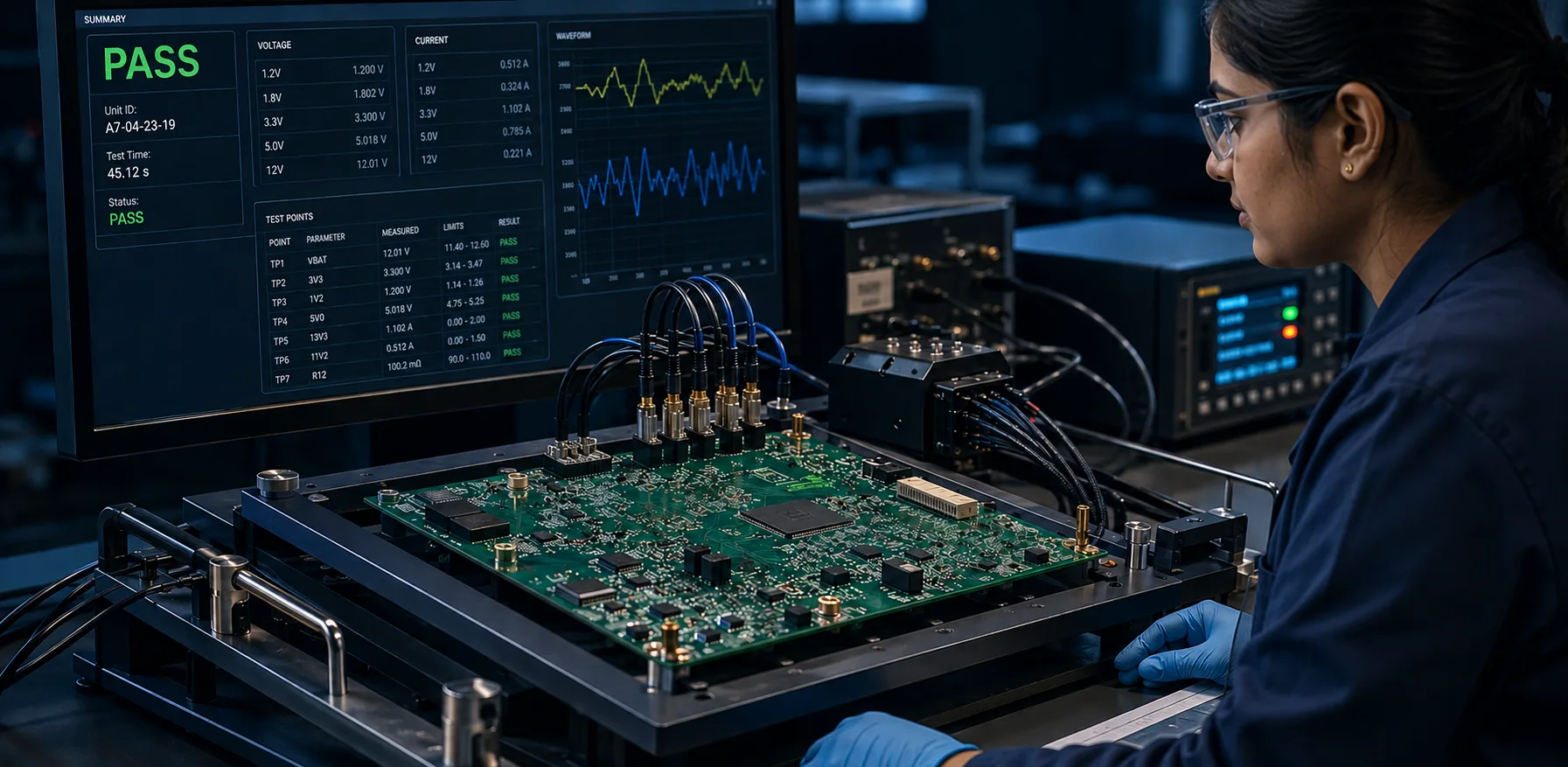
Functional testing of PCB assemblies during NPI and production
A PCB assembly can look perfect under a microscope.
It can pass automated optical inspection.
It can have correctly placed components.
It can even pass basic electrical checks.
And it can still fail to perform its intended function.
That is the fundamental reason functional testing matters.
Functional testing moves beyond asking:
"Was the PCB assembled correctly?"
and asks the more important question:
"Does the assembled PCB actually behave as the product requires?"
Functional Circuit Test (FCT) generally powers and stimulates the assembled board and evaluates its outputs and behavior against defined requirements. Unlike inspection methods that primarily identify physical or assembly defects, functional testing evaluates the board's operation.
For international electronics buyers, this distinction is important.
A supplier can deliver a visually excellent PCBA without necessarily demonstrating that every required function has been validated.
A robust manufacturing strategy therefore connects:
NPI → Test Development → Pilot Validation → Production Testing → Test Records → Continuous Improvement
1. What Is Functional Testing of a PCB Assembly?
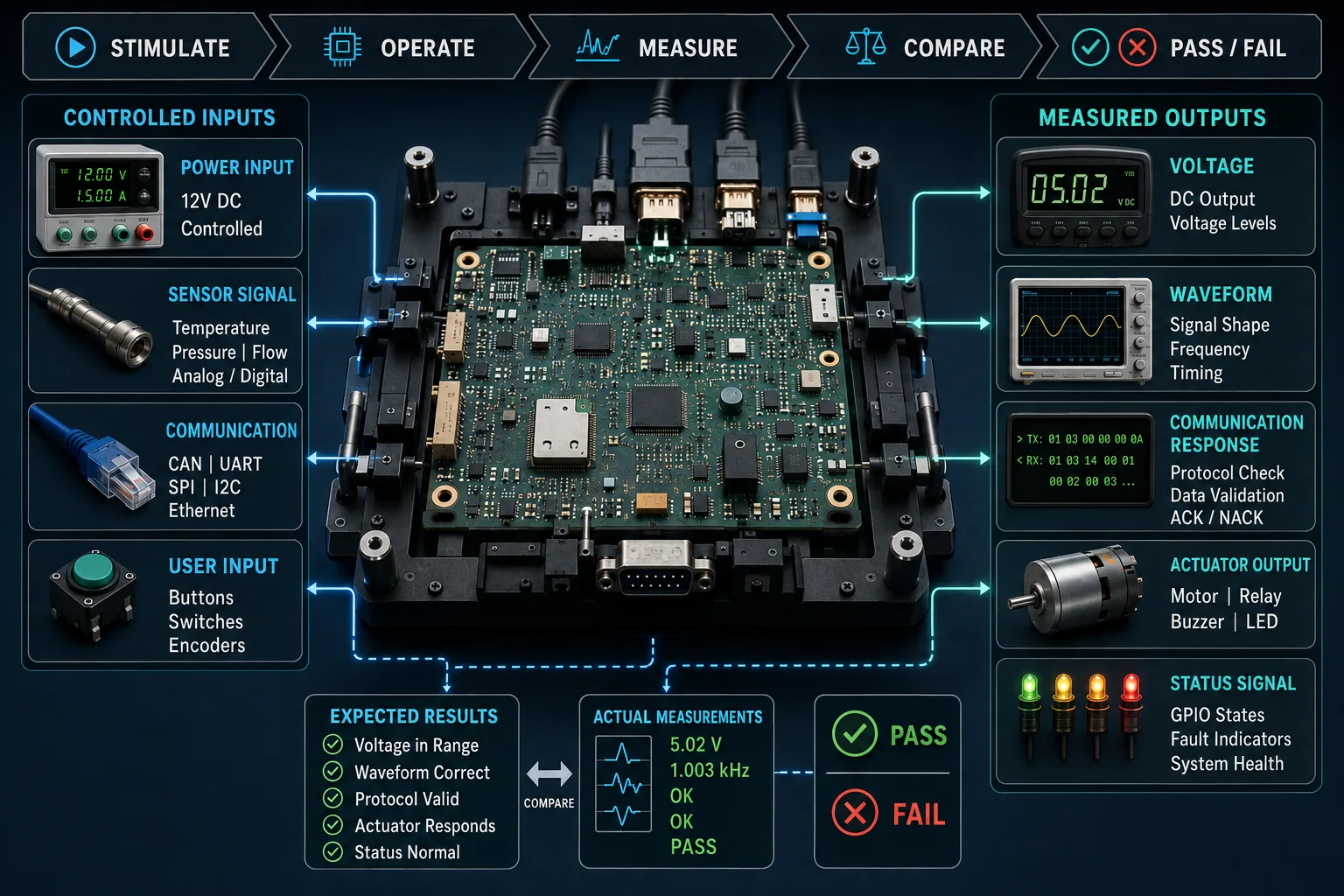
Functional testing applies defined inputs and operating conditions, then measures whether the PCBA produces the expected results.
Functional testing is the process of operating an assembled PCB under defined conditions and checking whether its expected functions and outputs meet predetermined requirements.
Depending on the product, testing may involve:
In other words, the PCBA is tested in a way that approximates how it is expected to operate in the final product.
This is why functional testing is fundamentally different from simply checking whether a board powers up.g
2. Functional Testing Is Not the Same as Inspection
PCB assembly quality involves several different layers of verification.
SPI
Solder Paste Inspection evaluates solder paste deposition before component placement.
AOI
Automated Optical Inspection evaluates visible assembly characteristics such as component presence, placement and solder-related defects.
X-Ray
X-ray inspection can provide visibility into hidden solder joints and structures such as BGA connections.
ICT
In-Circuit Testing can evaluate electrical characteristics and specific circuit nodes.
Flying Probe
Flying probe testing can provide flexible electrical access without requiring a traditional dedicated fixture.
Functional Testing
Functional testing evaluates whether the assembled circuit performs its intended operating functions.
These methods are complementary rather than interchangeable.
A robust test strategy may combine several of them depending on product complexity, volume, risk and required coverage.
3. Why Functional Testing Matters
Consider a power-management board.
AOI may confirm:
An electrical test may confirm:
But functional testing can go further.
It may verify:
That is the difference between verifying assembly characteristics and verifying product behavior.
4. When Should Functional Testing Be Performed?
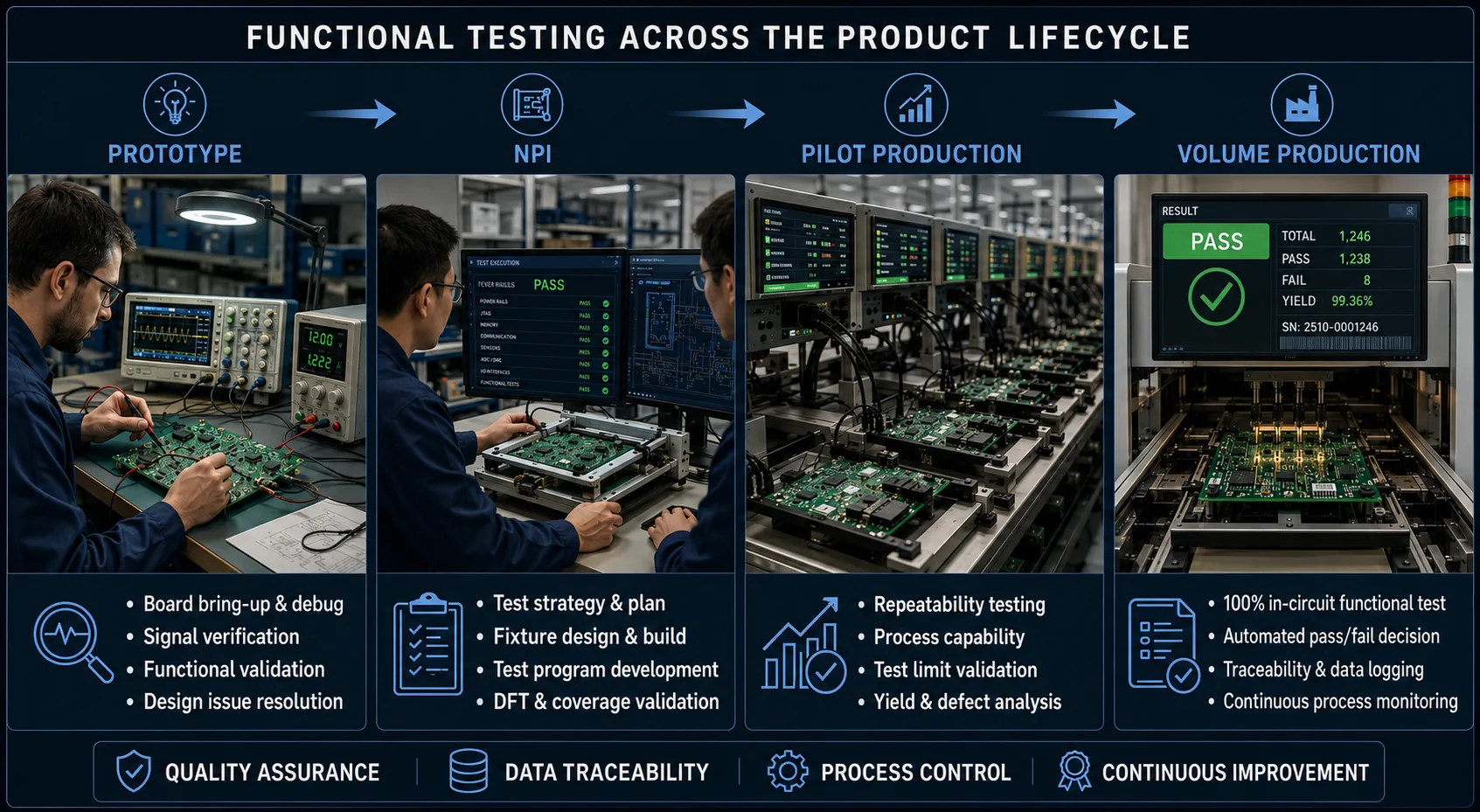
Functional testing evolves from engineering validation during prototype and NPI into a controlled production process.
Functional testing can have different roles throughout the product lifecycle.
Prototype
Used primarily for engineering validation and debugging.
NPI
Used to develop, validate and stabilize the test method.
Pilot production
Used to confirm test repeatability and establish production baselines.
Volume production
Used as a controlled production verification step.
Failure analysis
Used to investigate boards that fail another test or are returned from the field.
The test may look similar at each stage, but its purpose changes.
5. Functional Testing During Prototype
Prototype testing is often exploratory.
Engineers may use:
The objective is to answer questions such as:
At this stage, the engineer may change test conditions frequently.
The prototype test process is therefore usually less automated than production testing.
6. Functional Testing During NPI
NPI is where the engineering test approach starts becoming a repeatable manufacturing process.
The team needs to move from:
"An engineer knows how to test this board."
to:
"A defined test process can reliably test every production board."
That transition requires more than creating a test script.
It can involve:
NPI is therefore an important bridge between engineering and production.
7. The Difference Between a Prototype Test and a Production Test
A prototype engineer might connect an oscilloscope probe to a convenient point and manually inspect a waveform.
A production test system cannot depend on that individual engineer.
A production test needs:
This is one of the most important transformations during NPI.
8. Developing the Functional Test Strategy
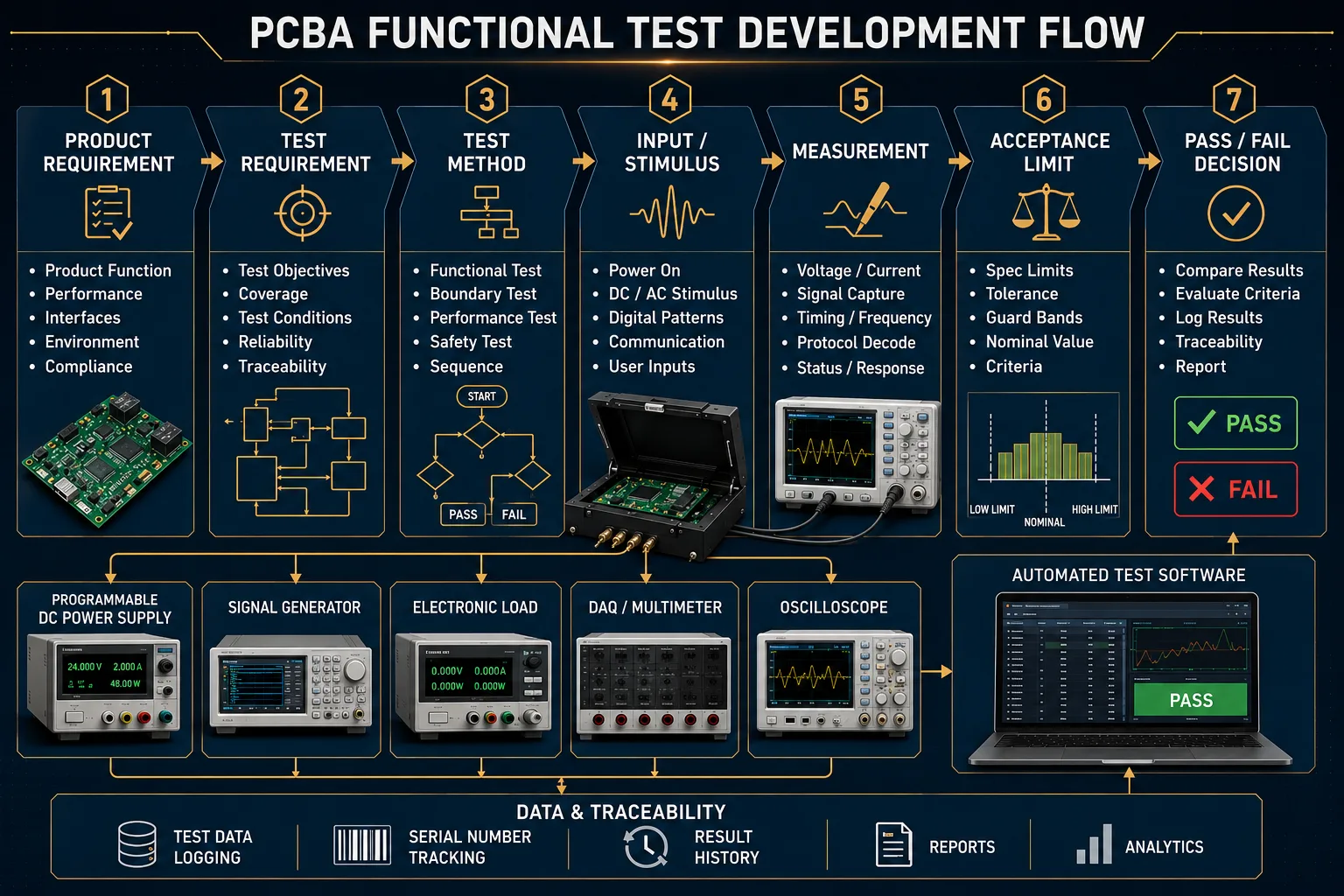
A production functional test should trace each measurement back to a defined product requirement.
A good functional test strategy begins with the product requirements.
Start by identifying:
What must the PCBA do?
Then identify:
What can be measured?
Then:
Under what conditions should it be measured?
And finally:
What constitutes pass or fail?
This produces a chain such as:
Product Requirement
↓
Test Requirement
↓
Test Method
↓
Measurement
↓
Acceptance Limit
↓
Pass/Fail Result
9. What Does a Functional Test Measure?
The exact measurements depend on the product.
Common examples include:
Electrical parameters
Signals
Interfaces
Outputs
Sensors
The test may provide a controlled stimulus and verify the expected sensor response.
10. Firmware Is Often Part of Functional Testing
Modern PCBAs frequently depend on firmware.
That means a functional test may need to verify both:
Hardware
and
Hardware + Firmware interaction
For example, the test sequence may:
A board that passes electrical checks but cannot execute its required firmware behavior may still be a production failure.
11. Functional Test Fixtures
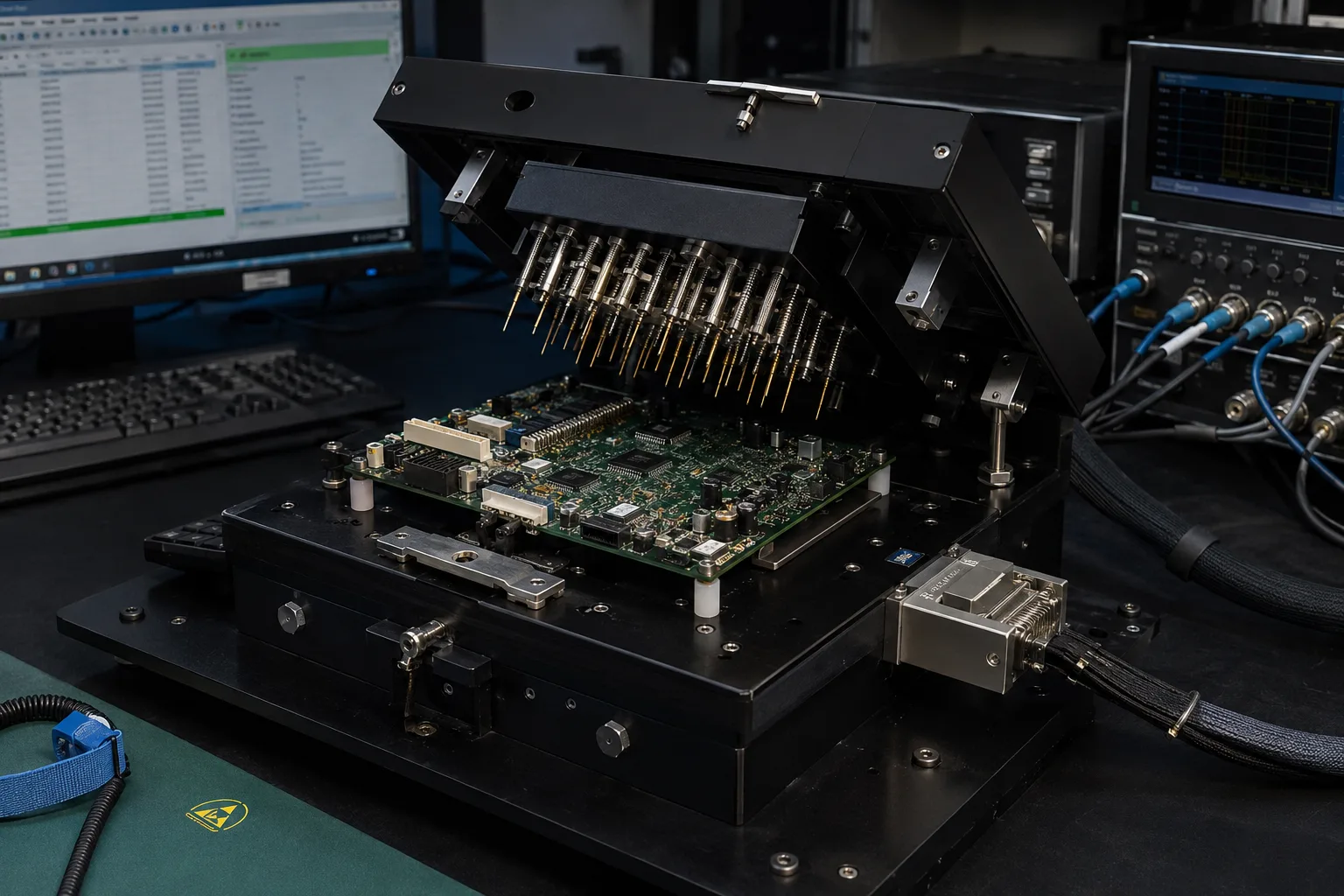
A functional test fixture provides repeatable electrical and mechanical access to the assembled PCB.
A functional test fixture provides a repeatable interface between the PCBA and the test system.
A fixture may provide access to:
The fixture should locate and connect the board consistently.
Depending on the product, functional test fixtures can range from relatively simple interfaces to sophisticated automated systems.
12. Designing the Test Fixture
A fixture should be designed around the actual test requirements.
Important considerations can include:
The fixture should not merely connect the PCB.
It should support a repeatable production process.
13. Functional Test Software
The test hardware is only one part of the system.
The software controls and evaluates the test sequence.
It may:
For automated production, test software should also handle failure conditions consistently.
14. Defining Pass/Fail Limits
This is one of the most important aspects of functional testing.
Suppose a circuit is specified to produce:
3.3 V
The production test cannot simply say:
"Check whether it is approximately 3.3 V."
A defined acceptable range is required.
For example:
Minimum limit → Nominal value → Maximum limit
The actual limits must come from the product specification, component requirements, engineering validation and applicable tolerances—not from arbitrary assumptions.
15. Avoiding Overly Tight Test Limits
An important NPI task is distinguishing between:
A genuine product failure
and
a measurement variation.
If production limits are unnecessarily tight, a good board may fail the test.
This creates:
Therefore, test limits should be validated during NPI using representative production-intent units and appropriate measurement capability.
16. Avoiding Overly Loose Test Limits
The opposite problem is equally dangerous.
If limits are too broad, defective boards may pass.
For example, if an output is expected to operate within a defined range but the test accepts an excessively wide range, marginal products may escape into production.
The objective is therefore:
Limits tight enough to detect meaningful failures, but realistic enough to avoid unnecessary false failures.
17. Test Coverage
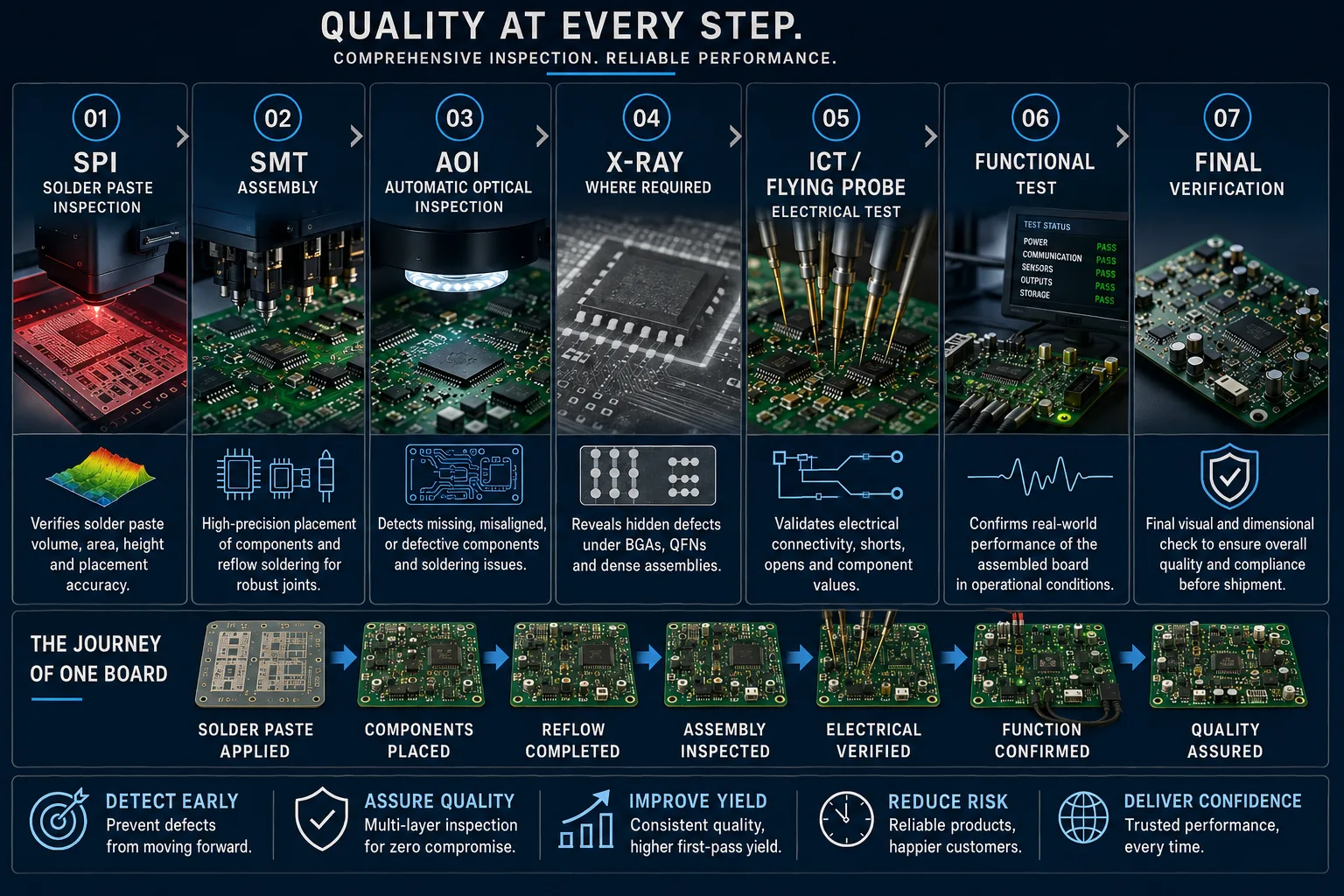
Different test methods address different failure mechanisms; functional testing is one layer of a broader PCBA quality strategy.
Test coverage describes how effectively the test strategy detects relevant failure modes.
A functional test might verify:
But it may not detect every possible manufacturing defect.
That is why functional testing should generally be viewed as part of a broader quality strategy.
A combination of:
SPI + AOI + X-Ray where appropriate + ICT/flying probe + functional testing
can provide different layers of defect detection.
18. Functional Test vs ICT
These two methods are sometimes confused.
ICT
In-circuit testing generally focuses on electrical characteristics and access to circuit nodes or components.
Functional Testing
Functional testing evaluates the board while it performs defined operating functions.
A simplified distinction is:
ICT asks:
"Are the relevant electrical characteristics correct?"
Functional testing asks:
"Does the assembled circuit perform its intended function?"
The two approaches can complement each other.
19. Functional Test vs Flying Probe
Flying probe is primarily an electrical test method that uses movable probes to access selected nodes.
Functional testing may instead operate the board through defined inputs and outputs.
A production strategy might use flying probe where flexible electrical testing is valuable and functional testing where actual product behavior needs to be verified.
The appropriate combination depends on the product.
20. Functional Testing During Pilot Production
Once the functional test has been developed, it should be exercised against pilot production units.
The goal is to determine:
This stage is where many practical test issues become visible.
21. First-Pass Yield and Functional Testing
One useful production metric is First-Pass Yield (FPY).
FPY indicates the proportion of units that pass a defined production stage without requiring rework or additional processing.
If functional testing produces a high failure rate, the manufacturing team should not automatically assume that every failed board is defective.
Failures should be categorized.
For example:
Actual PCBA defect
Test fixture problem
Test software problem
Incorrect test limit
Operator/setup issue
Upstream process issue
This distinction is critical.
22. Failure Analysis
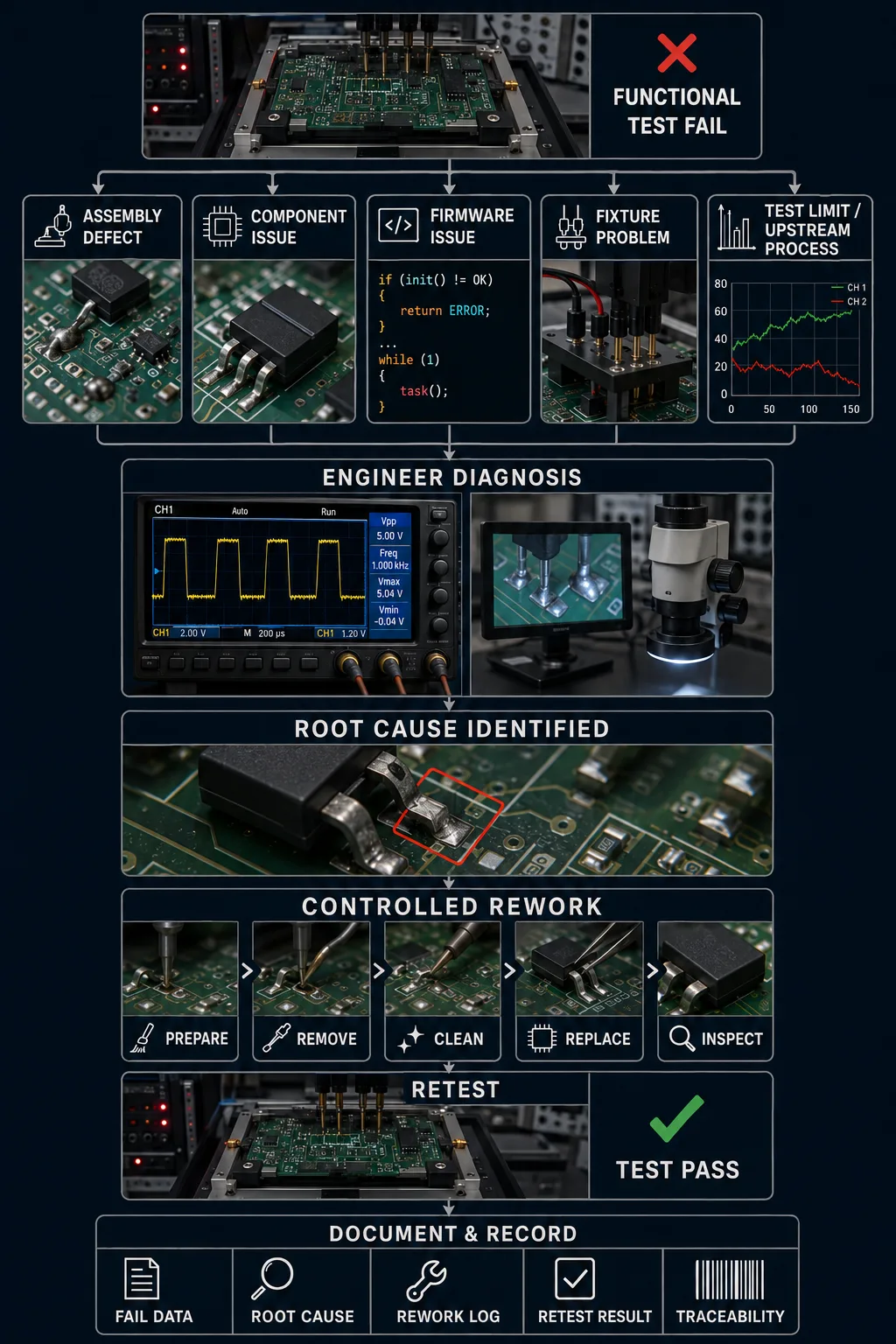
A functional-test failure should trigger structured diagnosis rather than automatic rework.
A failed functional test should initiate a controlled diagnostic process.
A useful workflow is:
Failure detected
↓
Capture test data
↓
Classify failure
↓
Inspect PCBA
↓
Perform electrical diagnosis
↓
Identify root cause
↓
Repair/rework if permitted
↓
Retest
↓
Record outcome
The goal should not merely be to make the board pass.
The goal is to understand why it failed.
23. Test Data and Traceability
For production programs, test results can become an important quality record.
Depending on the customer's requirements, records may include:
Traceability requirements should be agreed before production begins.
24. Why Traceability Matters
Imagine receiving a field-returned product.
Instead of asking:
"Was this board tested?"
a traceable manufacturing system can potentially answer:
This information can significantly improve failure analysis and quality management.
25. Functional Testing and Production Cycle Time
Functional testing adds value—but it also adds production time.
Therefore, test engineering should consider:
Test coverage
versus
Test duration
versus
Production volume
versus
Cost of undetected failure
A test that takes 30 seconds may be insignificant at 100 units.
At 500,000 units, the production impact is very different.
This is why test optimization becomes increasingly important as production scales.
26. Parallel Testing
For higher-volume production, test stations may be designed to test multiple units in parallel where technically and economically appropriate.
Parallelization can improve throughput, but it also introduces additional considerations around:
Test-system throughput should therefore be considered during NPI rather than after production demand increases. Test-system consistency and throughput are recognized considerations in production electronics testing.
27. Functional Test Repeatability
A production test must produce consistent results.
If the same good board is tested repeatedly, the test system should not randomly alternate between:
PASS
and
FAIL
because of uncontrolled measurement variation.
Repeatability can depend on:
NPI should therefore include test-system validation.
28. Test Fixture Maintenance
Functional fixtures are production equipment.
They can wear over time.
Potential issues include:
A production test strategy should therefore include maintenance and verification procedures.
29. Functional Testing and Firmware Control
Firmware revisions can change how a PCBA behaves.
For this reason, test documentation should clearly identify:
A functional test that was valid for one firmware release may not automatically remain valid for another.
Change control is therefore essential.
30. Functional Testing and NPI Documentation
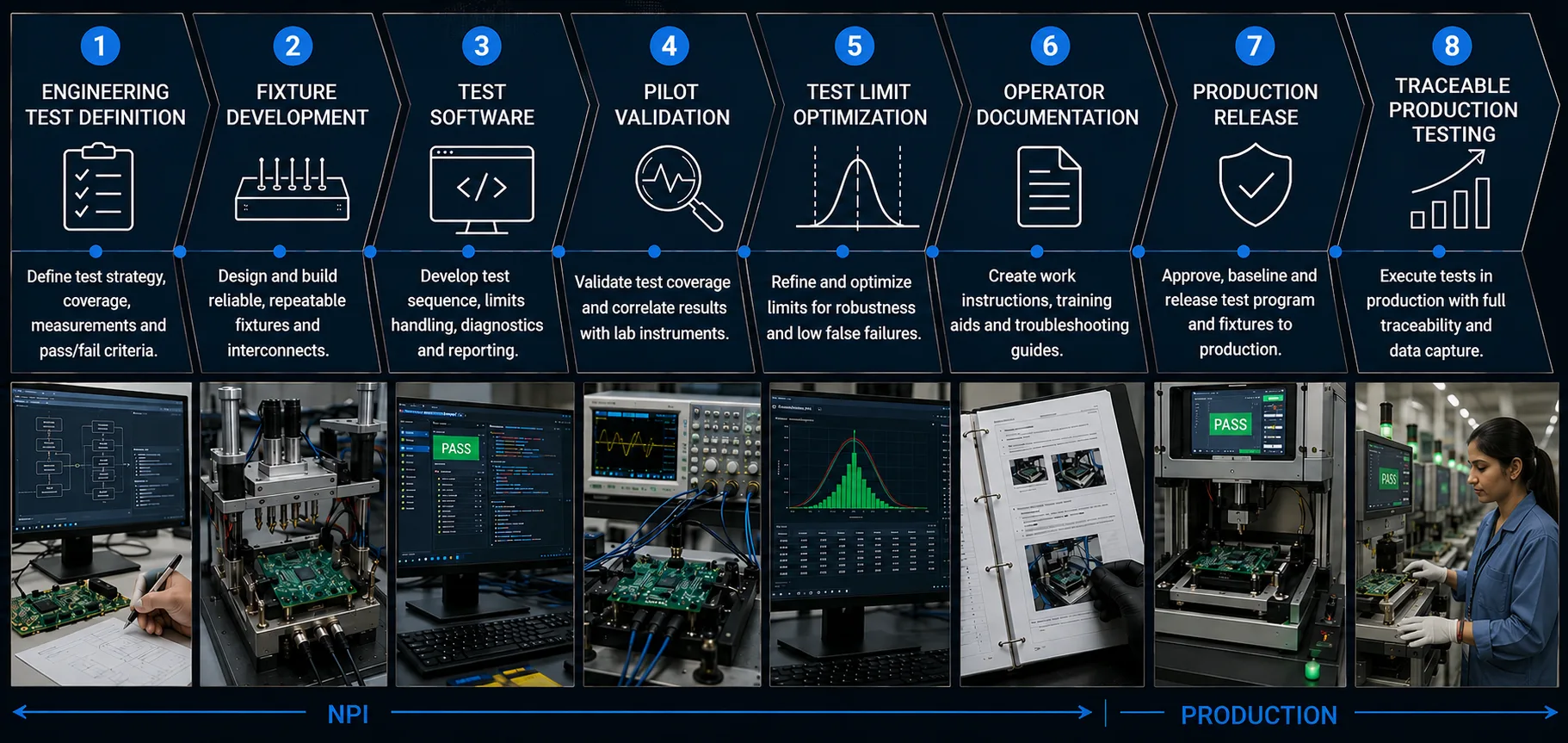
NPI converts an engineering functional test into a controlled and repeatable production process.
A production-ready functional test package may include:
Test procedure
What the test does.
Test sequence
The order in which operations occur.
Test limits
What constitutes pass/fail.
Fixture documentation
How the PCBA interfaces with the test equipment.
Software
The test program and required configuration.
Failure codes
How failures are categorized.
Retest procedure
What happens after a failed test.
Data requirements
What test information must be recorded.
This documentation turns engineering knowledge into a repeatable manufacturing process.
31. Common Functional Testing Mistakes
Mistake 1 — Testing only whether the board powers on
Power-up is only the beginning.
Mistake 2 — Developing the test after production starts
Late test development can delay production and create avoidable risk.
Mistake 3 — No defined acceptance limits
Without clear limits, test results become subjective.
Mistake 4 — Testing too little
Insufficient coverage can allow meaningful defects to escape.
Mistake 5 — Testing too much
Unnecessary tests increase cycle time without necessarily improving quality.
Mistake 6 — Ignoring fixture reliability
A defective fixture can create false failures.
Mistake 7 — No failure classification
Without failure categorization, recurring process problems remain hidden.
Mistake 8 — No test-data traceability
It becomes difficult to investigate field failures.
Mistake 9 — Ignoring firmware revisions
Hardware and software behavior may change together.
Mistake 10 — Treating NPI testing as identical to production testing
NPI is where the test process is developed and validated; production requires the resulting process to be stable and repeatable.
32. Functional Testing for Low-Volume Production
Low-volume products may not justify a highly automated functional test system.
A practical approach may combine:
The objective is to achieve appropriate coverage without creating disproportionate tooling cost.
33. Functional Testing for High-Volume Production
High-volume production places greater emphasis on:
At this stage, test engineering becomes an important part of manufacturing economics.
34. When Should a Manufacturer Develop the Test?
Ideally, test planning begins during NPI.
The manufacturing partner should understand:
This allows testability to influence PCB and fixture design before the production process is frozen.
A number of industry test-development approaches similarly emphasize bringing test strategy into the design/NPI phase rather than treating it solely as a late production activity.
35. What Should an International Buyer Ask a PCBA Supplier?
Before selecting a manufacturing partner, ask:
Can you perform functional testing?
Can you develop the test fixture?
Can you work from our test specification?
Can you develop the test procedure?
Can you integrate firmware into the production test?
Can you provide test records?
Can you support NPI test development?
How are failed boards handled?
Can you trace test results to serial numbers?
How are test limits controlled?
How are fixture maintenance and calibration handled?
These questions help distinguish a supplier that merely assembles PCBAs from a manufacturing partner capable of supporting a controlled production process.
36. What the Customer Should Provide
Functional-test development becomes much easier when the customer provides a clear engineering package.
Useful information may include:
Not every project will have all of these documents.
The manufacturing/test partner should identify gaps early rather than making assumptions.
37. A Practical PCBA Functional Testing Checklist
Before production release, ask:
Test Definition
Hardware
Software
NPI
Production
38. The Goal Is Not "More Testing"
A common misconception is that a better quality program simply means adding more tests.
That is not necessarily true.
The objective is:
The right test, at the right stage, with the right coverage and the right acceptance criteria.
Too little testing increases escape risk.
Too much testing can increase cost and cycle time without proportional benefit.
Good manufacturing engineering finds the balance.
39. FINAL TAKEAWAY
Functional testing is the stage where a PCB assembly moves from:
"It was assembled correctly."
to:
"It performs as intended."
But effective functional testing is not something that should be invented after production begins.
It should evolve through:
Product Requirements
↓
Prototype Testing
↓
NPI Test Development
↓
Fixture & Software Validation
↓
Pilot Production
↓
Test Optimization
↓
Production Release
↓
Traceable Functional Testing
A strong PCBA manufacturing partner should be able to connect these stages rather than treating functional testing as an isolated final inspection.
40. QUADRIONIX PERSPECTIVE
At QUADRIONIX, functional testing is viewed as part of the complete manufacturing and validation strategy.
The objective is not simply to put a board into a fixture and generate a PASS label.
The objective is to establish a repeatable, documented and production-appropriate method of verifying that the assembled PCB performs according to its intended requirements.
For an international customer, that means aligning:
→ PCB Design
→ DFT
→ PCBA Assembly
→ Inspection
→ NPI
→ Functional Test Development
→ Pilot Validation
→ Production Testing
→ Traceability
This approach can help identify problems earlier, establish a reliable production baseline and reduce the risk of functional failures reaching the customer.
If you are Planning a new PCBA program or Your PCBA Ready for Production Functional Testing.
Before moving into volume production, review:
Frequently Asked Questions
Ready to manufacture your electronics project?
Upload your Gerber files & BOM for automated DFM review, engineering feedback, and guaranteed delivery timelines.