Electronics Supply Chain Risks and How to Mitigate Them
A practical guide to understanding component shortages, supplier concentration, logistics disruption, geopolitical exposure and other risks that can affect electronics manufacturing—and how to build a more resilient supply chain.
Introduction
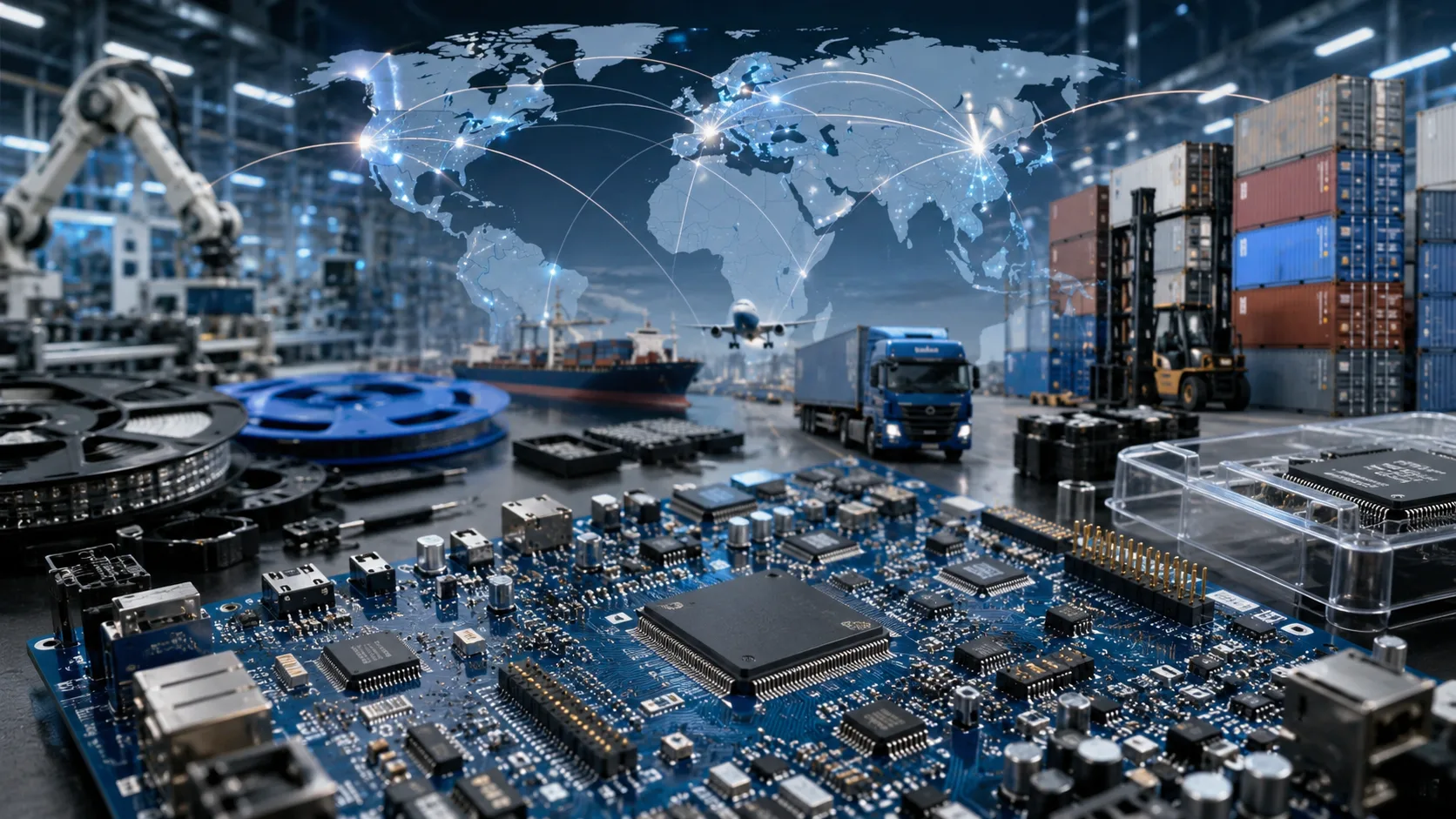
Modern electronics manufacturing depends on a supply chain that extends far beyond a PCB assembly facility.
A single electronic product may depend on:
Each part of that network can introduce risk.
A PCB assembly may be technically ready for production, the manufacturing process may be validated and customer demand may be growing—but production can still be delayed because one critical component is unavailable, a supplier is operating under allocation, transportation is disrupted or manufacturing capacity is constrained.
Electronics supply chain risk management is therefore not simply a procurement activity. It is part of protecting product delivery, manufacturing continuity and long-term business reliability.
The most resilient supply chains do not assume that every component or supplier will always remain available. Instead, they identify critical dependencies early and develop practical strategies for reducing the impact of disruption.
What Are the Biggest Risks in the Electronics Supply Chain?
The most significant electronics supply-chain risks typically include:
Not every risk affects every product equally.
The goal is therefore not to eliminate every possible risk. That is rarely practical.
The objective is to understand:
Which risks could stop production, delay delivery or significantly increase cost—and what can realistically be done before they become critical?
1. Why Are Electronics Supply Chains Particularly Vulnerable?
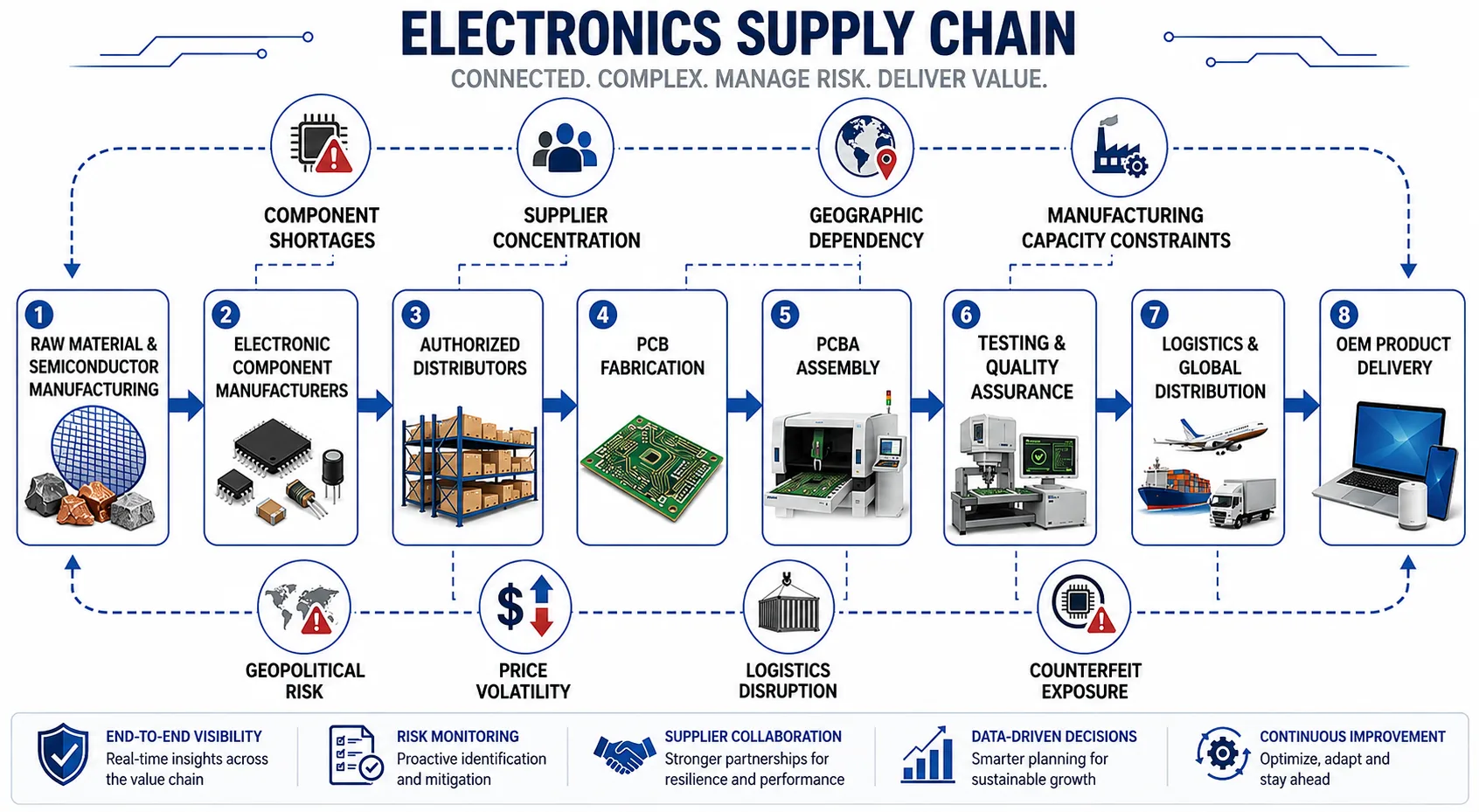
Electronics supply-chain risk can emerge at multiple points between component manufacturing and final product delivery.
Electronics supply chains are complex because many products depend on components manufactured through highly specialized and geographically distributed ecosystems.
A relatively simple PCBA may contain:
These components may come from many different manufacturers and regions.
The finished product is therefore dependent on the availability of the entire component ecosystem.
The critical challenge is interdependency.
Production is often constrained by the weakest link.
For example:
But if one critical IC cannot be sourced, the complete assembly may not be manufacturable.
This is why supply-chain risk should not be evaluated only by asking:
"Are the components available today?"
A more useful question is:
"Can the required components be sourced reliably, at the required quantity and quality, throughout the expected production period?"
2. Component Shortages and Allocation Risk
Component shortages are among the most visible risks in electronics manufacturing.
A shortage can result from:
During normal market conditions, a component may appear readily available.
However, availability can change quickly.
A component that is:
may later become:
How Can Manufacturers Reduce Component Shortage Risk?
Potential strategies include:
Early component risk identification
Identify critical components before production rather than waiting for purchasing problems to emerge.
Qualified alternates
Where technically appropriate, identify and validate alternatives before supply disruption occurs.
Supplier diversification
Avoid unnecessary dependency on a single procurement channel.
Forecast visibility
Share realistic production forecasts with relevant suppliers where longer-term planning is required.
Strategic inventory
For genuinely critical components, carefully planned inventory can provide protection against disruption.
However, inventory should not be treated as a universal solution.
Excessive inventory can create:
The right strategy depends on component criticality and expected product demand.
3. Long Lead Times and Lead-Time Uncertainty
A long lead time is not necessarily the same as a supply shortage.
A component may remain available from the manufacturer but require a lead time that does not match the customer's production schedule.
For example, a product may require:
while a critical component requires:
This creates planning risk.
The situation becomes more complicated when lead times are also unpredictable.
A sourcing plan based on an estimated lead time can become unreliable if:
The Key Question
Procurement should therefore consider both:
Availability
Can the component be purchased?
and:
Timing
Can the component arrive when production requires it?
A component that is technically available but arrives too late can still stop production.
4. Supplier Concentration Risk
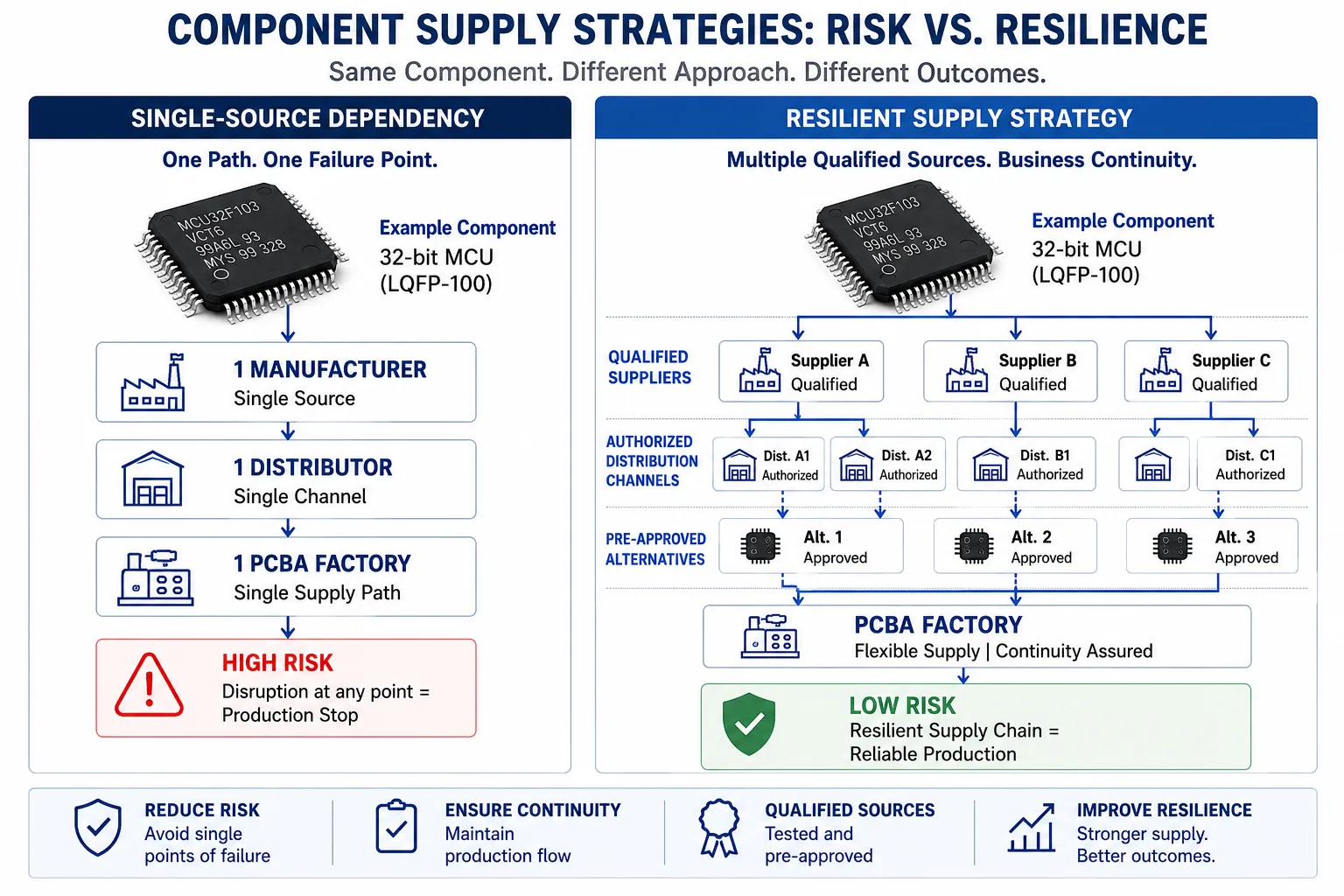
Resilience is not simply having more suppliers—it means understanding which supply alternatives are genuinely qualified and usable.
Supplier concentration occurs when a product depends heavily on one supplier, manufacturer or sourcing channel.
This can occur at several levels.
Single Manufacturer Risk
A critical component may be produced by only one manufacturer.
Single Distributor Risk
Even when multiple distributors exist, purchasing may depend primarily on one source.
Geographic Concentration
Several suppliers may exist but operate within the same geographic region.
Manufacturing Concentration
Multiple components may ultimately depend on the same semiconductor manufacturing ecosystem.
This means apparent diversification may not always represent genuine diversification.
How Should Supplier Concentration Be Evaluated?
A useful framework is:
Supply Risk = Dependency × Criticality × Replacement Difficulty
A single-source resistor may present relatively limited risk if multiple technically equivalent alternatives are easily available.
A single-source processor may present much greater risk if replacing it requires:
The level of concern should therefore depend on the consequence of losing the supply source.
5. Geographic Concentration Risk
Electronics manufacturing is globally interconnected.
This creates efficiency but also dependency.
A product may rely on:
Geographic disruption can therefore affect supply even when the immediate supplier is located somewhere else.
Potential causes include:
Mitigation Does Not Always Mean Moving Everything
A common reaction is to assume that the solution is simply to source from another country.
However, diversification is more complicated.
The key questions are:
Effective diversification requires understanding the full dependency chain rather than simply counting supplier locations.
6. Manufacturing Capacity Constraints
A component may be available, but the manufacturer may not have sufficient capacity to meet demand.
Capacity constraints can occur in:
This is particularly relevant when products move from prototype volumes to production.
A supplier that performs well for:
may not necessarily support:
without changes to capacity planning.
Questions to Consider
Before relying on a manufacturing or supply partner, buyers should understand:
Supply resilience includes manufacturing capacity—not just component sourcing.
7. Logistics and Transportation Disruption
Electronics supply chains depend on physical movement.
Potential logistics risks include:
A component can be manufactured and available but still fail to arrive in time.
How Can Logistics Risk Be Reduced?
Potential strategies include:
The objective is not to predict every disruption.
It is to avoid building a production plan that has no tolerance for disruption.
8. Geopolitical and Regulatory Risk
International electronics supply chains can be affected by changes in:
These changes may affect:
Practical Mitigation
Organizations should avoid treating regulatory and geopolitical exposure as purely external issues.
The practical question is:
Which components, suppliers or manufacturing locations would create a production problem if trade conditions changed?
For high-risk products or long lifecycle products, this can influence:
9. Demand Volatility
Supply-chain disruption does not always originate from a supplier.
Unexpected demand can also create risk.
If demand increases faster than forecast:
Conversely, if demand decreases:
Better Forecasting Helps—but Forecasts Are Never Perfect
The goal is not perfect prediction.
The goal is to create a sourcing strategy that can tolerate reasonable changes in demand.
Useful approaches may include:
10. Price Volatility and Commercial Risk
Lowest unit price does not always mean lowest supply-chain cost.
A low-cost component may create higher overall risk if it has:
A better sourcing decision considers the wider cost of disruption.
For example:
Component Price
$5
versus:
Cost of Production Delay
Potentially much greater than the component saving.
The appropriate decision is therefore not always:
"Which component is cheapest?"
but:
"Which sourcing decision provides the best balance between cost, availability and production continuity?"
11. Quality, Authenticity and Counterfeit Risk
Supply pressure can increase the temptation to purchase components from unfamiliar or poorly controlled sources.
This creates potential risks involving:
These risks can be particularly significant when a component becomes difficult to obtain through authorized channels.
Risk Mitigation Should Include Supplier Quality
For critical components, sourcing strategy should consider:
A component that arrives quickly but cannot be trusted can create a much larger manufacturing and field reliability problem.
12. Component Obsolescence as a Supply-Chain Risk
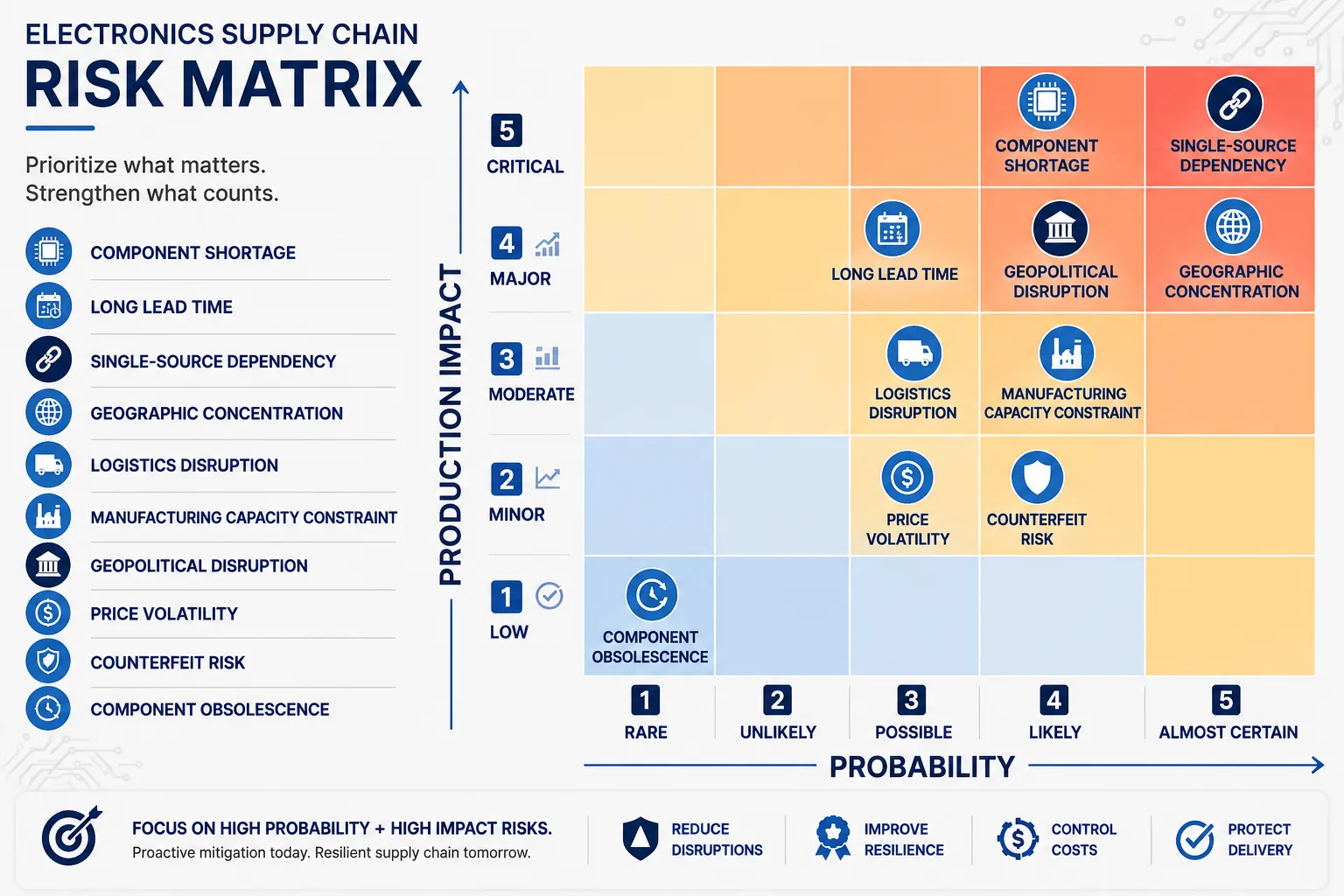
Supply-chain risks should be prioritized according to both likelihood and potential impact on production continuity.
Component obsolescence is closely connected to supply-chain resilience, but it requires deeper product-specific management.
A component may move through stages such as:
A product can therefore face increasing supply risk even when the PCB design itself remains unchanged.
For example:
The product design may be stable while the supply chain supporting the design is changing.
This is why component lifecycle should be monitored throughout the product lifecycle.
This article addresses obsolescence as a broader supply-chain risk.
For detailed management of:
read the related QUADRIONIX resource article:
BOM Risk Management and Component Obsolescence in Electronics Manufacturing.
13. How to Build a More Resilient Electronics Supply Chain
Supply-chain resilience is not created through a single action.
It is built through a combination of engineering, procurement and manufacturing decisions.
Step 1: Identify Critical Dependencies
Start by identifying components and processes that could stop production.
Examples may include:
Not every item requires the same level of attention.
Step 2: Evaluate Supply Depth
For critical items, understand:
Step 3: Qualify Alternatives Before a Crisis
One of the most effective strategies is to avoid waiting for a shortage before investigating alternatives.
Depending on the component, qualification may require:
A part that looks similar is not automatically a safe alternative.
Step 4: Align Inventory Strategy with Risk
Inventory should be strategic.
Higher-risk components may justify:
Lower-risk commodity components may not.
The right inventory decision depends on:
Criticality × Supply Risk × Forecast Confidence
Step 5: Diversify Where Diversification Creates Real Value
Multiple suppliers are useful only when they provide genuine alternatives.
A practical diversification strategy should consider:
Simply having more supplier names does not automatically create resilience.
Step 6: Monitor Risk Continuously
Supply conditions change.
A component that was low risk six months ago may become higher risk because of:
Supply-chain risk management should therefore be a continuing process.
14. A Practical Electronics Supply-Chain Risk Framework
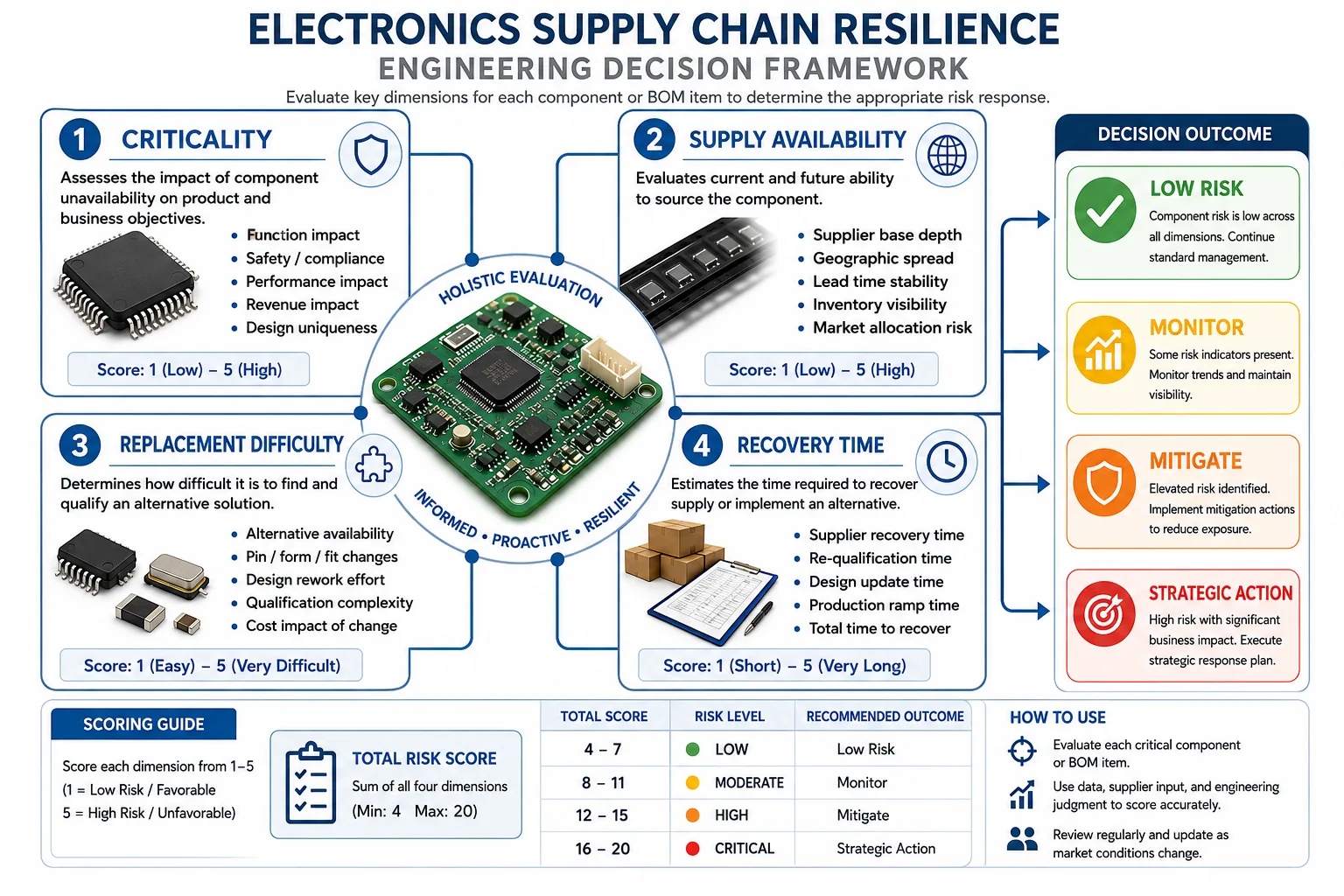
Effective mitigation begins by understanding both the likelihood of disruption and the difficulty of recovering from it.
A useful way to structure decision-making is to assess each major dependency against four factors.
1. Criticality
How seriously would production be affected?
2. Supply Availability
How easily can the required item be sourced?
3. Replacement Difficulty
How difficult would it be to change the component or supplier?
4. Recovery Time
How long would it take to restore production after disruption?
This produces a more useful conversation than simply classifying a supplier or component as:
Risk is relative to the impact on the specific product.
15. What Should OEMs and International Buyers Ask Their Manufacturing Partner?
Supply-chain resilience should be discussed before production is disrupted.
Useful questions include:
Component Sourcing
Alternatives
Lifecycle
Supply Planning
Traceability and Quality
The best time to understand a supplier's supply-chain process is before a production disruption occurs.
16. Supply-Chain Risk from Prototype to Production
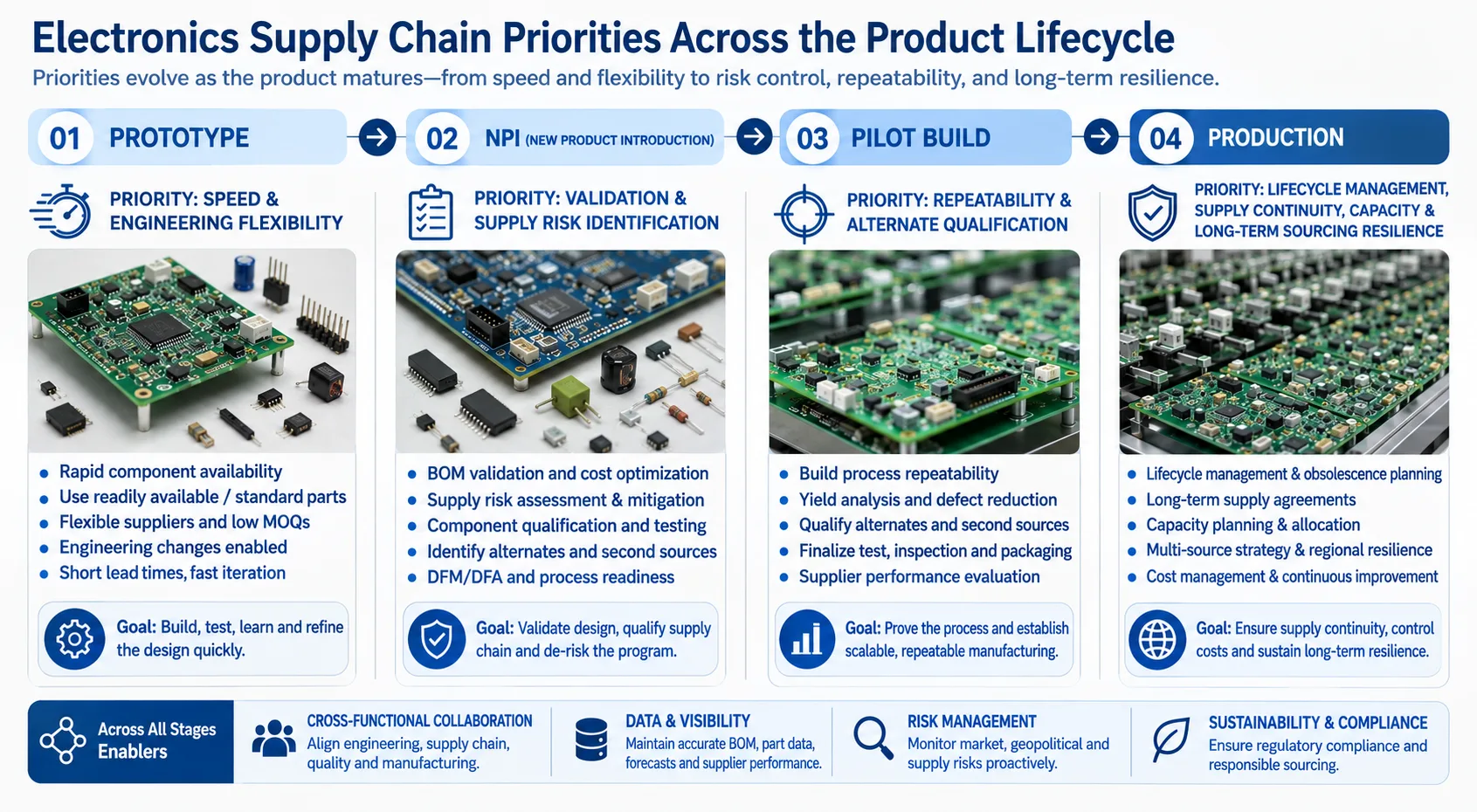
Supply-chain priorities evolve as electronics products move from prototype quantities to long-term production.
Supply risk often changes as a product progresses.
Prototype Stage
The priority may be:
NPI Stage
The focus begins shifting toward:
Production Stage
Long-term considerations become increasingly important:
A sourcing approach that works for prototypes should not automatically be assumed suitable for volume production.
17. Common Mistakes in Electronics Supply-Chain Risk Management
Mistake 1: Looking Only at Current Availability
Stock today does not guarantee supply tomorrow.
Mistake 2: Choosing Only by Lowest Component Price
A cheaper component can create higher total cost if it increases production risk.
Mistake 3: Waiting Until a Shortage Occurs
Alternatives are much easier to evaluate before production is stopped.
Mistake 4: Assuming Multiple Suppliers Mean Low Risk
Suppliers may still share the same geographic or upstream dependencies.
Mistake 5: Treating Prototype Sourcing as Production Sourcing
A sourcing strategy suitable for 10 units may not be suitable for 10,000.
Mistake 6: Ignoring Component Lifecycle
A technically successful product can still develop serious supply risk as components approach NRND or EOL.
Mistake 7: Purchasing from Uncontrolled Sources Under Pressure
Emergency purchasing without appropriate traceability can introduce significant quality and authenticity risk.
18. Practical Electronics Supply-Chain Risk Checklist
Before committing an electronics product to production, review the following.
Component Availability
☐ Critical components checked for availability☐ Lead times reviewed☐ Supply depth understood
Supplier Dependency
☐ Single-source dependencies identified☐ Geographic concentration considered☐ Critical supplier exposure reviewed
Manufacturing Capacity
☐ Production capacity requirements discussed☐ Demand increase scenarios considered☐ Forecast process defined
Alternatives
☐ Potential alternates identified where appropriate☐ Technical qualification requirements understood☐ Customer approval process defined
Logistics
☐ Production schedules include reasonable risk tolerance☐ Transportation dependencies considered☐ Documentation and customs requirements understood
Lifecycle
☐ Component lifecycle status reviewed☐ NRND/EOL exposure identified☐ Long-term monitoring process established
Quality
☐ Critical sourcing channels defined☐ Traceability requirements understood☐ Difficult-to-source component controls established
19. Key Takeaways
Electronics supply chains are vulnerable because electronics products depend on complex networks of specialized manufacturers, suppliers, logistics providers and production facilities.
The most important lessons are:
20. Conclusion
Electronics supply-chain risk cannot be eliminated completely.
Component markets change. Manufacturing capacity changes. Logistics networks change. Regulatory and geopolitical conditions can change.
The objective is therefore not to predict every possible disruption.
It is to understand where the product is vulnerable and reduce the consequences of predictable risks.
The strongest approach combines:
A resilient electronics supply chain is ultimately created through preparation.
A technically correct design can still face delays if critical components, suppliers or manufacturing dependencies are not evaluated early. QUADRIONIX can help review PCB/PCBA manufacturing requirements, component sourcing considerations and production-readiness risks before moving into larger-scale manufacturing.
The best time to discover a critical dependency is before it stops production. Reduce Supply Risk Before It Reaches Production
Frequently Asked Questions
Ready to manufacture your electronics project?
Upload your Gerber files & BOM for automated DFM review, engineering feedback, and guaranteed delivery timelines.