BOM Risk Management and Component Obsolescence in Electronics Manufacturing
How to manage component lifecycle, availability, sourcing, alternates and obsolescence risk to protect electronics production continuity.
Introduction
A Bill of Materials may look like a simple list of components and quantities.
In reality, it represents a large number of decisions that affect whether an electronic product can be manufactured reliably throughout its intended lifecycle.
A component may be:
This is why BOM management is not simply a purchasing activity.
It is a combined:
activity.
The most useful question is therefore not:
Can we buy these components today?
It is:
Can we reliably source the right components, at the required quality, quantity and cost, throughout the product's manufacturing lifecycle?
That is the foundation of effective BOM risk management.
1. What Is BOM Risk?
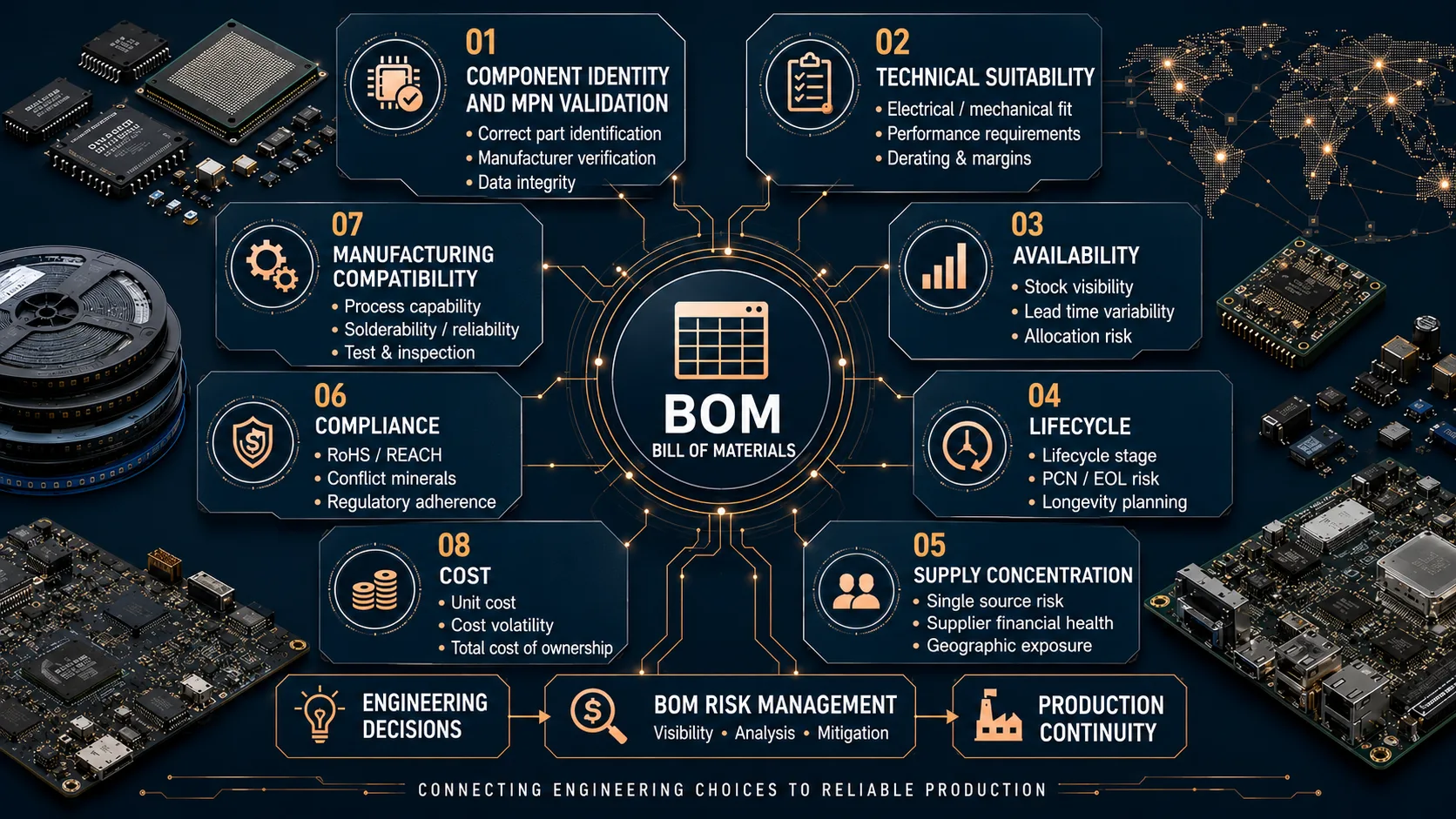
BOM risk extends beyond component availability to technical, lifecycle, sourcing, manufacturing, commercial and compliance factors.
BOM risk is the possibility that one or more components in a product's Bill of Materials could create problems involving manufacturing, availability, lifecycle, cost, quality, compliance or production continuity.
BOM risk can exist across several dimensions.
Technical Risk
The component may not meet the required:
Component Identity Risk
The BOM may contain:
Availability Risk
The component may have:
Lifecycle Risk
The component may be:
Supply Concentration Risk
The product may depend heavily on:
Commercial Risk
Pricing may be:
Manufacturing Compatibility Risk
A technically suitable component may still create problems involving:
Compliance Risk
The component may fail applicable:
The purpose of BOM risk management is to evaluate these dimensions together rather than treating a BOM as merely a list of part numbers and quantities.
2. Why BOM Risk Often Appears Too Late
A common manufacturing sequence is:
PCB Design Completed↓BOM Generated↓RFQ Issued↓Components Checked↓Problem Discovered↓Production Delayed
By this stage, changing a component may require:
The cost of change generally increases as the product moves closer to production.
A stronger process is:
BOM Creation↓Early BOM Risk Analysis↓Component Validation↓Alternate Strategy↓Supplier Validation↓NPI↓Production
The earlier a risk is identified, the more options the engineering and sourcing teams usually have.
3. The Eight Major Dimensions of BOM Risk
A practical BOM review should answer at least the following questions:
| Risk Dimension | Key Question |
|---|---|
| Component identity | Is the exact MPN correct? |
| Technical suitability | Does the component meet the required specification? |
| Availability | Can it be sourced when required? |
| Lifecycle | Will it remain suitable for the product lifecycle? |
| Supply concentration | Are sufficient sourcing options available? |
| Cost | Is pricing sustainable at production volume? |
| Manufacturing compatibility | Can it be assembled reliably? |
| Compliance | Does it meet applicable requirements? |
A reliable BOM should therefore be evaluated as a production system, not simply as a purchasing list.
4. Manufacturer Part Number Validation
One of the simplest and most important BOM checks is confirming the exact Manufacturer Part Number.
An MPN should not be treated as merely a text string.
The review should verify:
Small differences in suffixes can represent materially different components.
Two visually similar components may differ in:
A BOM containing an incorrect suffix can therefore create a significant manufacturing problem.
5. Package and Footprint Risk
A component may be electrically suitable but still be unsuitable for the existing PCB.
The following must be considered:
A replacement component should therefore not be approved simply because it performs a similar electrical function.
6. Same Footprint Does Not Always Mean Safe Replacement
This is one of the most important principles in alternate component management.
Same footprint does not necessarily mean same electrical behaviour.
Similarly:
Pin-to-pin compatibility does not automatically mean function-to-function compatibility.
A replacement may differ in:
An alternate should therefore be evaluated at system level, not simply at package level.
7. What Is Component Obsolescence?
Component obsolescence occurs when an electronic component required by a product can no longer be reliably procured in the required form, quantity, quality or timeframe.
The most obvious example is official manufacturer discontinuation.
However, practical obsolescence can begin earlier.
A component may technically still be manufactured while becoming increasingly difficult to source because of:
This leads to an important principle:
“Not obsolete” does not necessarily mean “low risk.”
A component can remain officially active while already presenting significant sourcing risk.
8. Understanding the Component Lifecycle
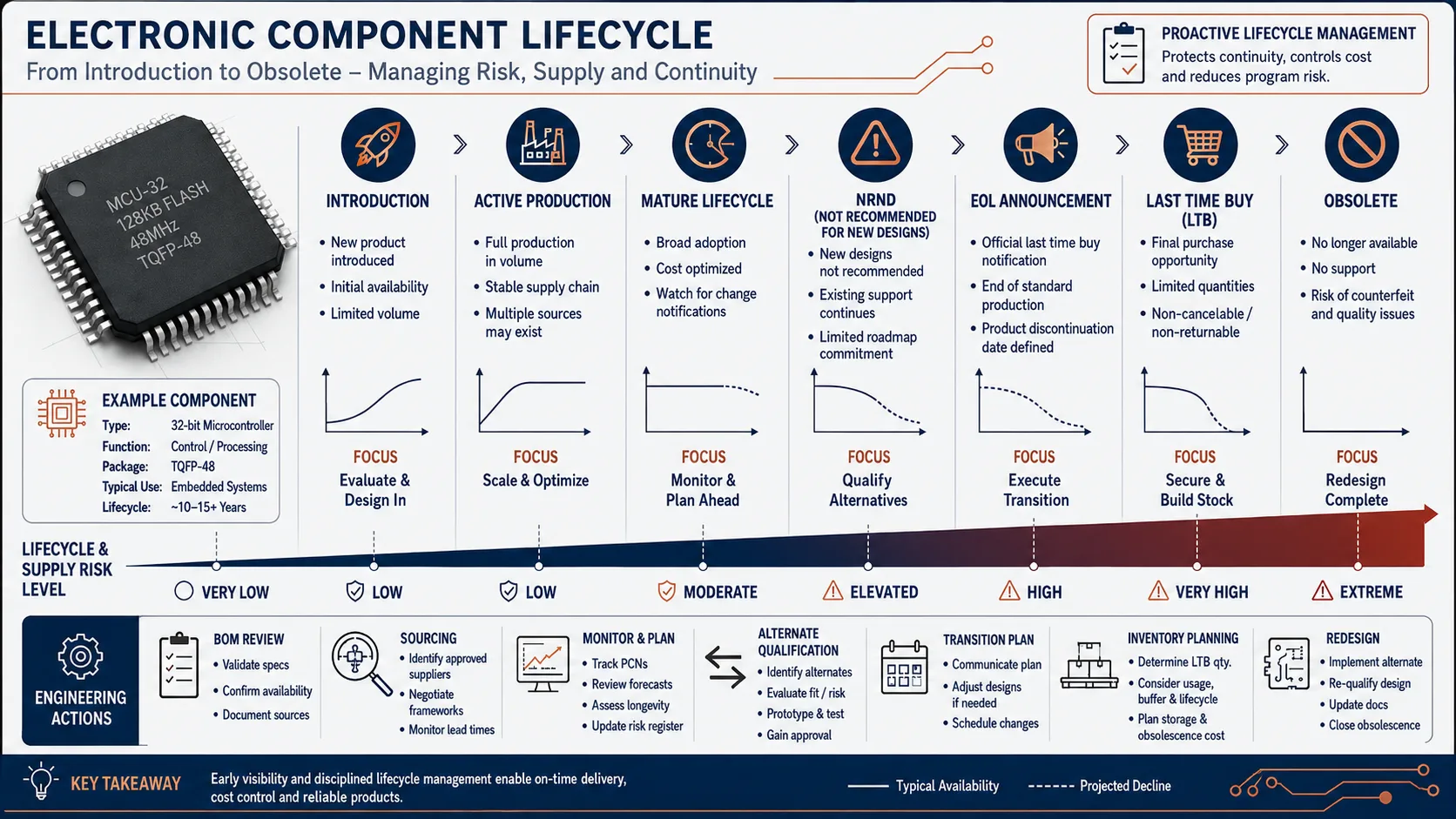
Component risk can increase progressively as a device moves from active production toward NRND, EOL and obsolete status.
Manufacturers may use different lifecycle terminology, but a typical progression can be understood conceptually as:
Introduction↓Active Production↓Mature Product↓NRND / Lifecycle Caution↓EOL Announcement↓Last-Time Buy↓Obsolete
The important point is that lifecycle risk is not binary.
A component does not suddenly become risky on the day it becomes obsolete.
Risk can increase gradually as the component moves through its lifecycle.
9. Active Does Not Mean Risk-Free
An active component is generally still supported by the manufacturer.
That does not automatically make it the lowest-risk choice.
Consider two active components.
Component A
Component B
Both may be classified as active.
Their real supply and replacement risk may be very different.
Lifecycle status should therefore be considered together with:
10. What Does NRND Mean?
NRND generally means:
Not Recommended for New Designs
It is an important lifecycle warning.
An NRND component may still be available to support existing customers.
However, it indicates that the component should generally be treated cautiously when selecting components for a new product.
For an existing product, the component may remain usable.
For a new product expected to remain in production for many years, selecting an NRND component requires careful justification.
The key lesson is:
NRND is not necessarily an immediate production emergency—but it is a design and lifecycle warning.
11. EOL and Last-Time Buy
An End-of-Life notification indicates that a manufacturer intends to discontinue a component.
The manufacturer may establish a final ordering period.
This is commonly referred to as:
Last-Time Buy (LTB)
An EOL event creates several possible strategies.
Option A — Purchase Inventory
Buy sufficient material to support the remaining product lifecycle.
Option B — Qualify an Alternate
Identify and technically qualify a replacement.
Option C — Redesign
Modify the circuit or PCB to support another component.
Option D — Combine Strategies
Use strategic inventory to support current production while planning and validating a redesign.
There is no universal answer.
The correct decision depends on:
12. Why Obsolescence Is More Than a Procurement Problem
A common mistake is assigning component obsolescence entirely to procurement.
The reality can involve multiple functions.
Procurement:The part is no longer reliably available.
Engineering:The replacement may not fit or behave the same way.
Manufacturing:The replacement package may require different assembly considerations.
Quality:Additional validation may be required.
Firmware:The new device may behave differently.
Program Management:The product schedule may be affected.
This demonstrates why obsolescence management should have cross-functional ownership.
13. The Real Cost of an Obsolete Component
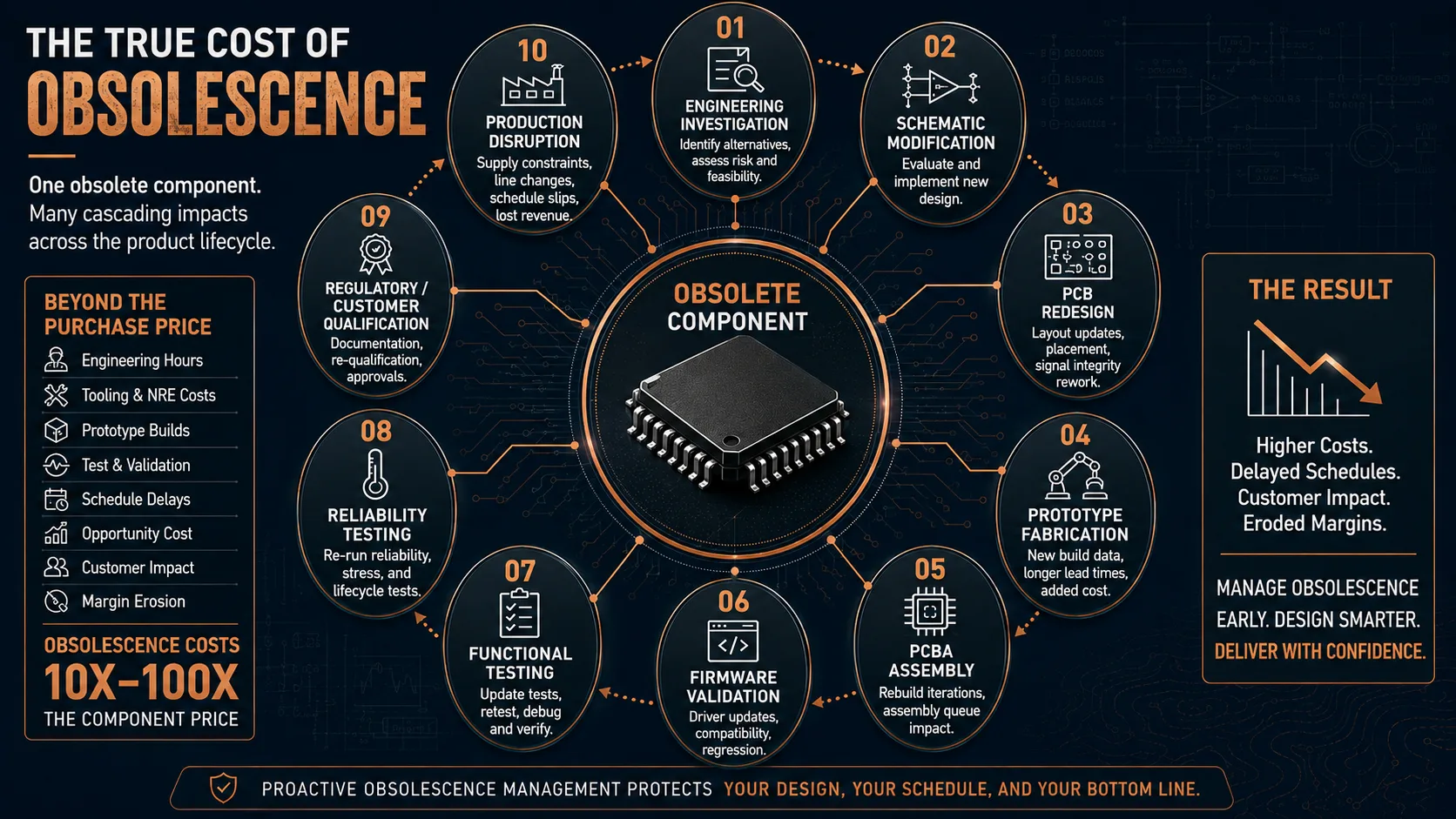
The business impact of component obsolescence can extend far beyond the price of the replacement scomponent.
The purchase price of the obsolete component may be one of the smallest costs involved.
The wider impact can include:
A low-cost component can therefore create a disproportionately large engineering and business impact.
14. Identifying High-Risk Components
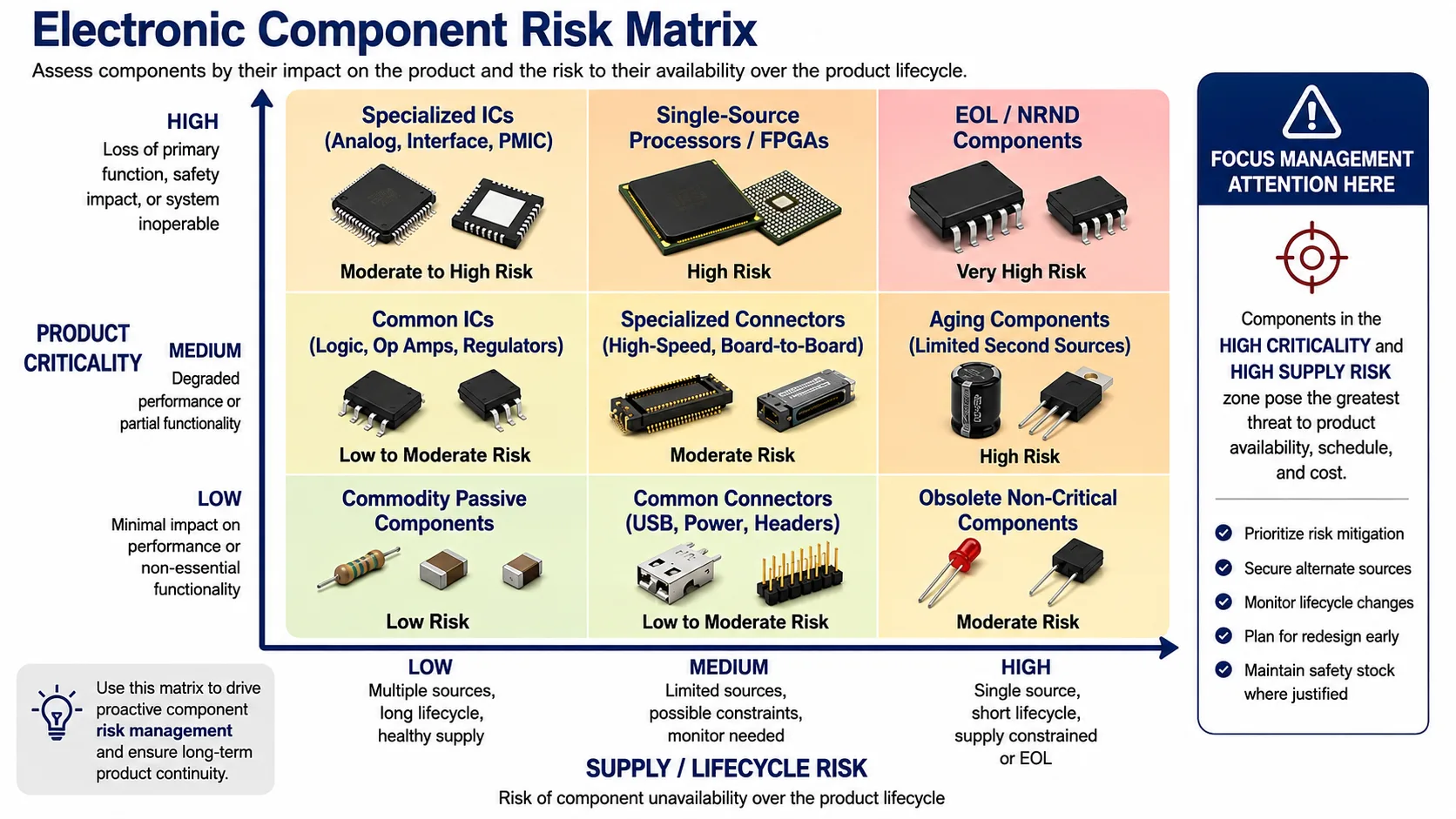
BOM management should prioritize components according to both their importance to the product and the difficulty of maintaining supply.
Not every component deserves the same level of monitoring.
A high-risk component may combine:
A low-cost commodity component available from multiple qualified sources may require less attention.
A useful prioritization framework is:
Component Risk = Criticality × Lifecycle Risk × Supply Concentration × Replacement Difficulty
This is not intended as a universal mathematical formula.
Its purpose is to force the right engineering and sourcing questions.
15. How to Qualify an Alternate Component
Finding an apparently similar component is not the end of the process.
A structured alternate qualification process can include:
Step 1 — Electrical Comparison
Compare critical electrical parameters.
Step 2 — Pinout Comparison
Verify every relevant functional pin.
Step 3 — Package Comparison
Review dimensions and land-pattern requirements.
Step 4 — Thermal Comparison
Evaluate power dissipation and thermal behaviour.
Step 5 — Circuit Analysis
Check whether surrounding circuitry remains valid.
Step 6 — PCB Impact
Determine whether layout changes are required.
Step 7 — Prototype Build
Build representative hardware where necessary.
Step 8 — Functional Validation
Verify actual system behaviour.
Step 9 — Reliability and Qualification
Perform applicable testing.
Step 10 — Documentation
Update the BOM, drawings, revisions and approved-component records.
The key principle is:
“The datasheet looks similar” is not a complete qualification process.
16. When an Alternate Triggers a PCB Redesign
An alternate can be electrically similar but physically incompatible.
For example, a change from:
QFN 4 × 4 mm
to:
QFN 5 × 5 mm
may require:
The PCB therefore becomes part of the component obsolescence problem.
This is one reason lifecycle planning should begin before procurement encounters an emergency.
17. Firmware Can Also Be Affected
Component replacement is not always limited to hardware.
For programmable components such as:
a replacement may require:
A technically similar component can therefore create a hardware-software integration project.
Component substitution should consider the complete system—not only the PCB footprint.
18. Last-Time Buy: How Much Inventory Is Enough?
A last-time buy is fundamentally a planning decision.
A simple starting calculation may be:
Required Quantity = Annual Consumption × Remaining Product-Support Years
However, that is only the beginning.
The calculation may also need to consider:
Buying too little can create future shortages.
Buying too much can create inventory exposure.
The objective is to balance:
Production Continuity ↔ Inventory Risk
19. Counterfeit and Authenticity Risk After EOL
When authorized channels no longer provide a component, sourcing teams may turn toward:
This can increase the risk of:
For critical products, the response to EOL should not simply be:
Find the cheapest remaining stock.
A better question is:
Can we establish a traceable and technically acceptable supply strategy?
20. Authorized vs Independent Sourcing
For critical components, sourcing decisions should consider:
Authorized and secondary sourcing do not necessarily carry the same risk profile.
The appropriate sourcing route depends on:
21. Inventory Is a Mitigation Strategy—Not a Complete Strategy
Strategic inventory can provide protection against an EOL event.
However, inventory does not eliminate obsolescence.
The product may outlive the inventory.
The stored component may eventually require redesign anyway.
Inventory can also create:
A stronger strategy combines:
Monitoring+Alternate Qualification+Design Flexibility+Last-Time-Buy Planning
22. Design for Component Longevity
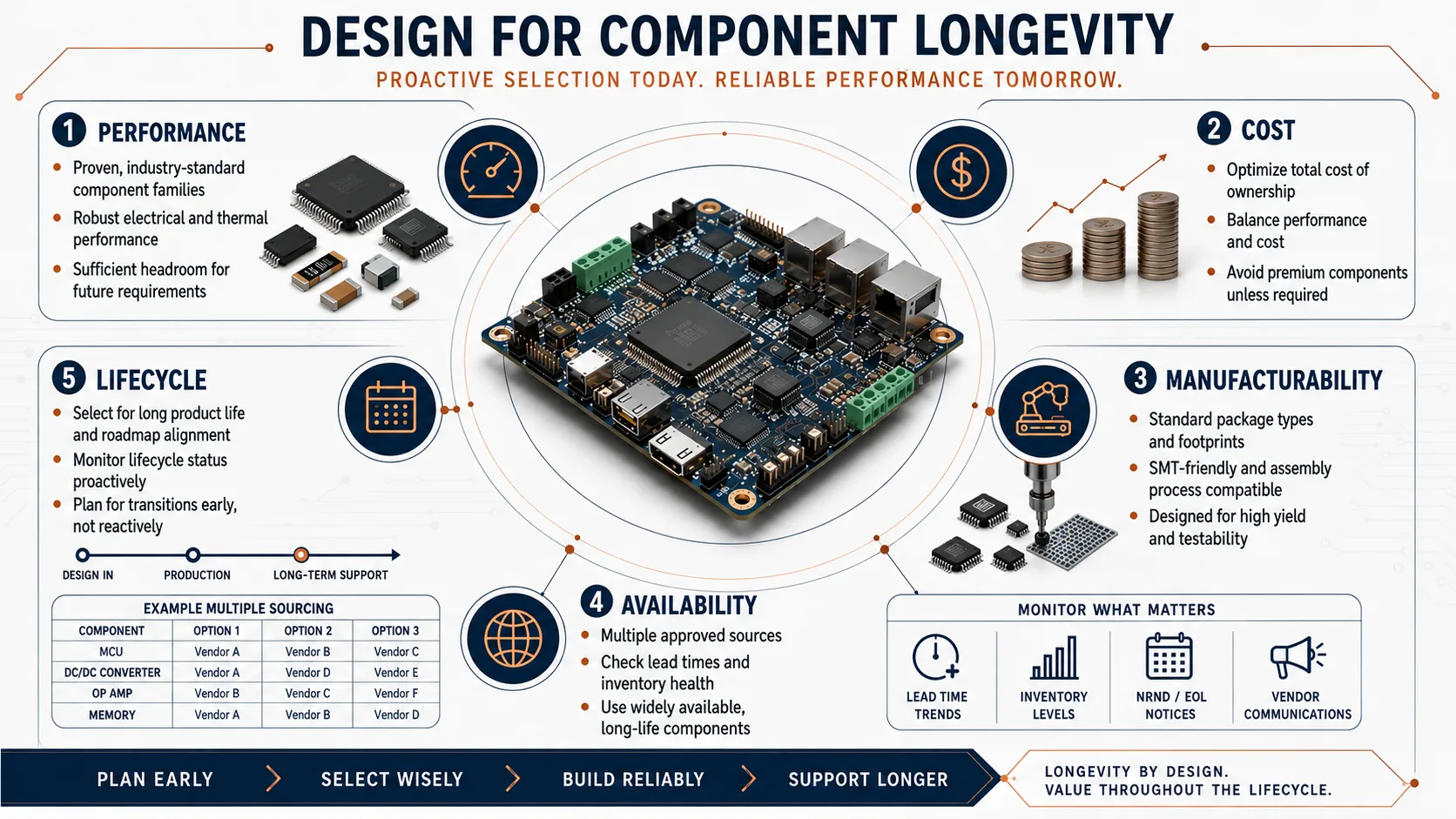
Long-term component strategy begins during product design by balancing performance with availability, manufacturability and lifecycle considerations.
One of the strongest ways to reduce future obsolescence risk is to consider lifecycle during component selection.
Where product requirements allow, engineering teams can consider:
This does not mean selecting the most common component regardless of performance.
The goal is to balance:
Performance + Cost + Manufacturability + Availability + Lifecycle
23. BOM Risk: Prototype vs Production
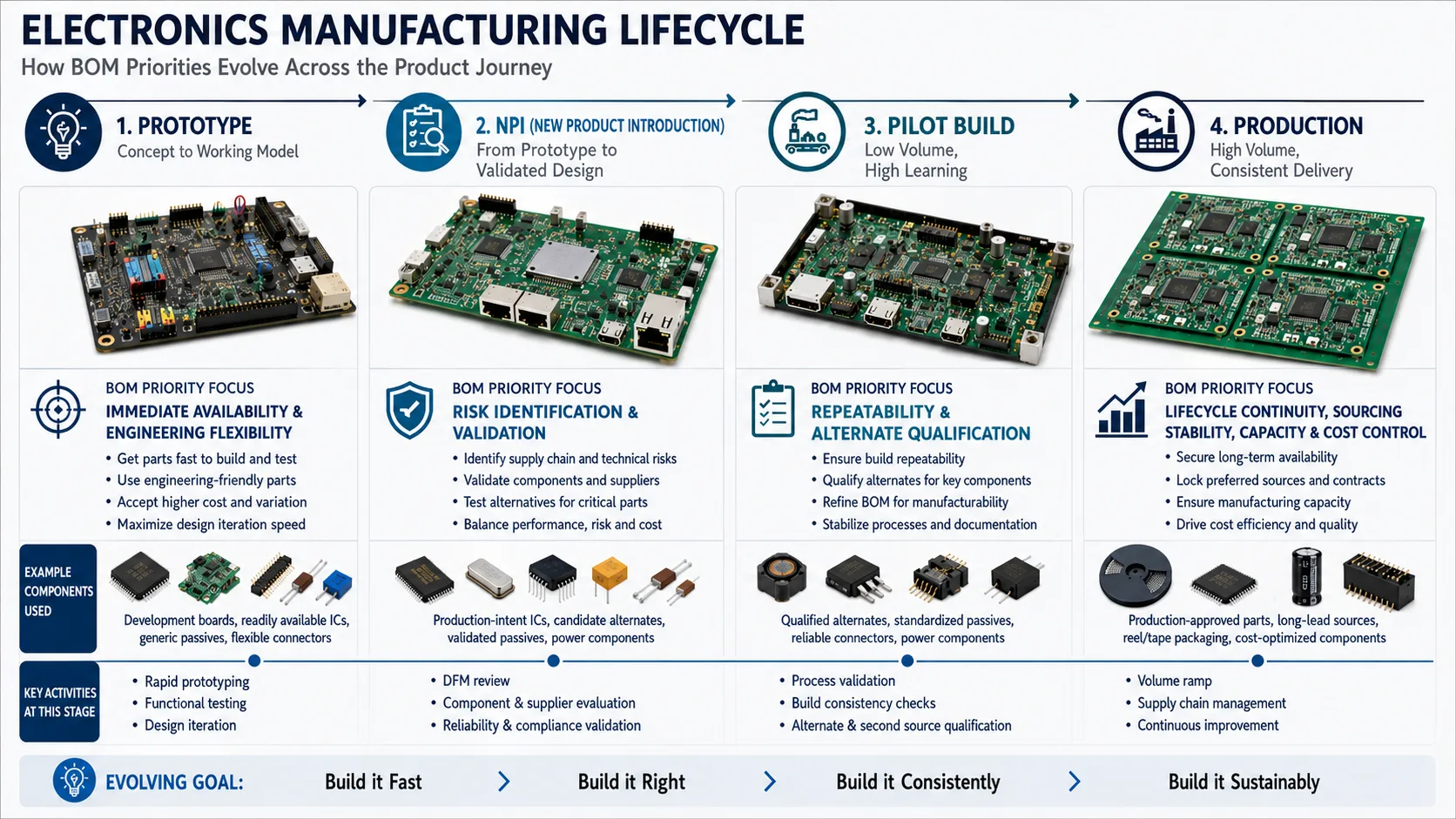
The BOM strategy should mature as an electronics product moves from prototype development into long-term production.
One of the most common mistakes is assuming that a component strategy suitable for a prototype will automatically be suitable for production.
Prototype
The priority may be:
Production
The priority increasingly becomes:
A difficult-to-source component may be perfectly acceptable for a small prototype build.
Building a long-term production program around that same component without a continuity strategy is a different decision.
24. A Practical 10-Step BOM Risk Management Process
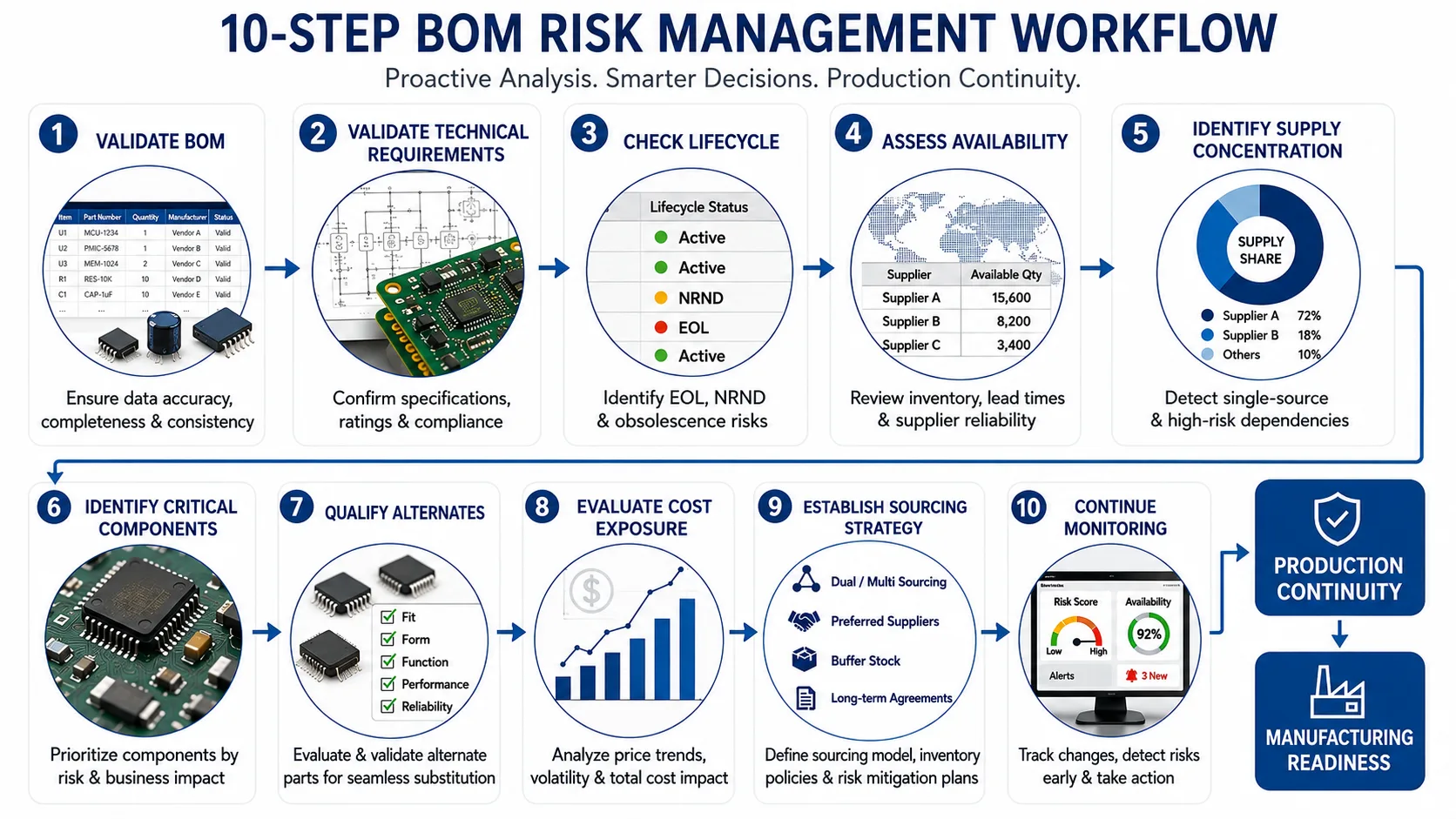
A structured BOM review turns component information into proactive production-risk management.
A practical integrated process can follow these steps.
Step 1 — Validate the BOM
Confirm:
Step 2 — Validate Technical Requirements
Check:
Step 3 — Check Lifecycle
Identify:
Step 4 — Assess Availability
Review:
Step 5 — Identify Concentration Risk
Identify:
Step 6 — Identify Critical Components
Prioritize components that could stop production.
Step 7 — Qualify Alternates
Do not wait for a shortage or EOL crisis before beginning where risk justifies early work.
Step 8 — Evaluate Cost Exposure
Look beyond current unit price.
Step 9 — Establish a Sourcing Strategy
Define:
Step 10 — Continue Monitoring
BOM risk changes throughout the product lifecycle.
25. BOM Risk Should Be Monitored Continuously
A BOM is not a static document.
A component can move from:
Low Risk↓Moderate Risk↓High Risk
without the PCB design changing.
For example:
A manufacturer announces EOL.
The PCB remains unchanged.
But the BOM's production risk changes immediately.
BOM governance should therefore continue after NPI and into production.
Relevant conditions that can change include:
A BOM should therefore be treated as a living engineering and supply-chain asset.
26. Product Change Notifications Matter
Lifecycle management is not limited to EOL announcements.
Manufacturers may issue Product Change Notifications relating to:
These events may have different consequences.
Some may require only review.
Others may require:
Monitoring relevant lifecycle and product changes is therefore part of BOM governance.
27. The Engineer–Procurement Connection
Component lifecycle management is where several disciplines meet.
Engineering asks:
Will this component perform correctly?
Procurement asks:
Can we reliably obtain it?
Manufacturing asks:
Can we build with it consistently?
Quality asks:
Can we verify and control it?
Product Management asks:
Can we support the product throughout its intended lifecycle?
A strong BOM strategy should answer all of these questions.
28. What International Buyers Should Ask Their PCBA Supplier
When outsourcing PCB assembly, buyers should ask their supplier about more than price and assembly capability.
BOM Validation
Availability
Lifecycle
Alternates
Sourcing
Cost
These questions help determine whether a supplier is simply quoting a BOM or actively helping manage manufacturing risk.
29. Component Substitution Must Be Controlled
A manufacturing partner should not silently replace a customer's component because another MPN is:
A controlled workflow should be:
Risk Identified↓Alternate Proposed↓Technical Comparison↓Customer Engineering Review↓Approval↓BOM Revision↓Production Release
This protects configuration control.
An approved alternate should be documented rather than existing only in emails or informal sourcing discussions.
30. Common BOM and Obsolescence Management Mistakes
Mistake 1 — Checking Lifecycle Only During RFQ
By then, redesign options may already be limited.
Mistake 2 — Treating “Active” as “Safe”
An active component can still have significant supply risk.
Mistake 3 — Selecting an Alternate Based Only on Datasheet Similarity
System-level implications may be different.
Mistake 4 — Assuming the Same Package Means Drop-In Compatibility
Pinout and electrical behaviour still require verification.
Mistake 5 — Waiting for the EOL Notice
The strongest mitigation options often exist before formal discontinuation.
Mistake 6 — Buying Excess Inventory Without a Strategy
Overbuying can create financial and storage exposure.
Mistake 7 — Using Secondary Sources Without Appropriate Controls
Traceability and authenticity can become critical.
Mistake 8 — Ignoring Firmware Impact
Programmable devices may create hardware-software dependencies.
Mistake 9 — Not Updating the Master BOM
An alternate that exists only in an email is not a controlled engineering alternate.
Mistake 10 — Treating Obsolescence as Procurement's Problem
The consequences can extend across engineering, quality, manufacturing and product management.
31. A Better Strategy: Risk Before Reaction
The weakest approach is:
EOL↓Panic↓Search↓Buy↓Redesign
A stronger approach is:
Select↓Monitor↓Assess↓Qualify↓Maintain Alternatives↓Plan Inventory↓Redesign When Necessary
This changes component management from reactive sourcing to controlled lifecycle management.
32. BOM Risk and Component Obsolescence Checklist
Before releasing a PCB assembly for production:
Component Identity
☐ Manufacturer identified☐ Exact MPN verified☐ Variant and suffix verified☐ Package confirmed☐ Relevant documentation reviewed
Technical
☐ Electrical requirements verified☐ Mechanical requirements verified☐ Footprint compatibility checked☐ Thermal requirements reviewed
Supply
☐ Current availability checked☐ Lead time assessed☐ Supplier availability reviewed☐ Single-source dependencies identified
Lifecycle
☐ Lifecycle status checked☐ NRND exposure identified☐ EOL exposure identified☐ Product lifecycle compared with component lifecycle
Alternates
☐ Critical components have an alternate strategy☐ Candidate alternates technically reviewed☐ Required qualification identified☐ Substitution approval process defined
Commercial
☐ Production-volume pricing evaluated☐ Price volatility assessed☐ MOQ considered☐ Total sourcing cost considered
Compliance
☐ Applicable environmental requirements reviewed☐ Customer-specific requirements considered☐ Required documentation available
Existing Product Monitoring
☐ Periodic lifecycle review established☐ EOL and product-change monitoring established☐ Critical components prioritized☐ Last-time-buy strategy defined where needed☐ Inventory requirements reviewed☐ Alternate qualification status maintained☐ Master BOM updated through controlled changes
This integrated checklist combines the technical, lifecycle, sourcing, manufacturing, commercial and compliance dimensions of the original articles.
33. The Right Question Is Not “Which Component Is Cheapest?”
A better question is:
Which sourcing option provides the best balance of technical suitability, supply continuity, lifecycle support, manufacturing compatibility and total cost?
Instead of:
Price↓Decision
a stronger process considers:
Technical Fit↓Supply Risk↓Lifecycle↓Manufacturing Compatibility↓Compliance↓Total Cost↓Decision
A lower unit price can be offset by:
The objective is not necessarily to eliminate every additional cost.
It is to avoid false savings that create larger costs later.
34. The Goal Is Not Zero Risk
No electronics BOM is completely risk-free.
The objective is not:
Eliminate every possible risk.
It is:
Identify the risks that matter, understand their potential impact and establish practical mitigation strategies before they disrupt production.
Depending on the component, risk may be:
The appropriate strategy depends on the product and the consequence of disruption.
35. QUADRIONIX Perspective
At QUADRIONIX, BOM and component analysis is viewed as part of the manufacturing-readiness process—not simply a procurement exercise.
A robust review connects:
MPN Validation↓Technical Verification↓Lifecycle Analysis↓Availability Assessment↓Supplier and Supply-Path Review↓Alternate Strategy↓Cost Evaluation↓Compliance Review↓Production Readiness
For projects where BOM and sourcing support form part of the manufacturing workflow, a practical review can focus on four checkpoints:
1. Lifecycle
Is the specified component active, NRND, EOL or otherwise showing lifecycle risk?
2. Availability
Can it be sourced through an appropriate supply channel in the required quantity and timeframe?
3. Technical Compatibility
If an alternate is considered, does it meet the relevant electrical, mechanical, package and manufacturing requirements?
4. Supply Resilience
Does the BOM have unnecessary exposure to single-source or difficult-to-replace components?
The objective is not simply to find a cheaper component.
It is to reduce the possibility that a component becomes the reason a PCB cannot be built.
If you are Planning a New PCBA Build or Managing Component Lifecycle Risk.
Before committing a design to production, identify component risks that could affect:
Identify BOM risks early. Qualify alternatives intelligently. Plan for lifecycle change. Build with greater confidence with QUADRIONIX for an engineering-led manufacturing-readiness and component-risk discussion.
36. Key Takeaways
37. Conclusion
Component obsolescence is inevitable.
The real risk is allowing an expected lifecycle event to become an unexpected manufacturing crisis.
A reliable BOM-management process should therefore answer, for every critical component:
What is the exact part?Is it technically suitable?Can it be sourced reliably?How long is it expected to remain viable?What happens if it becomes unavailable?Is there a technically qualified alternate?What would a replacement cost in engineering, manufacturing and time?
When these questions are answered early, BOM risk becomes something that can be managed rather than merely reacted to.
The strongest approach is:
Know the lifecycle.Know the supply structure.Know the critical components.Know the alternatives.Qualify them before they are urgently needed.Control BOM and engineering changes.
The goal is not to eliminate component obsolescence.
That is unrealistic.
The goal is to ensure that component obsolescence does not control the lifecycle of your product.
Frequently Asked Questions
Ready to manufacture your electronics project?
Upload your Gerber files & BOM for automated DFM review, engineering feedback, and guaranteed delivery timelines.